

Nepal’s culture is a meeting of South Asian Hindu traditions and Tibetan Buddhist ones, shaped by more than 140 caste and ethnic groups who speak 124 mother tongues. For visitors, that means a calendar packed with festivals, distinct food and dress in every region, and a living temple culture you can see on any street in the Kathmandu Valley.
This guide covers the people, languages, religions, festivals by month, food, dress, art and architecture, music and dance, family life, etiquette, and how culture changes from the Everest region to Chitwan. Figures come from Nepal’s 2021 National Population and Housing Census.
Nepal culture: key facts
| Topic | Key fact |
|---|---|
| Population (2021 census) | 29,164,578 |
| Caste and ethnic groups | 142 recorded in the 2021 census |
| Mother tongues | 124; Nepali is the mother tongue of 44.86% of people |
| Main religions | Hindu 81.19%, Buddhist 8.21%, Muslim 5.09%, Kirat 3.17%, Christian 1.76% |
| State | Federal democratic republic and officially secular (monarchy abolished in 2008) |
| Calendar | Bikram Sambat (about 56–57 years ahead of the Gregorian calendar); New Year falls in mid-April |
| Biggest festival | Dashain (late September or October), followed by Tihar |
| National dress | Daura suruwal with dhaka topi for men; gunyu cholo or sari for women |
| National dish | Dal bhat (lentils, rice, vegetable curry and pickle) |
| Greeting | “Namaste” with palms pressed together |
| UNESCO World Heritage Sites | Kathmandu Valley, Lumbini, Sagarmatha (Everest) National Park, Chitwan National Park |
People of Nepal: ethnic groups and castes
Nepal is one of the most ethnically diverse countries for its size. The 2021 census recorded 142 caste and ethnic groups, ranging from millions of people to a few hundred. No single group forms a majority.
Broadly, the population falls into hill caste groups (Brahman and Chhetri), Indigenous nationalities (Janajati) such as the Magar, Tamang, Newar, Rai, Gurung, Limbu and Sherpa, Madhesi groups of the southern plains, Dalit communities, Muslims and the Tharu of the Terai.
| Group | Share of population (2021) | Main areas |
|---|---|---|
| Chhetri | 16.45% | Hills nationwide, far west |
| Brahman (Hill) | 11.29% | Hills nationwide |
| Magar | 6.90% | Western and central hills |
| Tharu | 6.20% | Terai plains, including Chitwan and Bardia |
| Tamang | 5.62% | Hills around the Kathmandu Valley, Langtang |
| Bishwokarma | 5.04% | Nationwide (a Dalit group) |
| Muslim | 4.86% | Mainly the Terai |
| Newar | 4.60% | Kathmandu Valley and old trading towns |
| Yadav | 4.21% | Eastern and central Terai |
| Rai | 2.20% | Eastern hills, including Solukhumbu |
| Gurung | 1.86% | Annapurna and Manaslu foothills |
| Limbu | 1.42% | Far eastern hills |
| Sherpa | 0.45% | Everest region and other high valleys |
The Sherpa are famous worldwide for mountaineering, yet they make up less than half of one per cent of the population. Many people who work as guides and porters in the mountains are Rai, Tamang, Gurung or Magar. “Sherpa” is an ethnic group, not a job title.
Languages of Nepal
Nepali, written in Devanagari script, is the official language and the lingua franca. It is the mother tongue of 44.86% of the population, and most people speak it as a first or second language. The constitution recognises all mother tongues as national languages.
| Mother tongue | Speakers (2021) | Share |
|---|---|---|
| Nepali | 13,084,457 | 44.86% |
| Maithili | 3,222,389 | 11.05% |
| Bhojpuri | 1,820,795 | 6.24% |
| Tharu | 1,714,091 | 5.88% |
| Tamang | 1,423,075 | 4.88% |
| Bajjika | 1,133,764 | 3.89% |
| Avadhi | 864,276 | 2.96% |
| Nepal Bhasa (Newari) | 863,380 | 2.96% |
| Magar | 810,315 | 2.78% |
| Doteli | 494,864 | 1.70% |
Languages come from two big families. Nepali, Maithili and Bhojpuri are Indo-Aryan, related to Hindi. Tamang, Newari, Magar, Gurung, Sherpa and the many Rai languages are Tibeto-Burman. English is widely spoken in tourist businesses in Kathmandu and Pokhara, and by trekking guides, but much less in rural areas.
Religion in Nepal
Hinduism and Buddhism have lived side by side in Nepal for well over a thousand years, and the line between them is often blurred. Hindus visit Buddhist stupas, Buddhists worship at Hindu shrines, and many Newar families follow both. Nepal became officially secular after the end of the monarchy, but religion remains central to daily life.
| Religion | Followers (2021) | Share |
|---|---|---|
| Hinduism | 23,677,744 | 81.19% |
| Buddhism | 2,393,549 | 8.21% |
| Islam | 1,483,066 | 5.09% |
| Kirat | 924,204 | 3.17% |
| Christianity | 512,313 | 1.76% |
| Prakriti (nature worship) | 102,046 | 0.35% |
| Bon | 67,223 | 0.23% |
Hinduism
Most Nepali Hindus worship Shiva, Vishnu (often as Krishna or Narayan) and forms of the goddess such as Durga, Kali and Laxmi. Pashupatinath in Kathmandu, a temple to Shiva on the Bagmati River, is the most sacred Hindu site in the country. The cow is the national animal and slaughtering cattle is illegal.
Buddhism
Siddhartha Gautama, the Buddha, was born in Lumbini in southern Nepal. Today Nepal has two main Buddhist traditions: Tibetan (Vajrayana) Buddhism among Sherpa, Tamang, Gurung, Thakali and mountain communities, and Newar Buddhism in the Kathmandu Valley. Theravada Buddhism has also grown since the 20th century.
Kirat, Bon and other faiths
Kirat is the faith of the Rai, Limbu, Sunuwar and Yakkha peoples of the eastern hills. It centres on the Mundhum, an oral body of scripture, and on ancestor and nature worship. Bon, a pre-Buddhist Tibetan religion, survives in parts of Dolpo and Mustang. Islam is concentrated in the Terai, and Christianity has grown quickly in recent decades.

Festivals in Nepal by month
Most festivals follow the lunar calendar, so their Gregorian dates move by up to a few weeks each year. The table shows the usual month and, where announced, the 2026 date. Check the official Nepal government holiday list before booking around a specific festival.
| Usual month | Festival | What happens | 2026 date |
|---|---|---|---|
| Mid-January | Maghe Sankranti / Maghi | Marks the sun’s move into Capricorn. Families eat sesame sweets, yam, sweet potato and ghee. Maghi is also the Tharu New Year. | 15 January |
| January–February | Sonam Lhosar | Tamang and Hyolmo New Year, with gatherings at monasteries and at Tundikhel in Kathmandu. | 19 January |
| February–March | Gyalpo Lhosar | Sherpa and Tibetan New Year. Boudhanath fills with butter lamps, prayer flags and families in new clothes. | 18 February |
| February–March | Maha Shivaratri | Tens of thousands of pilgrims and sadhus gather at Pashupatinath to honour Shiva. | 15 February |
| March | Holi (Fagu Purnima) | The festival of colours. Expect water balloons and coloured powder in the streets; wear old clothes. | 2 March (hills), 3 March (Terai) |
| Mid-April | Nepali New Year and Bisket Jatra | Bhaktapur hauls a huge chariot of Bhairab through the old town and raises a ceremonial pole. | 14 April |
| April–May | Buddha Jayanti | Celebrates the Buddha’s birth, enlightenment and death. Big gatherings at Lumbini, Swayambhunath and Boudhanath. | 1 May |
| April–May | Ubhauli / Sakela | Kirat Rai and Limbu festival marking the move to higher pastures, with the Sakela circle dance. | 1 May |
| May | Tiji (Lo Manthang) | Three-day masked dance festival in Upper Mustang re-enacting a victory of good over evil. | Varies |
| April–June | Rato Machhendranath Jatra | Patan’s long chariot festival for the god of rain, pulled through the city over several weeks before the monsoon. | Varies |
| Late June | Ropain (Asar 15) | National Paddy Day. Rice planting in the mud, with curd and beaten rice. | Late June |
| August | Janai Purnima | Hindu men renew their sacred thread; many people tie a protective string on the wrist. Kwati (mixed bean soup) is eaten. | 28 August |
| August | Gai Jatra | Families who lost someone in the past year parade through the Kathmandu Valley with cows or children dressed as cows. | 29 August |
| August–September | Krishna Janmashtami | Krishna’s birthday, celebrated at Krishna Mandir in Patan Durbar Square. | 4 September |
| August–September | Teej | Women in red saris fast, sing and dance, praying to Shiva and Parvati for the long life of their husbands or a good marriage. | 14 September |
| September | Indra Jatra | Kathmandu’s eight-day festival with masked Lakhe dancers and the Kumari, the living goddess, pulled through the old city in a chariot. | Varies (September) |
| Late September–October | Dashain | Nepal’s biggest festival: 15 days honouring the goddess Durga. Families gather, elders give red tika and jamara (barley shoots), kites fly and bamboo swings go up. | 11–21 October (main days) |
| October–November | Tihar (Deepawali) | Five-day festival of lights honouring crows, dogs, cows and Laxmi, the goddess of wealth. Ends with Bhai Tika, when sisters bless brothers. | Laxmi Puja 8 November; Bhai Tika 10 November |
| October–November | Mani Rimdu | Sherpa Buddhist festival at Tengboche and other Khumbu monasteries, with masked cham dances. | Varies (usually October–November) |
| October–November | Chhath | Terai festival, especially among Maithili speakers, worshipping the sun at rivers and ponds at dawn and dusk. | 15 November |
| November–December | Udhauli | Kirat festival marking the move back down to lower pastures. | Varies |
| December | Yomari Punhi | Newar harvest festival. Families make yomari, steamed rice-flour dumplings filled with molasses and sesame. | Varies (full moon) |
| 30 December (approx.) | Tamu Lhosar | Gurung New Year, with cultural programmes in Pokhara and Kathmandu. | 30 December |

Dashain and Tihar: what visitors should know
Dashain and Tihar fall in the peak autumn trekking season, so many visitors see them. During the main days of Dashain, government offices, many shops and some restaurants close, and buses and flights out of Kathmandu fill up as people travel home. Book transport early and expect quieter city streets.
Dashain includes animal sacrifice, particularly on the eighth and ninth days, at temples such as Dakshinkali. It is an important religious practice; if you would rather not see it, avoid the temples on those mornings. Tihar is gentler: houses are lit with oil lamps, children sing deusi-bhailo songs door to door, and dogs are garlanded on Kukur Tihar.


Nepali food and drink
Nepali food is filling, home-cooked and built around rice, lentils and seasonal vegetables. Recipes change with altitude: rice dominates the hills and Terai, while buckwheat, millet, barley and potatoes take over in the mountains.

Everyday dishes
- Dal bhat tarkari: rice, lentil soup and vegetable curry with greens and achar. Most Nepalis eat it twice a day, and on treks refills are usually free.
- Momo: steamed or fried dumplings filled with buffalo, chicken, pork or vegetables, served with a spicy tomato and sesame sauce.
- Dhido: a thick paste of millet or buckwheat flour, eaten in the hills and mountains instead of rice.
- Thukpa and thenthuk: Tibetan-style noodle soups, common in the Himalaya.
- Gundruk: fermented, dried leafy greens, used in soups and pickles.
- Sel roti: a ring-shaped, slightly sweet rice-flour bread, fried for Dashain and Tihar.
- Chhurpi: hardened yak or cow cheese, chewed for hours in the mountains.
Newari cuisine
The Newars of the Kathmandu Valley have the richest food culture in Nepal. A samay baji platter, offered at festivals, combines beaten rice (chiura), roasted buffalo meat (choila), black soybeans, ginger, egg and pickles. Look out for bara (lentil pancakes), chatamari (a thin rice-flour “pizza”), kachila (spiced minced raw buffalo), yomari and juju dhau, the sweet “king of curds” from Bhaktapur.
Thakali and Tibetan food
In the Kali Gandaki valley, the Thakali people are known for their thali sets of rice, dal, buckwheat dishes and gundruk, served in roadside lodges across Nepal. Apples and apple brandy come from Marpha. In Sherpa and Tibetan areas, people drink salty butter tea and eat tsampa (roasted barley flour), Sherpa stew and riki kur (potato pancakes).
Drinks
Milk tea (chiya) is everywhere. Homemade alcohol varies by community: raksi is a distilled spirit made from rice or millet, chhyang is a cloudy rice or barley beer, and tongba, popular among the Limbu and Rai, is fermented millet in a wooden vessel topped up with hot water. Orthodox Brahman and Chhetri families traditionally avoid alcohol.
Traditional dress in Nepal
Day-to-day, most Nepalis wear modern clothes, especially in cities. Traditional dress comes out for weddings, festivals, official events and in many rural areas.
- Daura suruwal: the men’s national dress, a knee-length tied shirt with close-fitting trousers, often worn with a waistcoat, a patuka (cloth belt) and a dhaka topi, the patterned Nepali cap.
- Gunyu cholo and sari: women wear saris widely; gunyu cholo is a traditional blouse and wrap. Red is worn for weddings and Teej.
- Dhaka cloth: hand-woven patterned fabric, associated with Palpa and the eastern hills, used for topi caps and shawls.
- Newar haku patasi: a black sari with a red border, worn by Newar women at festivals.
- Chuba (bakhu): a wrap-around robe worn in Sherpa, Tibetan and Himalayan communities. Married Sherpa women wear a striped apron, the pangden.
- Gurung dress: women’s velvet blouses, gold jewellery and the large nose ring; men’s bhangra, a white cloth worn across the body.
- Tharu dress: colourful blouses, skirts and heavy silver jewellery, with tattoos traditionally among older women.

Art and architecture
Nepal’s art is overwhelmingly religious, and much of it comes from the Newar craftspeople of the Kathmandu Valley. Over centuries they built temples, palaces and courtyards for Hindu and Buddhist patrons alike, and exported their skills across the Himalaya. In the 13th century, the Newar artist Araniko travelled to the court of Kublai Khan, where he is credited with designing the White Stupa in Beijing.
Architectural styles
- Pagoda style: multi-tiered temples with sloping tiled roofs held up by carved wooden struts. Nyatapola in Bhaktapur, built in 1702, is five storeys high and survived the earthquakes of 1934 and 2015.
- Shikhara style: stone temples with a tall curved tower, introduced from India. Krishna Mandir in Patan Durbar Square is the best-known example.
- Stupa: the dome-shaped Buddhist monument, painted with the Buddha’s eyes. Boudhanath is one of the largest in the world.
- Newar courtyard houses: brick buildings with intricately carved wooden windows, arranged around shared courtyards (bahal and bahil).
The Kathmandu Valley UNESCO World Heritage Site
Inscribed in 1979, the Kathmandu Valley World Heritage Site covers seven monument zones:
- Kathmandu Durbar Square (Hanuman Dhoka)
- Patan Durbar Square
- Bhaktapur Durbar Square
- Swayambhunath, the “Monkey Temple”
- Boudhanath Stupa
- Pashupatinath Temple
- Changu Narayan, often considered the valley’s oldest temple
The 2015 earthquake damaged or destroyed many monuments, and much has since been rebuilt using traditional techniques. Our Kathmandu guide covers how to visit each site.
Crafts and painting
Patan is the centre of lost-wax bronze casting and metal repoussé. Thangka (Tibetan) and paubha (Newar) paintings depict deities and mandalas on cloth using mineral pigments. In Janakpur and the eastern Terai, women paint bold Mithila art on house walls. Woodcarving, pottery in Bhaktapur’s Potters’ Square and hand-made lokta paper are other living crafts.
Music and dance
Every community has its own songs and instruments, tied to farming, rituals and festivals. Folk songs cover love, migration, harvest and village life, and the improvised call-and-response dohori is still hugely popular in hill restaurants and on television.

Instruments
- Madal: a two-headed hand drum, the heartbeat of Nepali folk music.
- Sarangi: a small bowed string instrument, traditionally played by the Gandharva musician community.
- Panche baja: a five-instrument band of drums, cymbals and horns that plays at weddings.
- Dhime and dhaa: large Newar drums that lead festival processions.
- Damphu: a frame drum used in Tamang Selo music.
Dances to look out for
- Lakhe: a Newar demon dancer with a red mask and mane, seen at Indra Jatra.
- Maruni: danced at Tihar by Magar and other hill communities.
- Tharu stick dance: performed by Tharu men in Chitwan and other Terai districts, often at cultural shows in Sauraha.
- Sakela (Sili): the Rai circle dance, copying movements from nature and farming.
- Ghatu: a trance-like Gurung dance performed by young girls in spring.
- Cham: masked monastic dances at Mani Rimdu and Tiji.
Literature in brief
Bhanubhakta Acharya (1814–1868), who rendered the Ramayana into accessible Nepali verse, is honoured as the Adikavi, or “first poet”, of the Nepali language. Nepal Bhasa, the Newar language, has a written tradition going back many centuries. Twentieth-century writers such as Laxmi Prasad Devkota, author of the epic poem Muna Madan, made Nepali literature more personal and political, and it flourished further after democracy arrived in 1951.
Family, society and caste
Family is the centre of Nepali life. Many people live in extended households, elders are deferred to, and decisions about marriage, work and money often involve the whole family. Kinship terms are used with everyone: a stranger of your age might call you dai (older brother) or didi (older sister).
Arranged marriages remain common, especially in rural areas, although “love marriages” are increasingly accepted. Weddings are multi-day events. Large numbers of Nepalis work abroad in the Gulf, Malaysia, India and elsewhere, and remittances shape village life.
The caste system
Caste remains a sensitive but real part of Nepali society. Hindu hill society was historically ranked by caste, a hierarchy written into law by the Muluki Ain legal code of 1854. Discrimination based on caste was formally ended in the 1963 legal code and is a criminal offence under the Caste-Based Discrimination and Untouchability Act of 2011. The 2015 constitution guarantees equality.
In practice, Dalit communities still face discrimination, particularly in rural areas, and caste can still influence marriage choices. As a visitor, do not ask people their caste. Surnames often signal it, and the topic can be uncomfortable.
Women and gender
Women’s roles vary a great deal by community. Sherpa, Gurung and Thakali women have long run lodges and businesses, while some orthodox Hindu households are more conservative. The 2015 constitution requires at least a third of the seats in the federal parliament to be held by women. Practices such as chhaupadi (isolating women during menstruation) are illegal but persist in parts of the far west.

Etiquette in Nepal: dos and don’ts for visitors
Nepalis are warm and forgiving with foreigners, but a few customs matter a lot. Following them earns real goodwill.
Do
- Greet people with “Namaste” (or the more formal “Namaskar”), palms together at chest height. Greet elders first.
- Take off your shoes before entering a home, a temple, a monastery and some shops. Look for a pile of shoes at the door.
- Walk clockwise around stupas, chortens, mani walls and prayer wheels, and spin prayer wheels with your right hand.
- Use your right hand to eat, give and receive. For something important, such as money or a gift, offer it with the right hand while touching the right forearm with the left.
- Dress modestly, covering shoulders and knees, especially at religious sites and in villages.
- Ask before photographing people, rituals and cremations, and accept a “no”.
- Accept tea when offered; refusing outright can seem rude. A small sip is fine.
Don’t
- Don’t touch anyone’s head, including children’s. The head is considered sacred.
- Don’t point your feet at people, shrines or the hearth, or step over someone’s legs or food.
- Don’t share food from your plate or drink from someone else’s bottle once you have touched it. Food touched by your mouth is jutho (ritually polluted). Pour water into your mouth without touching the bottle if sharing.
- Don’t enter Hindu temples if a sign says non-Hindus are not allowed. Only Hindus may enter the main Pashupatinath temple, though visitors can watch from the far bank.
- Don’t wear leather items into some Hindu temples.
- Avoid public displays of affection; hand-holding between friends of the same sex is normal, kissing in public is not.
- Don’t touch offerings, shrines or ritual objects, and never sit on chortens or mani stones.
- Don’t lose your temper. Raising your voice causes loss of face on both sides and rarely helps.
Useful Nepali phrases
| Phrase | Meaning |
|---|---|
| Namaste / Namaskar | Hello, goodbye (respectful) |
| Dhanyabad | Thank you (used less often than in English) |
| Maaph garnus | Sorry / excuse me |
| Kati ho? | How much is it? |
| Mitho chha | It’s delicious |
| Pugyo | Enough (useful when your plate is refilled) |
| Dai / Didi | Older brother / older sister (polite address) |
| Bhai / Bahini | Younger brother / younger sister |
| Tashi delek | Greeting in Sherpa and Tibetan areas |
Culture by region: what you will see where
Nepal’s culture changes as quickly as its altitude. These are the communities you are most likely to meet on popular routes.
| Region | Main communities | Religion | What to look for |
|---|---|---|---|
| Kathmandu Valley | Newar, plus people from every part of Nepal | Hindu and Newar Buddhist | Durbar Squares, the Kumari, Indra Jatra, Bisket Jatra, Newari food |
| Everest region (Khumbu) | Sherpa, with Rai lower down | Tibetan (Nyingma) Buddhist | Tengboche Monastery, Mani Rimdu, mani walls, prayer flags |
| Annapurna foothills | Gurung, Magar | Buddhist, Hindu and shamanic traditions | Stone villages, Gurung museums, Gurkha heritage, Tamu Lhosar |
| Lower Mustang (Kali Gandaki) | Thakali | Buddhist and Bon influences | Thakali cuisine, whitewashed Marpha, salt-trade history |
| Upper Mustang | Loba (Tibetan) | Tibetan Buddhist | Walled Lo Manthang, cave monasteries, the Tiji festival |
| Langtang and Helambu | Tamang, Hyolmo | Tibetan Buddhist | Tamang Selo music, Sonam Lhosar, stone villages |
| Chitwan and the Terai | Tharu, Madhesi groups | Hindu, with Tharu traditions | Mud-walled Tharu houses, stick dance, Chhath, Mithila art |
| Eastern hills | Rai, Limbu | Kirat | Sakela dance, tongba, Ubhauli and Udhauli |
Kathmandu Valley: the Newars
The Newars built the valley’s three royal cities of Kathmandu, Patan and Bhaktapur. Their year is a run of jatras (chariot and procession festivals), and their guthis, community trusts, still organise rituals and maintain temples. Bhaktapur is the best place to see Newar life at its most traditional.
Everest region: the Sherpa
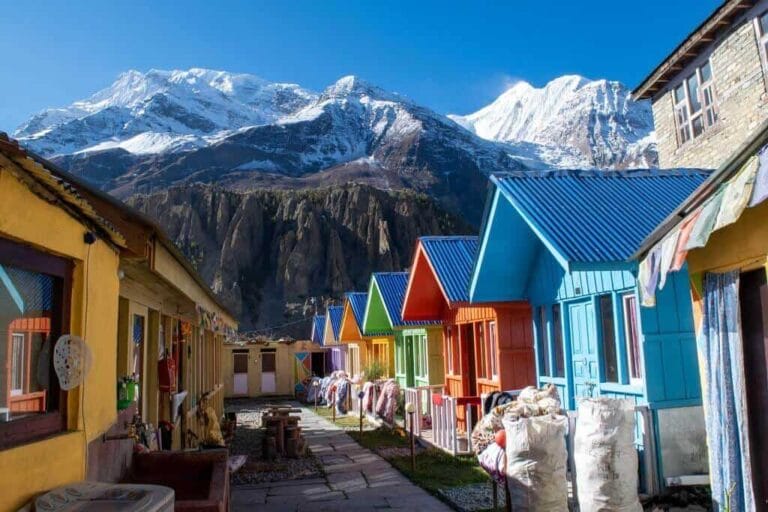
The Sherpa migrated from eastern Tibet roughly five centuries ago. Their culture is built around Tibetan Buddhism, yak herding and trade, and, since the 1950s, mountaineering. Trekkers to Namche Bazaar and Tengboche pass mani stones carved with the mantra “Om mani padme hum” and monasteries that welcome respectful visitors. Read about Tenzing Norgay, the most famous Sherpa of all.
Annapurna region: the Gurung and Magar
Villages such as Ghandruk are Gurung heartland, with slate-roofed stone houses and a long tradition of service in Gurkha regiments of the British and Indian armies. Rodhi, a traditional youth gathering house, and Gurung shamanic priests (pachyu and klepri) are part of local culture. Many homestays in the Annapurna region are Gurung or Magar run.
Mustang: Thakali and Loba
Lower Mustang is home to the Thakali, traders who once controlled the salt route between Tibet and India. North of Kagbeni, Upper Mustang was the semi-independent Kingdom of Lo until 2008, and its Loba people live a Tibetan way of life almost unchanged by roads until recently.
Chitwan: the Tharu
The Tharu are among the Indigenous peoples of the Terai, known for resistance to malaria in the days when the lowland forests were feared by outsiders. Around Chitwan National Park you can visit Tharu villages and museums and see the stick dance. Choose community-run cultural programmes so money reaches local families.
Eastern hills: the Rai and Limbu
The Rai and Limbu are Kirat peoples with their own languages, priests and scripture. Their villages line the approaches to Makalu and Kanchenjunga and the lower Solukhumbu, where you will hear Rai languages on the walk-in to the Everest region.
How to experience Nepali culture respectfully
- Time your trip for a festival. October and November offer Dashain, Tihar and good trekking weather; see our guide to the best season to travel in Nepal.
- Stay in family-run teahouses and community homestays on treks in Nepal rather than international chains.
- Hire local guides. A good guide explains rituals, translates and opens doors to conversations you would not otherwise have.
- Buy crafts directly from makers in Patan, Bhaktapur and Janakpur.
- Learn a few phrases and read our things to know before travelling to Nepal.
Conclusion
Nepali culture is not one thing but dozens of overlapping traditions: Newar temple towns, Sherpa monasteries, Gurung villages, Tharu farms and Kirat hill communities, held together by a shared calendar of festivals, food and hospitality. The more of the country you see, the more it rewards curiosity and good manners.
If you would like a trip that combines trekking with time in Kathmandu’s old cities, festivals and village homestays, plan your trip with us or start with our Nepal travel guide.
See Nepal’s culture for yourself: visit Pashupatinath Temple, Boudhanath Stupa and Swayambhunath in Kathmandu, or the old Newar towns of Bhaktapur, Patan and Bandipur.
Frequently asked questions
What is the culture of Nepal known for?
Nepal is known for its blend of Hindu and Buddhist traditions, more than 140 caste and ethnic groups, Newar temple architecture in the Kathmandu Valley, Sherpa mountain culture, and a calendar full of festivals such as Dashain, Tihar and Holi. Hospitality and strong family ties are central to daily life.
What are the main traditions in Nepal?
Key traditions include greeting with “Namaste”, receiving tika and blessings from elders at Dashain, lighting oil lamps at Tihar, eating dal bhat twice a day, walking clockwise around stupas, removing shoes indoors, and avoiding jutho (food or drink touched by someone’s mouth). Many communities also keep their own new year, such as Gyalpo, Sonam and Tamu Lhosar.
What is the main religion in Nepal?
Hinduism. In the 2021 census, 81.19% of people identified as Hindu, 8.21% as Buddhist, 5.09% as Muslim, 3.17% as Kirat and 1.76% as Christian. Nepal is officially a secular state, and Hindu and Buddhist practices often overlap.
How many ethnic groups and languages are there in Nepal?
The 2021 census recorded 142 caste and ethnic groups and 124 mother tongues. The largest groups are Chhetri (16.45%), Hill Brahman (11.29%), Magar (6.90%), Tharu (6.20%) and Tamang (5.62%). Nepali is the mother tongue of 44.86% of the population, followed by Maithili (11.05%) and Bhojpuri (6.24%).
What is the biggest festival in Nepal?
Dashain, a 15-day Hindu festival honouring the goddess Durga, usually in late September or October. Families reunite, elders give red tika and jamara, and much of the country takes a long holiday. Tihar, the five-day festival of lights, follows two to three weeks later.
What is the traditional dress of Nepal?
For men, the daura suruwal with a dhaka topi cap; for women, the sari or gunyu cholo. Different communities have their own dress, such as the chuba and striped pangden apron in Sherpa areas and the black and red haku patasi worn by Newar women.
What should I not do in Nepal as a tourist?
Avoid touching people’s heads, pointing your feet at people or shrines, wearing shoes in homes and temples, sharing food you have bitten, public kissing, and entering temples marked for Hindus only. Always ask before photographing people or ceremonies, and walk clockwise around Buddhist monuments.
Is it rude to refuse food or tea in Nepal?
A flat refusal can seem unfriendly, especially in a home. Accepting a small amount is polite. When you have had enough, say “pugyo” (enough) and cover your plate with your hand, because hosts will otherwise keep refilling it.