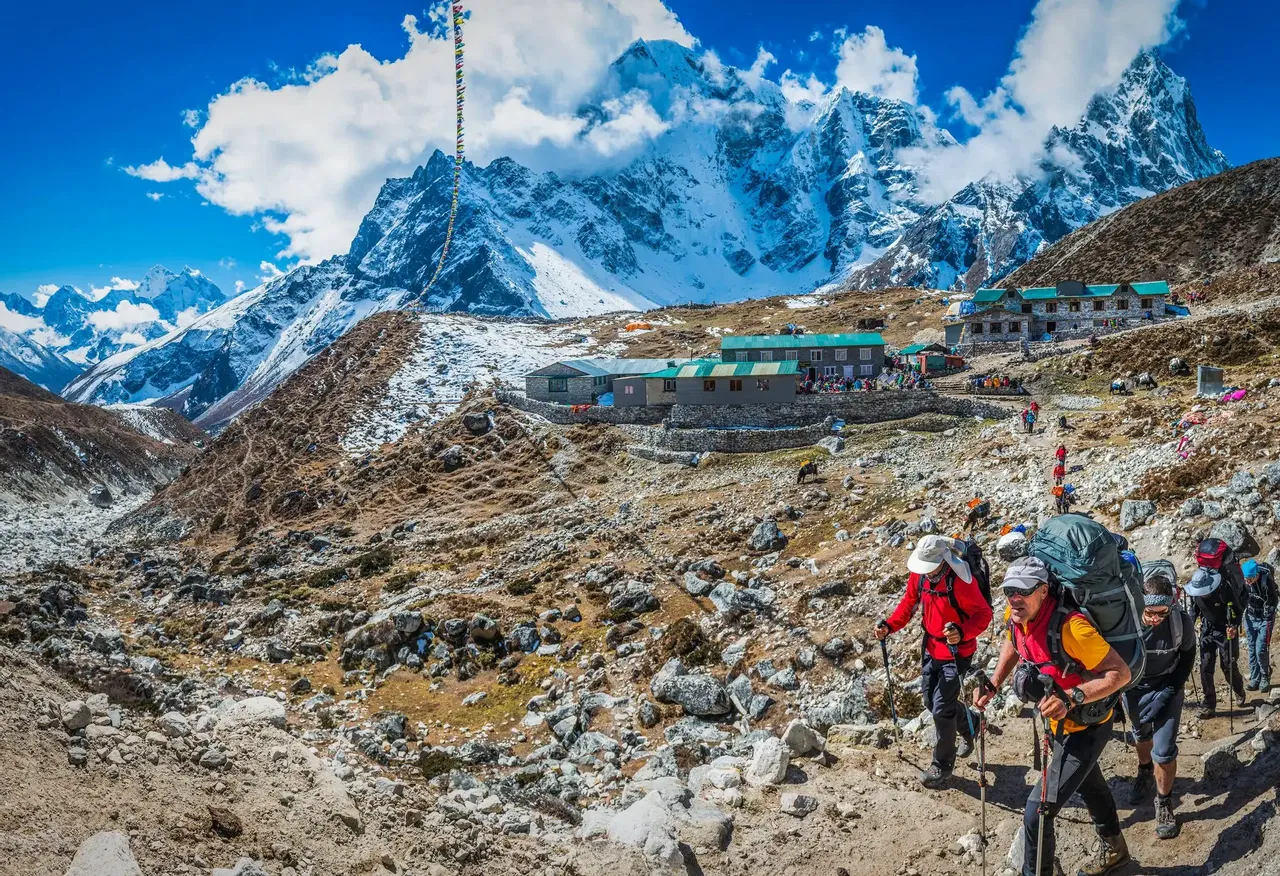
Into the heart of the Annapurna Sanctuary, through forests, mountain villages and steep trails to Annapurna Base Camp at 4,130 metres.
The Annapurna Base Camp Trek is one of those adventures where the scenery transforms almost every few days. You don’t just set off towards a mountain and keep staring at the same view as you get closer. You start off strolling through villages, farms, and lush green hills before making your way through rhododendron and bamboo forests.
Then, at some point, the trees start to thin out and the mountains close in around you. That’s when the trek turns into something entirely different.
At 4,130 meters (13,550 ft), Annapurna Base Camp is in the Annapurna Sanctuary, encircled by some truly stunning mountains in the Annapurna range. Annapurna I towers at 8,091 meters, while Machhapuchhre, Annapurna South, Hiunchuli, and a bunch of other peaks dominate the horizon.
But don’t be fooled by its lower altitude compared to Everest Base Camp; this trek is not a walk in the park. While ABC doesn’t reach the same heights as Everest Base Camp, it certainly knows how to challenge your legs. You’ll face lots of steep climbs, long descents, and what can sometimes feel like an endless number of stone steps.
The great part is that the scenery keeps evolving. One day you’re walking through a forest alongside a river, and just a few days later, you find yourself in a massive natural amphitheater of Himalayan peaks, with Annapurna looming over you. That contrast is what truly makes the Annapurna Base Camp Trek special.
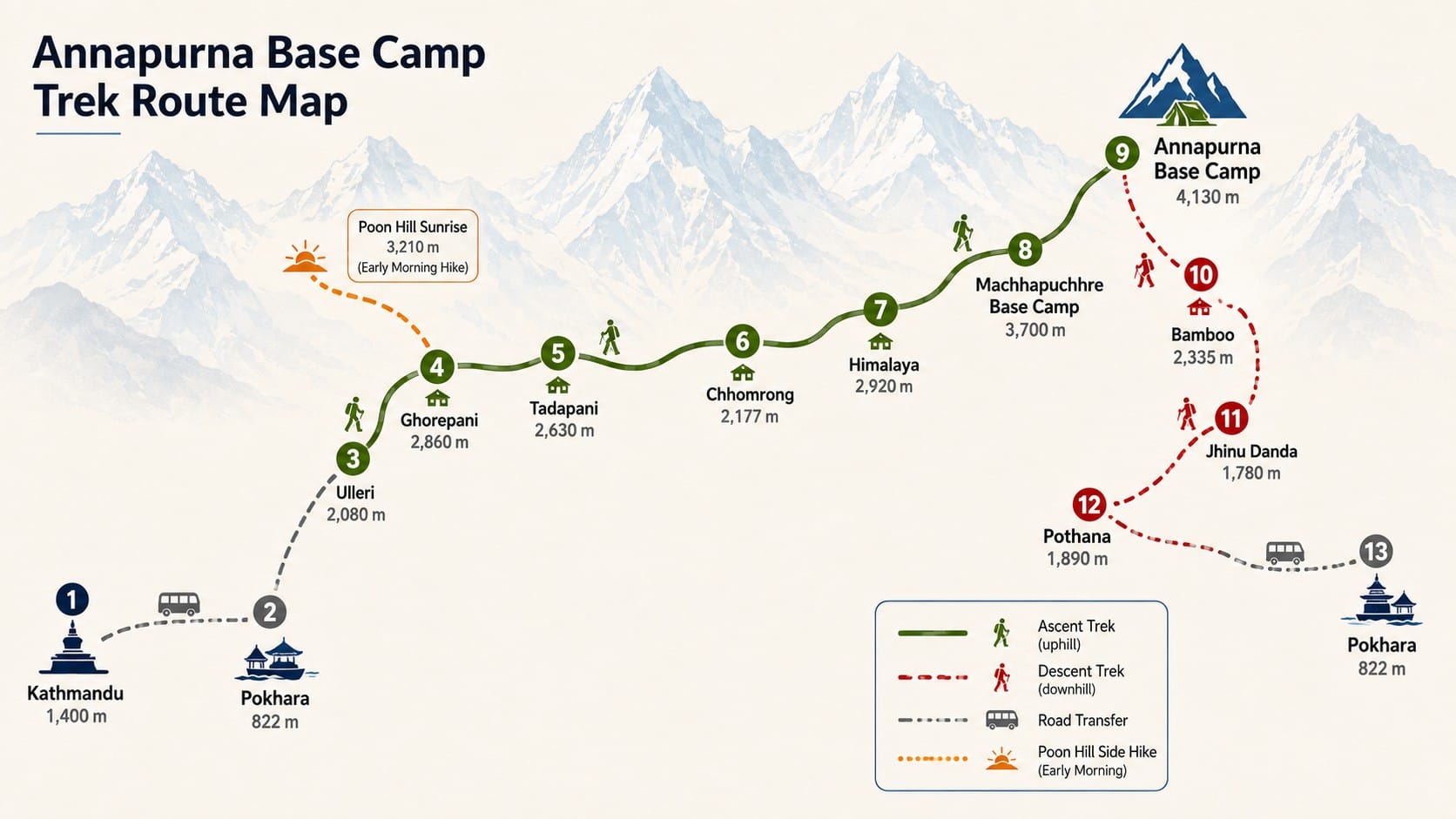
Welcome to Nepal. Your trip begins in Kathmandu, where you will meet your trek leader and the rest of the group for a pre-trip briefing.
If you arrive early, you have the rest of the day to explore Kathmandu or simply recover from your journey before heading towards the mountains.
Overnight: Kathmandu hotel.
Leave Kathmandu in the morning and drive west towards Pokhara.
Sitting beside Phewa Lake with the Annapurna range rising behind it, Pokhara feels very different from Kathmandu. This is also your final chance to pick up any trekking equipment you may have forgotten before heading onto the trail.
You will have a trek briefing and prepare your bags for the days ahead.
Drive from Pokhara to Nayapul, where the walking finally begins.
The trail follows the Bhurungdi Khola through farmland and villages before climbing steeply towards Ulleri. This first day gives you a pretty good introduction to something you will become very familiar with on this trek: stone steps.
On a clear day, you should also get your first views of Annapurna South from Ulleri.
Continue climbing through forests towards Ghorepani.
Rhododendron forest dominates much of today’s trail, particularly during spring when this part of the Annapurna region can be full of colour.
By the end of the day, you reach Ghorepani at 2,860 metres.
It is an early start today.
Head up to Poon Hill before sunrise for panoramic views across the Annapurna range. Yes, getting out of bed before dawn after several days of walking might not sound particularly exciting, but this is one morning where the effort is worth it.
After sunrise, return to the trail and continue towards Tadapani.
Don’t underestimate today. The combination of climbing and descending makes it one of the more demanding days of the trek.
Wake up to views of the Annapurna range and Machhapuchhre before descending towards Kimrung Khola.
Once you reach the river, naturally, you have to climb back up again.
The trail eventually reaches Chhomrong, one of the major villages on the route into the Annapurna Sanctuary.
Today is a proper up-and-down trekking day.
Descend to Chhomrong Khola, cross the suspension bridge and then climb the stone stairs towards Lower and Upper Sinuwa.
From here, continue through bamboo and rhododendron forest towards Khuldighar and eventually Himalaya, where you spend the night.
The landscape begins changing noticeably today.
Leave the forests behind as you climb through the narrowing valley towards Deurali and continue beside the Modi River.
Eventually, the valley opens up and you reach Machhapuchhre Base Camp at 3,700 metres.
You are now properly inside the high Himalayan environment, with the mountains surrounding you rather than sitting somewhere on the horizon.
This is the day you have been walking towards.
From Machhapuchhre Base Camp, continue higher into the Annapurna Sanctuary until you finally reach Annapurna Base Camp at 4,130 metres, the highest point of the trek.
From here, Annapurna I, Annapurna South, Machhapuchhre and Hiunchuli rise around the sanctuary.
Compared with some of the previous days, today’s walk is surprisingly short. But at this altitude, there is no reason to rush.
Wake up early at base camp for sunrise over the surrounding mountains.
Then comes the part your knees may enjoy considerably less.
Retrace the trail down through the sanctuary towards Bamboo. You lose around 1,900 metres of elevation today, making this one of the longest descents of the entire trip.
Continue descending and retrace the familiar staircases around Chhomrong before heading towards Jhinu Danda.
If your legs still have something left in them, you can walk down towards the natural hot springs beside the Modi Khola.
After the long descent from base camp, the timing is pretty much perfect.
Cross the river and continue towards Landruk before walking through Tolkha and Deurali on the way to Pothana.
You may be getting close to the end of the trek, but this isn’t exactly a gentle victory lap. There is still more than 1,000 metres of climbing during the day.
Your final day on the trail is thankfully much shorter.
Walk downhill from Pothana through Dhampus towards Phedi, where the trekking portion of the adventure finally ends.
From Phedi, drive back to Pokhara.
After ten nights in mountain teahouses, that first proper shower back at the hotel might feel almost as rewarding as reaching base camp.
Today is completely free.
Sleep in, give your legs a rest or head out and explore Pokhara. You can walk around Lakeside, take a boat onto Phewa Lake, visit the International Mountain Museum or simply find somewhere comfortable to sit with views towards the mountains you have just spent days walking through.
Your Annapurna Base Camp adventure ends in Pokhara today.
There are no planned activities, so you are free to continue your travels in Nepal or make your way back towards Kathmandu for your onward journey.
You carry your daypack while trekking, while your main trekking bag is carried by a porter. Keep the weight of your porter bag to 10 kg or less.
We’ll confirm before departure whether a trekking duffel is provided or whether you need to bring your own.
As this trip finishes in Pokhara rather than Kathmandu, avoid leaving anything important at your Kathmandu hotel unless you are planning to return there afterwards.
Layers are much more useful than one extremely heavy jacket on this trek. You can be walking through warm forests at lower elevations and dealing with much colder conditions around Machhapuchhre and Annapurna Base Camps only a few days later.
Leave the heavy jeans at home. They are uncomfortable to walk in, take ages to dry and use up valuable space in your 10 kg luggage allowance.
Do not arrive in Nepal with brand-new boots and make the Annapurna trail their first proper test.
There are thousands of stone steps on this route. Discovering that your new boots give you blisters on day two is something you definitely want to avoid.
Mountain teahouses provide a bed, mattress and usually blankets, but bedrooms are generally not heated.
The temperature also drops considerably once you reach the higher sections around Machhapuchhre Base Camp and Annapurna Base Camp, so a proper sleeping bag is still important.
If there is one trek where your knees will appreciate trekking poles, this is it.
ABC involves a lot of climbing and descending rather than one continuous ascent. There are also long stone staircases, and some of the descents can be harder on your legs than the climbs.
A head torch is essential for the early-morning walk to Poon Hill.
Keep any medication you cannot afford to lose in your daypack rather than your porter bag.
You can charge devices at many teahouses, although it may cost extra and electricity becomes less reliable higher up the trail.
A good power bank is therefore worth the small amount of extra weight.
Do not plan on relying on ATMs once the trek begins.
Withdraw enough Nepali rupees in Pokhara for your expected expenses on the trail, with a little extra kept aside for unexpected costs.
Annapurna Base Camp reaches 4,130 metres, so altitude sickness is still something you need to take seriously even though this trek does not go as high as Everest Base Camp.
There are no dedicated acclimatisation days on this itinerary. Instead, the route gains altitude over several days before reaching Machhapuchhre Base Camp at 3,700 m and Annapurna Base Camp at 4,130 m.
Once you reach the higher sections, walk slowly, stay hydrated and tell your trek leader if you develop any symptoms. Never try to push through altitude sickness simply because base camp is close.
Pay attention to how you feel as the trek climbs higher, particularly from Himalaya onwards.
Headache, unusual tiredness, dizziness, nausea, vomiting or loss of appetite can all be signs of acute mountain sickness. Tell your trek leader if you experience any of them rather than waiting to see whether they become worse.
If a pulse oximeter is used during the trek, its reading is only one part of the assessment. How you feel and whether your symptoms are getting worse matter more than chasing a particular oxygen-saturation number.
If you develop symptoms of altitude sickness, you should not continue ascending until the symptoms have resolved. If symptoms become worse while resting, descent is the priority.
You can use medication like acetazolamide (Diamox) to help prevent or treat altitude sickness. However, you should talk to a doctor or travel-health expert to see if it is right for you before going to Nepal.
Do not use Diamox as a way of ignoring symptoms and continuing higher.
Serious warning signs such as confusion, loss of coordination or breathlessness while resting require urgent action and descent.
If you have serious altitude sickness or another medical emergency, the first priority is to get you to a lower altitude and the right medical help.
Depending on your condition and location, this may involve descending on foot or arranging emergency evacuation. Helicopter evacuation may be required in a serious emergency, but flights depend on weather, visibility and aircraft availability.
This is why appropriate trekking insurance is essential. Your policy should cover emergency medical treatment and evacuation from the maximum altitude reached on this trip.
On Day 2, we travel from Kathmandu to Pokhara by private vehicle. The journey normally takes around 7 hours, although traffic, roadworks and weather can make travelling times longer.
Pokhara is where we prepare for the trek before heading towards the Annapurna region the following morning.
On Day 3, a private vehicle takes us from Pokhara to Nayapul, where the trekking portion of the trip begins.
The drive takes approximately 1 hour before we continue on foot towards Ulleri.
On the final trekking day, we walk from Pothana through Dhampus to Phedi.
From Phedi, a private vehicle takes us back to Pokhara, where you can finally enjoy a proper shower and give your legs a well-earned rest.
This trip ends in Pokhara on Day 15.
Transport from Pokhara to Kathmandu is not part of the standard plan. You need to set up your trip back on your own if you are going to Kathmandu for an international flight or traveling to other places in Nepal.
During the trek, you stay in local mountain teahouses rather than camping.
Teahouses are simple but comfortable. Rooms usually have two beds at lower levels. However, as you go higher, the places to stay become simpler, and you may need to share with more people near Machhapuchhre Base Camp and Annapurna Base Camp. Beds, pillows and blankets are normally provided, but bedrooms are generally not heated.
Hot showers are available at many teahouses for an additional charge, although hot water is not always guaranteed. Wi-Fi and charging are also usually available for a fee and become less reliable as you climb higher.
Most meals are not included, so you order and pay for food directly at the teahouses along the route.
Expect simple, filling trekking food rather than a huge restaurant menu. Dal bhat — rice served with lentil soup, vegetable curry and pickle — is available almost everywhere and is one of the best meals for a long day of walking.
Teahouses also commonly serve dishes such as noodles, fried rice, potatoes, soups, momos, pasta and eggs. Breakfast options normally include porridge, pancakes, toast and eggs. Food becomes more expensive as you climb higher because almost everything has to be carried into the mountains.
If you have vegetarian, vegan or other dietary requirements, let us know before departure so we can make the trekking team aware.
Do not drink untreated tap water during the trek.
Safe filtered water is available to buy at teahouses and settlements along the Annapurna route, but the price increases as you climb higher. Carry at least one reusable bottle or hydration bladder and refill whenever you have the opportunity.
You can also treat water yourself using purification tablets or a suitable water filter.
Avoid relying on single-use plastic bottles. Carrying a reusable bottle and treating or buying filtered water is cheaper over the course of the trek and creates far less waste in mountain communities.
You do not need to carry everything yourself during the trek.
Your main trekking bag is carried by a porter, while you carry a smaller 25–35-litre daypack containing the things you need during the day.
Your daypack should have water, waterproof clothes, extra clothes, sun protection, snacks, a camera, valuable items, and any medicine you might need while walking.
Keep your packing simple. Anything you do not need in the mountains should be left behind before the trek begins.
Porter support is included during the trekking portion of the trip.
Your trekking bag must weigh no more than 10 kg per person. Porters have strict weight limits, so please do not arrive with an overweight bag expecting additional equipment to be carried.
You are responsible for carrying your own daypack.
We will confirm before departure whether a trekking duffel is provided or whether you need to bring your own.
You can rent or buy most basic trekking equipment in Kathmandu and Pokhara, including sleeping bags, down jackets and trekking poles.
Pokhara is your final major stop before beginning the trek, so it is also your last good opportunity to replace forgotten equipment.
Rental equipment can vary considerably in quality. Check sleeping bags, jackets, zips and trekking poles carefully before leaving the shop.
Bring personal items where fit, comfort or reliability are particularly important.
This includes your trekking boots, daypack, base layers, waterproof clothing, prescription medication and personal electronics.
Most importantly, bring boots that you have already worn on longer walks.
The Annapurna Base Camp route involves long climbs, descents and plenty of stone steps. A multi-day Himalayan trek is not the place to discover that your new boots do not fit properly.
The Annapurna Base Camp route requires an Annapurna Conservation Area Permit (ACAP) and a TIMS card.
This itinerary includes Poon Hill and Annapurna Base Camp. The Nepal Tourism Board says trekkers must go with a licensed guide and have a TIMS card from a trekking agency.
The required trekking paperwork will be arranged before the trek begins. You may need to provide a copy of your passport and passport-sized photographs, so have these ready when requested.
Current official fees are NPR 3,000 for the ACAP permit and NPR 2,000 for the TIMS card for most foreign travellers. Different rates apply to SAARC nationals.
Most travellers can obtain a tourist visa on arrival at Tribhuvan International Airport in Kathmandu.
Current tourist visa fees are:
Your passport must be valid for travel, and you should check the latest entry requirements for your nationality before leaving home. Some nationalities must obtain a visa before arriving in Nepal, while Indian citizens do not require a Nepalese visa.
For this 15-day trip, make sure your visa gives you enough time for any additional days you plan to spend in Nepal before or after the trek.
Travel insurance is mandatory for this trip.
Your policy must include coverage for trekking above 4,130 meters, as well as emergency medical help, mountain rescue, and helicopter evacuation.
Do not assume ordinary travel insurance automatically covers high-altitude trekking. Check the altitude limit and trekking exclusions carefully before buying your policy.
Helicopter evacuation from the mountains can be extremely expensive, and evacuation may need to be paid for if your insurer does not provide appropriate cover. UK government travel advice specifically recommends insurance covering mountain rescue and helicopter costs when trekking in Nepal.
Bring enough Nepali rupees with you when leaving Pokhara for the trekking portion of the trip.
You will need cash for meals that are not included, drinks, snacks, hot showers, Wi-Fi, charging, tips and other personal expenses.
ATMs and card payments should not be relied upon once you are in the mountains. Remote areas of Nepal may have limited access to ATMs and card facilities, so treat Pokhara as your main opportunity to withdraw the cash you need for the trail.
Keep some additional cash separate from your everyday spending money for unexpected expenses.
It is a long-distance trekking route circling the Annapurna mountain range, known for diverse landscapes, cultural richness, and the high Thorong La Pass at 5,416 m.
Yes, as of 2025, trekking without a licensed guide is illegal and risky; guides enhance safety and cultural experience.
Annapurna Conservation Area Permit (ACAP) and Trekkers’ Information Management System (TIMS) card are mandatory and can be obtained in Kathmandu or Manang.
Scenic villages (Chame, Pisang, Manang), Thorong La Pass, Muktinath temple, and views of Annapurna I, Dhaulagiri, and Machapuchare mountains.
Yes, many extend their trek to include ABC for more mountain views but this requires additional days and fitness.
Tea houses along the route offer basic rooms and meals; standards improve closer to populated areas.
Spring (March-May) and Autumn (September-November) are ideal for clear skies and moderate temperatures.
Thorong La Pass is at 5,416 meters (17,769 feet), the most challenging and highest point of the trek.
Not legally in 2025; solo trekking without a guide is prohibited for safety reasons.
Coverage is patchy; better in towns like Manang but often unavailable in remote sections.
Yes. You can join the trek as a solo traveller and travel with the other trekkers booked on your departure.
You do not need to find someone to book with you.
Previous multi-day trekking experience is helpful, but you do not need to be an experienced mountaineer.
There is no technical climbing involved. The bigger challenge is walking for several consecutive days, including long ascents, steep descents and a lot of stone staircases.
Being comfortable with long days of hill walking will make the trek considerably more enjoyable.
You should have a good level of cardiovascular fitness and be comfortable walking for around 5–8 hours on consecutive days.
Do not judge this trek only by its maximum altitude of 4,130 metres. Several days involve more than 1,000 metres of climbing or descending, and the repeated stone staircases can be surprisingly hard on your legs.
In the weeks before you leave, focus on taking long walks, walking on hills, and doing back-to-back walking days instead of just working out in a gym.
This is not a race.
Your trek leader and assistant guides manage the group’s pace and provide support throughout the trek. Himalayan trekking is generally approached steadily, particularly as you gain altitude.
If the group naturally spreads out, the guide team can manage different walking speeds while keeping everyone together safely.
You will be accompanied by an experienced trek leader, supported by assistant guides and porters during the trekking portion of the trip.
The trekking team manages the route, walking pace, accommodation logistics and day-to-day safety while you are in the mountains.
Mountain weather is unpredictable, and reaching Annapurna Base Camp can never be guaranteed.
Heavy snowfall, landslides, avalanches or unsafe trail conditions can occasionally affect sections of the route, particularly higher in the Annapurna Sanctuary.
If conditions are considered unsafe, the trekking team may delay, shorten or amend the itinerary. Safety takes priority over reaching base camp. Both the comparable MBA itinerary and the route on which this trip is based warn that itineraries may need to change when mountain conditions make the planned route unsafe.
Yes.
The trip finishes in Pokhara on Day 15, so it is easy to extend your stay rather than travelling immediately onwards.
Pokhara is also a pretty good place to do absolutely nothing for a couple of days after walking through the Himalayas.
If you would like additional accommodation, let us know and we can check the available options.
The minimum age for this trip is 15 years.
Anyone under 18 must travel with a parent or legal guardian, and younger trekkers should already be comfortable with demanding multi-day walking before attempting the trek.
Vaccination requirements depend on your vaccination history, health and where you will be travelling before and after the trek.
Check the current Nepal recommendations with a travel-health service or your GP well before departure rather than leaving it until the last minute.
Also remember that trekking takes you into remote areas where access to medical care is much more limited than in Kathmandu or Pokhara.
Best Seller