
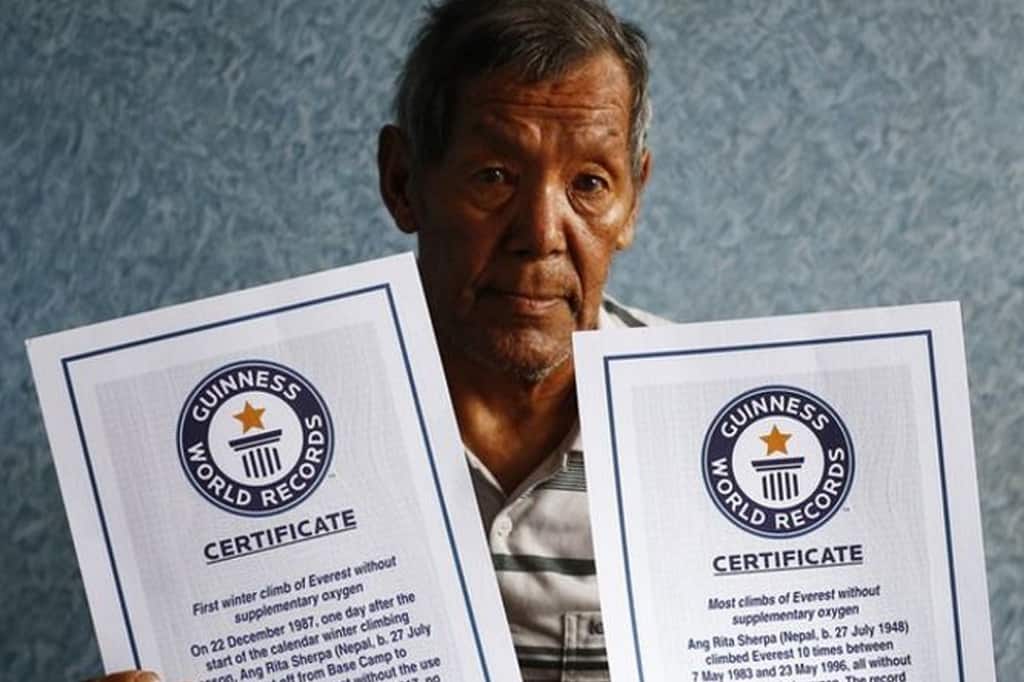
Ang Rita Sherpa (1948–2020) was a Nepali mountaineer known as the “Snow Leopard”, who climbed Mount Everest ten times without bottled oxygen between 1983 and 1996. Guinness World Records recognises this as the most ascents of Everest without supplementary oxygen, and his December 1987 climb is still the only winter ascent of Everest made without it.
He was the first person of any nationality to reach ten Everest summits, at a time when Sherpa climbers were rarely credited by name. This profile sets out his life and record using verified sources, and corrects some dates that are often repeated wrongly online.
Ang Rita Sherpa: key facts
| Fact | Detail |
|---|---|
| Nickname | The Snow Leopard |
| Born | 1948 (Guinness gives 27 July 1948), Yillajung village, Solukhumbu district, Nepal |
| Died | 21 September 2020, Kathmandu, aged 72 |
| Everest summits | 10, all without bottled oxygen (7 May 1983 to 23 May 1996) |
| Guinness World Records | Most climbs of Everest without supplementary oxygen; first winter climb of Everest without supplementary oxygen (22 December 1987) |
| Other 8,000m peaks | Dhaulagiri, Cho Oyu (four times), Kangchenjunga and Makalu, per Explorersweb |
| First 8,000m summit | Dhaulagiri, 1979 |
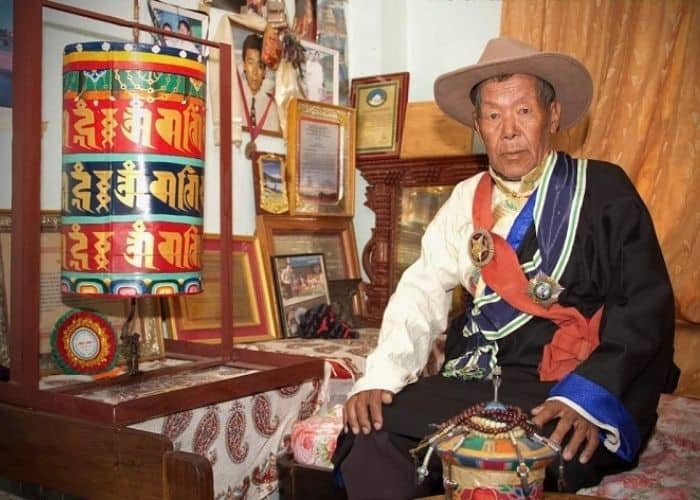
| Honours | Order of Gorkha Dakshina Bahu (First Class); Order of Tri Shakti Patta (First Class) |
| Family | Wife Nima Chokki (d. 2013); three sons and a daughter |
Early life in Solukhumbu
Ang Rita was born in 1948 in Yillajung, a village in the Solukhumbu district of eastern Nepal, the district that contains Everest. Guinness World Records gives his date of birth as 27 July 1948. Some sources name Thame, the nearby Khumbu village, as his birthplace.
His parents were farmers and yak herders. There were no schools in the area when he was a child (the first schools in the Khumbu were built in the early 1960s), so he herded yaks and helped carry goods over the passes into Tibet instead of studying.
At around 15 he left farming to work as a porter so he could support his family. He would spend roughly the next 15 years carrying loads before he was given the chance to climb as a guide himself.
How he became the “Snow Leopard”
His first job was as a low-altitude porter on a Dhaulagiri expedition. According to Adventure Journal’s 2024 profile, he was pressed into high-altitude work during that trip and reached Camp III at about 7,400m with no training and no proper equipment, not even suitable boots.
The climbers who saw him nicknamed him the Snow Leopard, and the name stuck. In Nepali he became known as Heem Chituwa. His first 8,000m summit came on Dhaulagiri in 1979, according to Explorersweb.
Fellow Nepali climbers who worked with him have described his performance at altitude without oxygen as something that seemed to defy physiology.
Ten Everest summits without bottled oxygen
Ang Rita’s first Everest summit came on 7 May 1983, while working for a German-American expedition. Over the next 13 years he would return again and again, mostly guiding foreign teams, and set a record that held for years: the first person to reach the top of Everest ten times.
| # | Date | Route | Notes |
|---|---|---|---|
| 1 | 7 May 1983 | South-east ridge | German-American expedition |
| 2 | 15 October 1984 | South pillar | With a Czechoslovak team, on a new variation of the route |
| 3 | 29 April 1985 | South-east ridge | Norwegian expedition; guided its leader, Arne Næss |
| 4 | 22 December 1987 | South-east ridge | Winter ascent without oxygen, with Korean climber Heo Young-ho |
| 5 | 14 October 1988 | South-east ridge | |
| 6 | 23 April 1990 | South-east ridge | Set a new record for the most Everest ascents |
| 7 | 15 May 1992 | South-east ridge | |
| 8 | 16 May 1993 | South-east ridge | |
| 9 | 13 May 1995 | North Col–north-east ridge | His only ascent from the Tibet side |
| 10 | 23 May 1996 | South-east ridge | With Swedish climber Göran Kropp, 12 days after the May 1996 disaster |
Dates and routes follow the summit list compiled on Wikipedia from the Himalayan Database and contemporary reports; Guinness World Records confirms the first and last dates.
The question about 1983
Explorersweb notes one point of debate. The American climber David Breashears, who was on the 1983 expedition, has said that he and Ang Rita shared a bottle of oxygen in their tent at Camp IV before and after the summit push, though Ang Rita did not use oxygen while climbing. Breashears stressed that he raised it only to keep the record accurate, not to diminish the achievement.
Guinness and Nepali authorities count all ten ascents as oxygen-free. Explorersweb’s obituary counted nine ascents without bottled oxygen, reflecting the 1983 question.
The 1987 winter ascent
On 22 December 1987, the day after calendar winter began, Ang Rita reached the summit with the Korean climber Heo Young-ho. Heo used bottled oxygen; Ang Rita did not. Guinness World Records lists it as the first winter climb of Everest without supplementary oxygen, and states that no other climber had repeated the feat as of its last update.
The descent was nearly fatal. According to Adventure Journal, the pair lost their way near 8,600m and spent the night in the open, moving constantly to stop themselves from freezing. Explorersweb’s obituary in 2020 described it as still the only winter ascent of Everest without supplementary oxygen.
Other Himalayan climbs
Ang Rita’s reputation was not built on Everest alone. Explorersweb’s obituary credits him with ascents of Kangchenjunga, Makalu, Cho Oyu (four times) and Dhaulagiri (three times), mainly in the 1980s and 1990s and mostly without bottled oxygen. Adventure Journal gives four ascents of Dhaulagiri, so the exact count varies between sources.
Like most Sherpa climbers of his generation, much of his high-altitude work went unrecorded by name.
Retirement and later life
Ang Rita made his tenth and final Everest ascent on 23 May 1996 and then retired from high-altitude guiding. His health declined in the years that followed. His family has said that King Birendra, through Crown Prince Dipendra, asked him to stop climbing.
Nepal’s government honoured him with the Order of Gorkha Dakshina Bahu and the Order of Tri Shakti Patta, both first class. In June 2017 he was presented with his Guinness World Records certificate at an event in Kathmandu.
His later years were hard. He suffered a stroke in the mid-2010s and never fully recovered. Fellow climbers, including Kami Rita Sherpa, have spoken publicly about how little state support Nepal’s record-breaking mountaineers receive in old age.
Family
Ang Rita and his wife, Nima Chokki, had three sons and a daughter. Their eldest son, Karsang Namgyal Sherpa, was also an Everest summiter; he died in 2012 after returning from the summit. Nima Chokki died the following year. Another son, Chhewang (Tshewang) Dorje Sherpa, has also climbed Everest.
Death and funeral
Ang Rita Sherpa died on the morning of Monday 21 September 2020 at his daughter’s home in Jorpati, Kathmandu, aged 72, after a long illness. He was survived by two sons, a daughter and grandchildren.
His body was kept at a monastery in Boudha before a Buddhist funeral at Teku in Kathmandu on 23 September, held with national honours. The tourism minister draped the national flag over his body, and the Armed Police Force fired a gun salute.
Ang Rita Sherpa’s place in Everest history
| Climber | Everest summits | Notable for |
|---|---|---|
| Ang Rita Sherpa | 10 (1983–1996) | Most ascents without bottled oxygen; only winter ascent without it |
| Tenzing Norgay | 1 (1953) | First ascent, with Edmund Hillary |
| Kami Rita Sherpa | 32 (May 2026) | Most Everest ascents by anyone |
| Lhakpa Sherpa | 11 (May 2026) | Most Everest ascents by a woman |
| Melissa Arnot Reid | 6 | First American woman to summit and descend without supplemental oxygen |
Many climbers have since passed his total of ten summits, but almost all of them used bottled oxygen. As far as published records show, his combination of ten oxygen-free ascents and a winter ascent without oxygen has not been matched.
Visiting Ang Rita’s home region
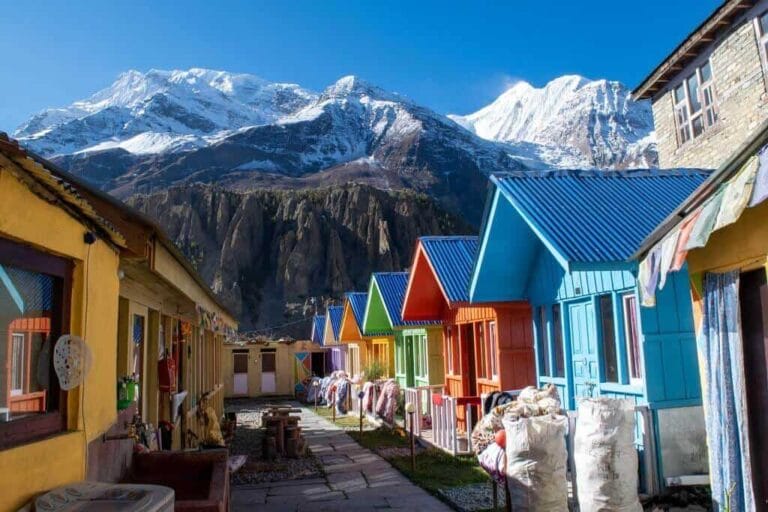
Solukhumbu is also where most trekkers meet the Everest region. The Everest Base Camp trek passes through Sherpa villages including Namche Bazaar and Tengboche, and a side trip west from Namche leads to Thame, home to many famous climbing families.
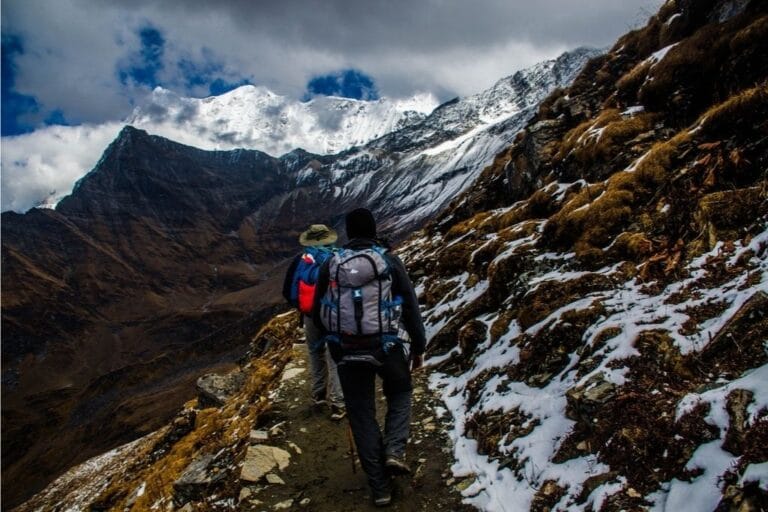
The trek takes around 12 to 14 days and reaches about 5,364m. It needs no climbing skills but does require careful acclimatisation; see our guide to altitude sickness on Everest and our overview of the Everest region. Our Everest Base Camp trek runs with licensed Nepali agencies and local Sherpa guides.
Frequently asked questions
Who was Ang Rita Sherpa?
A Nepali mountaineer from Solukhumbu, nicknamed the Snow Leopard, who climbed Everest ten times without bottled oxygen between 1983 and 1996. He died in Kathmandu in 2020.
How many times did Ang Rita Sherpa climb Everest?
Ten times, from 7 May 1983 to 23 May 1996, all without supplementary oxygen according to Guinness World Records. He was the first person to reach ten Everest summits.
Why was Ang Rita Sherpa called the Snow Leopard?
Climbers gave him the nickname early in his career after he carried loads to about 7,400m on Dhaulagiri with no training or proper boots. It reflected his strength and ease at altitude without bottled oxygen.
Did Ang Rita Sherpa climb Everest in winter?
Yes. On 22 December 1987 he summited without supplementary oxygen, with Korean climber Heo Young-ho. It is recognised as the only winter ascent of Everest without supplementary oxygen.
When did Ang Rita Sherpa die?
He died on 21 September 2020 at his daughter’s home in Kathmandu, aged 72, after a long illness. His funeral was held with national honours on 23 September.
Who holds the record for most Everest summits without oxygen?
Ang Rita Sherpa, with ten ascents, according to Guinness World Records.
Is Ang Rita Sherpa related to Kami Rita Sherpa?
We have found no reliable source saying they are related. Both are Sherpa climbers from Solukhumbu and share a common Sherpa name element.
Did Ang Rita Sherpa have children?
Yes, three sons and a daughter. His eldest son, Karsang Namgyal Sherpa, died in 2012; another son, Chhewang Dorje, has also climbed Everest.