

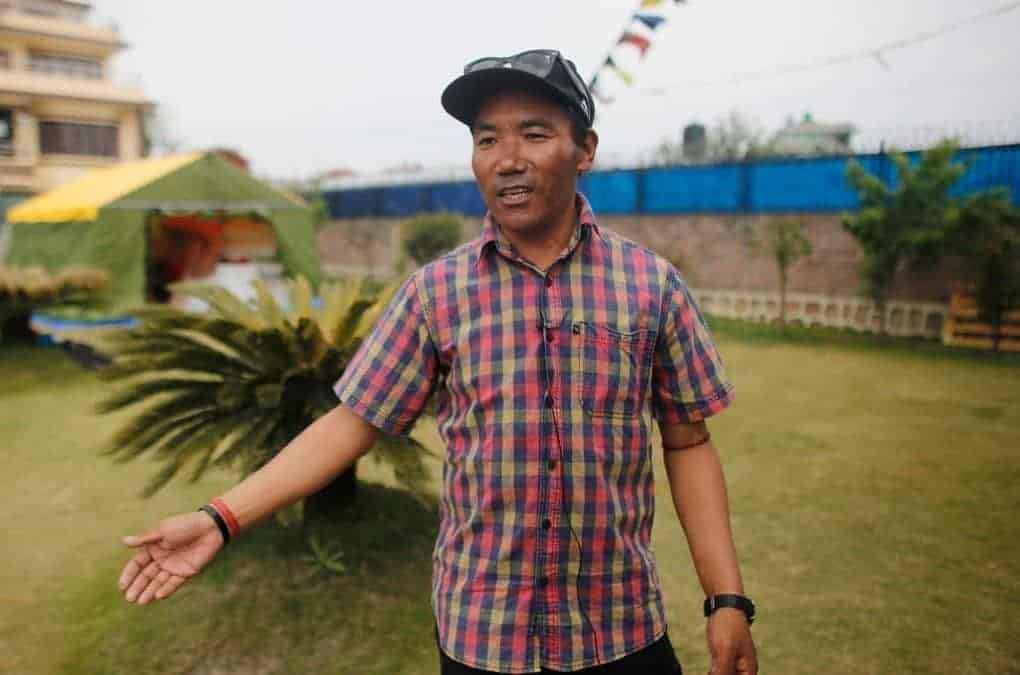
Climbing Mount Everest once is considered the achievement of a lifetime.
Kami Rita Sherpa has done it 32 times.
On 17 May 2026, the 56-year-old Sherpa mountaineer reached the summit of Everest at 10:12 in the morning. It was his 32nd successful ascent, and once again he had broken a world record that already belonged to him.
But perhaps what is even more interesting is where his story started.
Kami Rita was born in Thame, a small village in the Khumbu region of Nepal. Mount Everest was not some distant mountain he first saw in a documentary or dreamed about from the other side of the world. Mountains, expeditions and climbing were already part of life around him.
Kami Rita Sherpa at a glance
His father worked on Himalayan expeditions. His elder brother became a mountaineer. And by the age of 12, Kami Rita himself was carrying equipment towards Everest Base Camp.
He didn’t begin with the intention of becoming the man with the most Everest summits in history.
In fact, at one point he wanted to become a Buddhist monk.
Kami Rita Sherpa at a glance
| Born | 17 January 1970 |
| Birthplace | Thame, Solukhumbu, Nepal |
| Nationality | Nepali |
| Known for | Most successful ascents of Mount Everest |
| Everest summits | 32 |
| First Everest summit | 13 May 1994 |
| Latest Everest summit | 17 May 2026 |
| Age at latest summit | 56 |
| Other major mountains climbed | K2, Lhotse, Cho Oyu and Manaslu |
| Profession | High-altitude mountaineer and guide |
Who is Kami Rita Sherpa?
Kami Rita Sherpa is a Nepali mountaineer and high-altitude guide who holds the world record for the most successful ascents of Mount Everest.
He first reached the summit in 1994 when he was 24 years old.
It would have been an extraordinary achievement even if he had stopped there.
He didn’t.
Kami returned to Everest again and again, climbing the mountain in almost every climbing season that followed. In some years he even reached the summit twice.
By May 2018, his 22nd ascent took him beyond the previous record and made him the person with more Everest summits than anyone else.
Since then, most of the records he has broken have been his own.
His 32nd ascent came on 17 May 2026.
Growing up in Thame
To understand Kami Rita’s story, it helps to understand where he came from.
Thame is a small Sherpa village west of Namche Bazaar in Nepal’s Solukhumbu district.
It has an unusually important place in Everest history.
Tenzing Norgay, who reached the summit of Everest with Edmund Hillary in 1953, had close connections with Thame. Apa Sherpa, who once held the record for the most Everest ascents, also came from the area.
Kami Rita grew up surrounded by that mountaineering culture.
His father, Mingma Tshering Sherpa, worked on mountain expeditions after Nepal began opening its mountains to foreign climbers during the 1950s.
This wasn’t glamorous work.
For many Sherpa families in the Khumbu, expedition work offered something much more practical: an income.
Kami Rita has spoken openly about this.
His family did not have much money, and his education ended early. The school he attended in Thame had been built with the support of Edmund Hillary, but Kami left school after only a few years.
By around the age of 12, he had started carrying loads for trekking and climbing expeditions.
Everest was slowly becoming his workplace.
Kami Rita almost became a monk.
Mountaineering wasn’t his only possible future.
When he was young, Kami Rita considered becoming a Buddhist monk and spent time at the monastery in Thame.
But life took him in another direction.
Expedition workers would return to the village with better clothing, equipment and money than many families in Thame had access to.
Kami also had a family that needed financial support.
Eventually the mountains offered a more practical way to earn a living.
He followed the path already taken by his father and elder brother.
What started as carrying loads would eventually take him to the highest point on Earth.
His first Everest expedition wasn’t successful.
There is an important difference between Kami Rita’s first Everest expedition and his first Everest summit.
He joined his first Everest expedition in 1992.
He didn’t reach the top.
At the time, he was still a beginner and worked around the expedition rather than as the experienced climbing leader he would later become.
Two years later he returned.
On 13 May 1994, aged 24, Kami Rita reached the summit of Mount Everest for the first time.
Interestingly, his reaction wasn’t simply about standing on top of the world.
For Kami, summiting Everest also meant something practical.
Having an Everest summit on his climbing record meant he could get better expedition work.
That is often missed when records are reduced to numbers.
For many foreign climbers, Everest is an expensive personal ambition.
For people such as Kami Rita, Everest has also been a profession.
From one Everest summit to 32
Kami Rita continued climbing Everest almost every year after his first summit.
There were interruptions.
Everest expeditions effectively stopped in 2014 following the avalanche in the Khumbu Icefall that killed 16 Nepali workers. The mountain was again closed following the 2015 Nepal earthquake, and Nepal cancelled its climbing season in 2020 during the COVID-19 pandemic.
Whenever Everest reopened, Kami kept returning.
And sometimes once in a season wasn’t enough.
He reached the summit twice in 2010, twice in 2013, twice in 2023 and twice again in 2024.
By 2018, he had reached the summit 22 times and established a new world record.
Then came 23.
And the number kept moving.
He reached his 30th summit in 2024 and his 31st in May 2025.
On 17 May 2026, Kami Rita climbed Everest for the 32nd time, reaching the summit at 10:12 am.
It remains the highest number of successful Everest ascents by any person in history.
Why climbing Everest 32 times is difficult to comprehend
There is a danger in looking at a number such as 32 and forgetting what each one represents.
Kami Rita didn’t simply walk the same hiking trail 32 times.
Every Everest ascent means going through the dangers of the mountain again.
From the Nepal side, that includes traversing the treacherous Khumbu Icefall, climbing through the Western Cwm and up the Lhotse Face, reaching the South Col and then entering the death zone above 8,000 metres.
The Khumbu Icefall alone is constantly moving.
Seracs collapse. Crevasses open. Routes change.
Then there is extreme cold, exhaustion, high winds and an atmosphere containing roughly a third of the oxygen available at sea level.
Experience reduces some risks.
It doesn’t remove them.
Kami Rita knows this better than most. He has lost friends and relatives on Everest, including people killed in the 2014 Khumbu Icefall disaster.
Yet he continued returning to the mountain.
Kami Rita Sherpa and Pasang Dawa Sherpa
For several years, another Nepali mountaineer has been getting increasingly close to Kami Rita’s record.
Pasang Dawa Sherpa.
During the 2023 climbing season, Pasang Dawa twice equalled Kami Rita’s record before Kami climbed Everest again and moved ahead.
The numbers have continued to rise since.
As of 2026, Kami Rita holds the record with 32 successful Everest summits, while Pasang Dawa has reached the summit 31 times.
So there is now only one ascent between them.
Whether either man views it as a competition is another question, but it has created one of the more unusual records in modern mountaineering.
The record could change again.
Everest isn’t the only 8,000-metre mountain he has climbed.
With so much attention on his Everest record, it is easy to assume that Everest is the only major mountain Kami Rita climbs.
It isn’t.
His mountaineering career also includes successful ascents of some of the most difficult mountains in the Himalayas.
He has climbed Cho Oyu eight times, Manaslu several times, and has made successful ascents of K2 and Lhotse.
K2, in particular, is worth mentioning.
At 8,611 metres, it is the world’s second-highest mountain, but many experienced climbers consider it technically more difficult and dangerous than the standard climbing routes on Everest.
Kami reached its summit in 2014.
So while the Everest number is what made him famous, his experience goes much further than a single mountain.
Everest is also sacred.
There is another side to Kami Rita’s relationship with Everest that is easily overlooked.
For him, the mountain is not simply something to conquer.
Sherpa Buddhist traditions regard mountains throughout the Himalayas as sacred.
Before climbing, expedition teams traditionally take part in a puja ceremony, during which a lama blesses the climbers and their equipment and asks permission from the mountain deities.
Kami Rita has spoken about this relationship many times.
Even after reaching the summit repeatedly, he does not treat Everest casually.
He has said that when others begin celebrating and taking photographs at the top, he bows his head and asks the goddess of the mountain for forgiveness.
That makes the language we often use around Everest—”conquering”, “defeating” or “beating” the mountain—look very different from the way many Sherpas themselves understand it.
Why the word Sherpa matters here
Kami Rita’s story also provides a good example of why Sherpa should not simply be used as another word for mountain guide or porter.
Sherpa refers to an ethnic community whose traditional homeland includes parts of the high Himalayas of Nepal.
Kami Rita is Sherpa.
His profession is mountaineering and high-altitude guiding.
The two things are not interchangeable.
Foreign expeditions have depended on Sherpa climbers for generations, particularly on Everest. They carry equipment, establish camps, fix ropes, transport oxygen, prepare routes and guide climbers through some of the most dangerous sections of the mountain.
Yet historically, the international climbers paying for expeditions received far more attention than the people making many of those climbs possible.
Records such as Kami Rita’s make that much harder to ignore.
A dangerous profession, not merely a record.
Perhaps one of the most important things about Kami Rita’s story is that he hasn’t always spoken about mountaineering in the romantic way outsiders often do.
Everest provided him with opportunities.
It allowed him to earn money, move his family to Kathmandu and provide his children with the education he never received.
But he has also made it clear that he doesn’t want his children to have to make their living in the same way.
The reason is simple.
It is dangerous.
Foreign climbers can spend years saving money for one Everest expedition and then return home.
Sherpa guides may return season after season because the mountain is their livelihood.
For Kami Rita, the 32 summits tell two stories at the same time.
One is about perhaps the most experienced Everest climber in history.
The other is about what generations of Sherpa families have done to make Himalayan mountaineering possible.
Is Kami Rita Sherpa still climbing Everest?
Yes.
At 56 years old, Kami Rita returned to Everest in 2026 and reached the summit for the 32nd time.
He had previously suggested that he might continue climbing until around the age of 60, although plans like these can obviously change.
And now there is another reason people will be watching the next Everest season.
Pasang Dawa Sherpa currently sits only one summit behind him.
Whether Kami Rita reaches number 33 remains to be seen.
But 32 trips to the highest point on Earth already seem difficult enough to understand.
Frequently asked questions about Kami Rita Sherpa
How many times did Kami Rita Sherpa climb Mount Everest?
Kami Rita Sherpa has climbed Mount Everest 32 times, which is the highest number of successful Everest ascents by any person in history. His latest summit came on 17 May 2026, extending his own world record.
Who has climbed Mount Everest the most times?
Kami Rita Sherpa holds the world record for the most successful ascents of Mount Everest. With 32 summits, he has climbed Everest more times than anyone else.
When did Kami Rita Sherpa first climb Mount Everest?
Kami Rita Sherpa first reached the summit of Mount Everest on 13 May 1994. That first successful ascent came when he was 24 years old.
How old is Kami Rita Sherpa?
Kami Rita Sherpa was born on 17 January 1970. That makes him 56 years old as of 2026.
Is Kami Rita Sherpa still alive?
Yes, Kami Rita Sherpa is still alive. He remains active in high-altitude mountaineering and was still climbing Everest in 2026, when he completed his record 32nd ascent.
Has Kami Rita Sherpa climbed K2?
Yes, Kami Rita Sherpa has climbed K2. Although he is best known for his Everest record, his climbing career also includes other major Himalayan peaks such as K2, Lhotse, Cho Oyu and Manaslu.
Where does Kami Rita Sherpa live?
Kami Rita Sherpa was born in Thame, a village located west of the main trekking hub of Namche Bazaar, in Nepal’s Everest region. He has also been reported to live in Kathmandu with his family.
Is Kami Rita Sherpa related to Lhakpa Sherpa?
There is no widely confirmed evidence that Kami Rita Sherpa is closely related to Lhakpa Sherpa, the famous female Everest climber. The confusion usually comes from the fact that Sherpa is both an ethnic identity and a family name used by many people from the region.
How much does Kami Rita Sherpa make?
Kami Rita Sherpa’s exact income is not publicly known. However, he has previously indicated that experienced Everest climbing guides can earn a significant income during the Everest season. The amount can vary depending on the expedition company, the guide’s role, bonuses, and how many climbs they complete.
Why has Kami Rita Sherpa climbed Everest so many times?
Kami Rita Sherpa has climbed Everest so many times because mountaineering has been his profession for most of his adult life. Unlike many foreign climbers who attempt Everest once as a personal goal, Kami Rita has spent decades working as a high-altitude guide, returning season after season and building one of the most remarkable records in Himalayan history.