

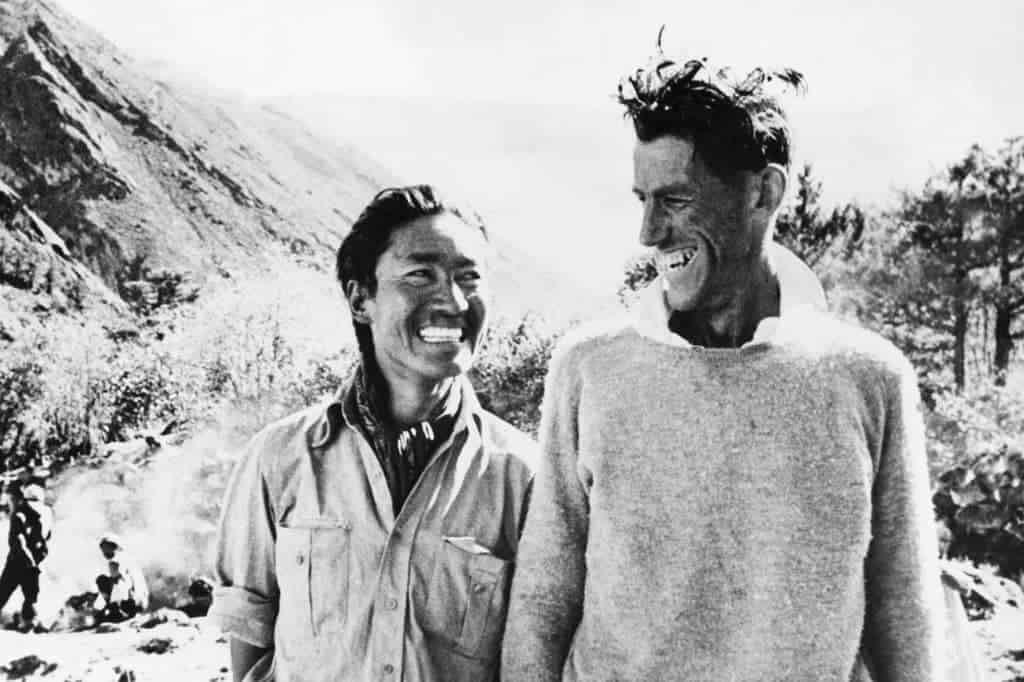
Many people know the famous picture: Tenzing Norgay on the top of Mount Everest, holding an ice axe, with the flags of Britain, Nepal, India, and the United Nations waving in the wind. What the photo doesn’t show is how long it took him to get there.
By 1953, Tenzing was already a veteran of Himalayan expeditions. Most of us know he reached the summit with Edmund Hillary on 29 May 1953 after navigating the grueling approach to Everest Base Camp through the Khumbu. What is less known is that, according to the Himalayan Mountaineering Institute, he had already attempted Everest six times prior to that successful journey.
In 1952, a year before the historic summit, Tenzing and Swiss climber Raymond Lambert pushed to around 8,600 metres on Everest. Compared to modern expeditions with high-tech gear, climbing that high with 1950s equipment was an extraordinary feat—it was the highest point any human had ever reached at the time.
So the story of Tenzing Norgay isn’t simply about what happened during fifteen minutes on the summit. It is about the man who spent two decades earning his way to the top.
Tenzing Norgay at a glance
| Full name | Tenzing Norgay |
| Original name | Namgyal Wangdi |
| Born | Around May 1914 |
| Birthday celebrated | 29 May |
| Died | 9 May 1986 |
| Known for | First confirmed ascent of Mount Everest with Edmund Hillary |
| Everest summit | 29 May 1953 |
| Summit time | Approximately 11:30 am |
| Other achievements | Reached roughly 8,600 m on Everest with Raymond Lambert in 1952 |
| Later role | Director of Field Training at the Himalayan Mountaineering Institute |
| Major honours | George Medal, Padma Bhushan and numerous international mountaineering honours |
Who was Tenzing Norgay?
Tenzing Norgay was a Sherpa mountaineer who became one of the most foundational figures in the history of Himalayan climbing.
On 29 May 1953, Tenzing and New Zealand mountaineer Edmund Hillary reached the 8,848-metre summit of Mount Everest as part of the British expedition led by John Hunt. They became the first people confirmed to have reached the highest point on Earth and returned safely.
That distinction—being confirmed—carries real historical weight. When George Mallory and Andrew Irvine vanished high on the mountain in 1924 during the Mount Everest Reconnaissance Expedition, they left behind one of mountaineering’s greatest unsolved mysteries.
Because no conclusive evidence proves they reached the top, the 1953 ascent by Hillary and Tenzing stands as the official first successful climb. Yet, viewing Tenzing merely as the climber who accompanied Hillary misses the true scope of his legacy.
Long before 1953, he was already one of the most experienced high-altitude mountaineers in the entire range.
Where was Tenzing Norgay born?
Determining Tenzing’s exact origins is surprisingly complex. He was born around 1914, but the subject is under debate. Different accounts place his birthplace either in Tibet or in the Khumbu region of present-day Nepal.
In his autobiography, Tenzing mentioned growing up in Khumbu, but other biographies and family statements say he was born in Tibet and came to Nepal as a child. This ambiguity is why stating a single, definitive birthplace can be misleading.
What remains undeniable is that Tenzing’s life was shaped by three regions—Tibet, Nepal, and India. He spent many of his younger years exploring the villages of the Solukhumbu region before going to Darjeeling, India.
It became his main home and the starting point for early trips to the Himalayas. Born Namgyal Wangdi, his name was later changed to Tenzing Norgay on the advice of a high-ranking Buddhist lama. Tenzing only knew he was born in late May; however, the date and year were unknown. As a result, he chose 29 May as his official birthday.
From the Himalayas to Darjeeling
Before Everest became a popular spot for trekking, Darjeeling served as the primary recruitment hub where European teams hired skilled workers from the Himalayas.
Tenzing moved to Darjeeling as a young man seeking expedition work. His major breakthrough arrived in 1935 when legendary mountaineer Eric Shipton selected the roughly 20-year-old Tenzing for a British reconnaissance team.
That selection marked the beginning of a two-decade relationship with the mountain. Throughout the 1930s, Tenzing was involved in many British expeditions, moving up from a porter to a highly respected lead climber in the mountains.
This evolution represented a major historical shift. In the past, most accounts of Himalayan trips were told by foreign leaders. The local Sherpa climbers, who took on the most dangerous jobs in high places, were often overlooked.
Tenzing belonged to the pioneering generation that transformed how Sherpa expertise was recognised globally.
Tenzing Norgay’s 1952 Everest attempt
A year before Everest was successfully climbed, Tenzing came remarkably close to reaching the summit himself.
In 1952, Nepal opened its borders to foreign expeditions, allowing a Swiss team to attempt the mountain from its southern approach. Tenzing joined the expedition not just as a high-altitude porter, but as a full climbing partner alongside Swiss mountaineer Raymond Lambert.
Together, Tenzing and Lambert pushed up the Southeast Ridge to approximately 8,600 metres (28,200 feet) before extreme exhaustion, freezing temperatures, and failing oxygen equipment forced them to turn back. It highlighted the severe high-altitude risks of trekking in Nepal that mountaineers still navigate to this day.
To put that attempt in perspective: Everest’s summit stands at 8,848.86 metres. Tenzing and Lambert had reached a point just a few hundred vertical metres below the peak while relying on primitive 1950s gear, heavy wool clothing, and experimental oxygen systems.
Though they did not reach the top, the expedition was a turning point. Tenzing entered the 1953 season possessing more first-hand knowledge of Everest’s upper reaches than virtually any other living climber.
The 1953 British Mount Everest Expedition
The following year, Tenzing joined the 1953 British Mount Everest expedition, organised under the military-style leadership of Colonel John Hunt.
This was far from a small team of independent climbers; it was a massive, highly structured campaign. Historical accounts record over 350 porters, around 20 high-altitude Sherpas, and several tonnes of gear supporting the core climbing team. Managing that moving city across the rough Himalayan terrain represented a monumental logistical operation.
Even with that level of institutional support, success on the mountain was never guaranteed. Over several weeks, the team systematically established camps higher up the peak, pushing a line through the treacherous Khumbu Icefall (a feature that remains the most hazardous section on modern Everest climbing routes) moving across the Western Cwm, up the steep Lhotse Face, and onto the wind-scoured South Col.
The first official summit assault launched on 26 May, carried out by Tom Bourdillon and Charles Evans.
They reached the South Summit—within striking distance of the main peak—before malfunctioning oxygen equipment and running out of daylight forced them to retreat. Everest remained unclimbed, clearing the path for the second team: Edmund Hillary and Tenzing Norgay.
Tenzing Norgay and Edmund Hillary
Tenzing and Hillary built considerable trust throughout the expedition. At one point, when Hillary slipped into a deep crevasse, Tenzing reacted instantly—securing his position with his ice axe and arresting the fall. Accounts from the expedition highlight that moment as the catalyst for the deep mutual reliance between the two climbers.
On 28 May, supported by George Lowe, Alfred Gregory, and Ang Nyima, they established their final high camp at roughly 8,500 metres. The conditions were brutal, and oxygen was scarce.
The following morning got off to a difficult start when Hillary discovered his boots had frozen solid outside the tent, requiring nearly two hours to thaw. Once ready, the two men strapped on their 30-pound oxygen units and set out along the final summit ridge toward one last major obstacle.
The Hillary Step
Guarding the summit was a formidable 12‑metre rock face—a vertical wall that would later be named the Hillary Step.
Hillary managed to jam his way up a narrow fissure between the rock and an ice cornice, working his way to the top before pulling Tenzing up behind him.
Once above that final barrier, the mountain’s greatest technical challenge was behind them. They walked the remaining snow crest, and at approximately 11:30 am on 29 May 1953, Tenzing Norgay and Edmund Hillary stood on the summit of Mount Everest.
Who reached the summit first?
In the aftermath, international media fixated on who physically placed their boot on the summit first.
Tenzing later clarified in his autobiography that Hillary stepped onto the top moments before him. However, viewing the ascent as a race misses the core reality of high-altitude climbing. They moved attached to the same rope; John Hunt and the expedition leadership maintained throughout that they reached the summit together as a unified team.
What happened on top of Everest?
They remained at the summit for just 15 minutes.
Hillary took the iconic photograph of Tenzing holding his ice axe draped with the flags of Nepal, Britain, India, and the United Nations. No photo of Hillary was taken—Tenzing had little experience handling a camera, and Hillary declined when Tenzing offered.
Before descending, Tenzing buried an offering of sweets in the snow in accordance with his Buddhist faith, while Hillary placed a small crucifix given to him by John Hunt. Reaching the top was only half the battle; they still had to navigate the dangerous descent.
Why Tenzing Norgay’s story matters
Tenzing’s ascent changed much more than the record books.
For decades, Himalayan expeditions had relied heavily on Sherpa climbers, while international press coverage concentrated almost exclusively on European expedition leaders. Tenzing’s victory ensured Sherpas could no longer be relegated to background figures. He brought worldwide attention to the skill, endurance, and indispensability of high-altitude Sherpa mountaineers.
It is also worth clarifying what the word Sherpa actually means. Sherpa is not a job title or a synonym for “porter.” The Sherpa are an ethnic group with deep historical and cultural roots in the high Himalayas of Nepal and Tibet. Because so many Sherpas became exceptionally skilled high-altitude guides, Western media began using their ethnic name as a generic term for support staff.
When you trek through the Solukhumbu region—visiting historic settlements like Namche Bazaar, Khumjung, Khunde, and Thame—you are travelling through communities whose history existed long before Everest expeditions arrived. Tenzing belongs to that rich, enduring heritage.
What happened to Tenzing after Everest?
Everest changed Tenzing’s life overnight. He became an international icon and received honours from nations around the globe. However, his most lasting contribution came after his summit career ended.
Following the surge of global interest in mountaineering after 1953, the Himalayan Mountaineering Institute (HMI) was established in Darjeeling in 1954. Tenzing was appointed its first Director of Field Training, a role he held until 1976 before continuing as a senior adviser until his death. Through HMI, Tenzing personally trained and inspired generations of future Indian and international climbers.
Tenzing Norgay’s awards and honours
Tenzing received widespread recognition from Nepal, India, Britain, and international sporting organisations. Among his primary honours were:
- The George Medal (United Kingdom) following the 1953 Everest expedition
- The Order of the Star of Nepal (First Class)
- India’s Padma Bhushan (one of India’s highest civilian honours)
- Queen Elizabeth II Coronation Medal
- The Himalayan Club’s Tiger Medal
His legacy even extends beyond Earth. When NASA’s New Horizons spacecraft flew past Pluto, scientists named a prominent range of icy mountains the Tenzing Montes in his honour.
Tenzing Norgay’s family
Tenzing married three times and raised a large family. His passion for the mountains carried forward through subsequent generations: his son Jamling Tenzing Norgay and his grandson Tashi Tenzing both reached the summit of Mount Everest.
However, Tenzing never pressured his children to follow in his footsteps. His success allowed him to provide them with educational opportunities that were unavailable to him as a young load-carrier—a milestone he considered one of his proudest personal achievements.
When did Tenzing Norgay die?
Tenzing Norgay passed away in Darjeeling on 9 May 1986, at the age of 71. He spent his later years surrounded by the mountain culture he helped build.
Seeing Tenzing Norgay’s legacy in Namche Bazaar
For trekkers heading toward Everest Base Camp today, Tenzing’s story comes alive early in the journey.
Travellers on the trail can visit his memorial statue above the acclimatisation hub of Namche Bazaar, where the Tenzing Norgay Sherpa Heritage Centre stands as an inspiring stop for trekkers. Inaugurated on 29 May 2023—the 70th anniversary of the first confirmed ascent—the complex overlooks the sweeping crescent of the village, with Everest visible on the horizon.
Taking time to visit the heritage centre shifts your perspective on the trek. You realise you aren’t simply hiking toward a famous peak—you are walking through the living history that made Himalayan mountaineering possible.
Frequently asked questions about Tenzing Norgay
What is Tenzing Norgay famous for?
Tenzing Norgay is best known for making the first confirmed ascent of Mount Everest alongside Sir Edmund Hillary on 29 May 1953. He was already a veteran Himalayan mountaineer and had participated in six previous Everest attempts before the successful 1953 expedition.
Was Tenzing Norgay the first person to climb Mount Everest?
Tenzing Norgay and Edmund Hillary are jointly credited as the first people confirmed to have reached the summit of Mount Everest. Tenzing later clarified in his autobiography that Hillary physically stepped onto the summit moments before him, but they climbed on a single rope team and official history credits the victory to both men.
Was Tenzing Norgay Nepalese or Indian?
Historical sources associate Tenzing with Tibet, Nepal, and India rather than a single modern nationality. Accounts of his birthplace differ, placing it in either Tibet or the Khumbu region of Nepal. His childhood was deeply connected to the Everest region, while Darjeeling, India, became his long‑term home and base of operations later in life.
Was Tenzing Norgay a Sherpa?
Yes, Tenzing is widely recognised as a Sherpa mountaineer. However, “Sherpa” is an ethnic community originating in the high Himalayan regions of Nepal and Tibet, not a job title. While many Sherpas became world‑renowned guides and climbers, not every Sherpa works in mountain tourism, and not every Himalayan porter is an ethnic Sherpa.
How many times did Tenzing Norgay attempt Mount Everest?
According to the Himalayan Mountaineering Institute, Tenzing was on Everest six times before successfully reaching the top on his seventh attempt in 1953.
Did Tenzing Norgay climb Everest without oxygen?
No. Tenzing Norgay and Edmund Hillary used open-circuit supplementary oxygen systems during their successful 1953 summit push.
How long did Tenzing Norgay and Edmund Hillary stay on Everest’s summit?
They stayed on the summit for approximately 15 minutes to take photographs, leave offerings, and inspect the ridge before beginning their descent.
What did Tenzing Norgay leave on Mount Everest?
Tenzing placed a small offering of sweets and food in the snow as a gift to the mountains in accordance with his Buddhist faith. Hillary buried a small crucifix given to him by expedition leader John Hunt.
Why is there no summit photograph of Edmund Hillary?
Hillary photographed Tenzing holding his ice axe draped with flags, creating one of the most famous images in mountaineering history. Tenzing later stated that he offered to take Hillary’s photograph, but Hillary declined. As a result, no photograph of Hillary standing on the summit exists from the first ascent.
Where can you learn about Tenzing Norgay in Nepal?
Trekkers on the Everest Base Camp route can visit the Tenzing Norgay Sherpa Heritage Centre and his memorial statue above the acclimatisation hub of Namche Bazaar. Located near the Sagarmatha National Park visitor centre, it offers cultural context for Sherpa history alongside sweeping views of Everest in the distance.