
Lhakpa Sherpa is a Nepali mountaineer who holds the record for the most ascents of Mount Everest by a woman. On 17 May 2026 she reached the summit for the 11th time, extending a record she has held for two decades, and she remains the first Nepali woman to climb Everest and come back down alive.
Her story is unusual even by Everest standards: a girl from a remote village in the Makalu region who was never allowed to go to school, who later worked as a dishwasher in Connecticut between expeditions, and whose life became the 2024 Netflix documentary Mountain Queen: The Summits of Lhakpa Sherpa. This guide sets out the verified facts, from her first summit in 2000 to her 2026 record.
Lhakpa Sherpa: key facts
| Fact | Detail |
|---|---|
| Nationality | Nepali; lives in the United States (Hartford, Connecticut, according to 2026 reports) |
| Born | 1973 by most accounts, in the Makalu area of Sankhuwasabha district, eastern Nepal |
| Everest summits | 11, as of her 17 May 2026 ascent (most by any woman) |
| Summit years | 2000, 2001, 2003, 2004, 2005, 2006, 2016, 2017, 2018, 2022, 2026 |
| Routes | Eight ascents from the north (Tibet) side and three from the south (Nepal) side, per the Kathmandu Post |
| First summit | 18 May 2000, leading the Nepali Women Millennium Expedition |
| K2 | Summited on 27 July 2023, 13 years after turning back on her first attempt in 2010 |
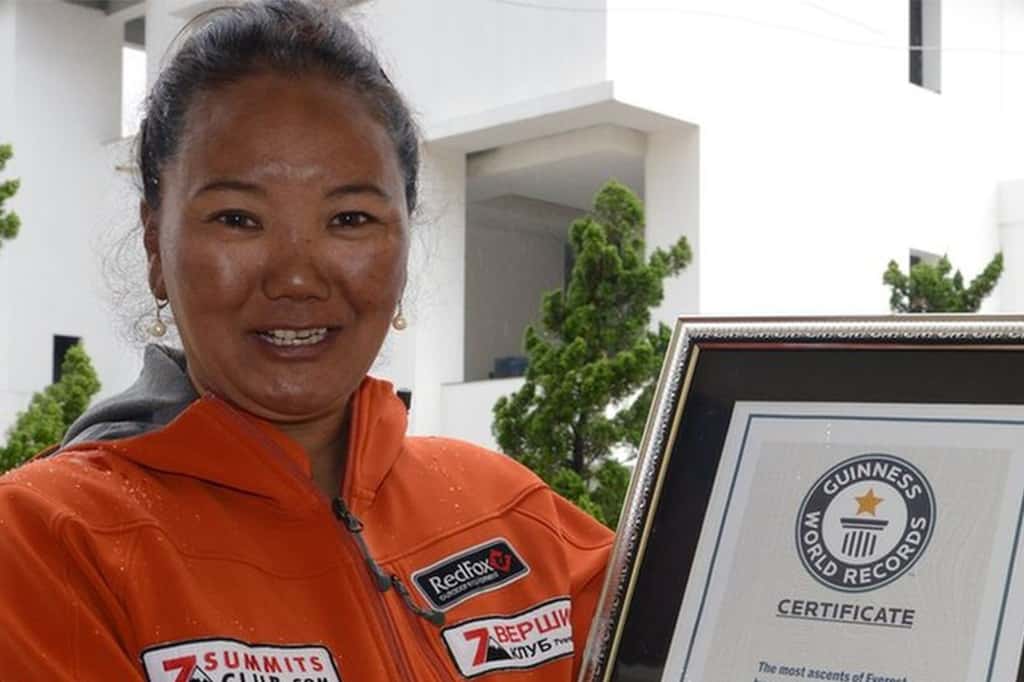
| Guinness World Records | Most ascents of Everest by a woman; inducted into Guinness World Records ICONS in 2024 |
| Documentary | Mountain Queen: The Summits of Lhakpa Sherpa (dir. Lucy Walker), premiered at TIFF 2023, on Netflix from 31 July 2024 |
| Children | A son, Nima, and two daughters, Sunny and Shiny |
How many times has Lhakpa Sherpa climbed Everest?
Lhakpa Sherpa has climbed Everest 11 times as of May 2026. Her 11th summit came at around 9:30am local time on 17 May 2026, according to the Kathmandu Post, which cited Chhang Dawa Sherpa at Everest Base Camp. Nepal’s Department of Tourism also marked the ascent in a press release alongside Kami Rita Sherpa’s 32nd summit on the same day.
The climbing magazine Lacrux reported that she climbed the 2026 route from Nepal’s south side, working as a guide for a client, at the age of 52.
Many older articles, including earlier versions of this page, describe her as a nine-time or ten-time summiter. Those numbers were correct when they were written. The table below shows how her record built up.
| Ascent | Year | Notes |
|---|---|---|
| 1 | 2000 | 18 May; first Nepali woman to summit and survive the descent |
| 2 | 2001 | Climbed with her then-husband, George Dijmarescu |
| 3 | 2003 | Summited with her brother Mingma Gelu Sherpa and sister Ming Kipa Sherpa (aged 15) |
| 4–6 | 2004, 2005, 2006 | Consecutive ascents, giving her six summits by 2006 |
| 7 | 2016 | From the Tibet side, after the 2014 and 2015 seasons were disrupted by disaster |
| 8 | 2017 | |
| 9 | 2018 | |
| 10 | 2022 | 12 May; crowdfunded climb, filmed for Mountain Queen |
| 11 | 2026 | 17 May, via the south side, guiding a client |
For context, the overall Everest record belongs to Kami Rita Sherpa, who reached 32 summits on the same morning in 2026. You can read more in our profile of Kami Rita Sherpa, and in our round-up of Mount Everest facts.
Early life in the Makalu region
Lhakpa grew up in Balakharka, a village in the Makalu area of Sankhuwasabha district in eastern Nepal, one of 11 children in a family that kept yaks and farmed. Her first name, like many Sherpa names, comes from the day of the week she was born: Lhakpa means Wednesday.
Girls in her community were not sent to school. Accounts of her childhood describe her carrying a younger brother to school and back while being denied a place herself. She never learned to read or write fluently, something that later became an issue in her divorce proceedings.
As a teenager she found work carrying loads for trekking and climbing groups, a job then done almost entirely by men. She worked her way up through portering and kitchen work on expeditions, learning ice and rope skills on the job, until she was strong and experienced enough to aim for Everest itself.
First Nepali woman to summit Everest and survive
In 2000 Lhakpa led the Nepali Women Millennium Expedition, supported by the Kathmandu agency Asian Trekking. On 18 May 2000 she reached the summit, becoming the first Nepali woman to climb Everest and return safely.
The distinction matters. Pasang Lhamu Sherpa became the first Nepali woman to reach the top in April 1993, but she died on the descent. Pasang Lhamu is a national heroine in Nepal, and Lhakpa’s achievement is usually described as completing what Pasang Lhamu began.
Her early success came at a time when there was almost no route for Nepali women into high-altitude guiding. Today the picture is changing slowly, with more Nepali women working as licensed mountain guides and trekking guides, but in 2000 she was close to alone.
The family record: three siblings on the summit
In May 2003 Lhakpa climbed Everest with her brother Mingma Gelu Sherpa and her younger sister Ming Kipa Sherpa, who was 15 at the time. It was recognised by Guinness World Records as the first time three siblings had stood on the summit together.
Mingma Gelu has continued to work in the expedition industry; it was he who gave the Himalayan Times details of Lhakpa’s K2 history in 2023. The family’s Everest connections run deep, which is common in Sherpa communities where mountain work is often passed between siblings and generations.
Marriage, abuse and starting again in Connecticut
Lhakpa met the Romanian-American climber George (Gheorghe) Dijmarescu in 2000 and they married around 2002. She moved to Hartford, Connecticut, and the couple climbed Everest together several times in the early 2000s. They had two daughters, Sunny and Shiny. Her son, Nima, was from an earlier relationship.
The marriage was violent. During a 2004 Everest expedition, Dijmarescu struck her in front of other climbers, an incident later described by the journalist Michael Kodas in his book High Crimes. Reporting by the New York Times describes a later assault in 2012, after which she and her daughters left the family home. The marriage was dissolved in 2015.
We include this because it is central to how she has told her own story, including in the Netflix documentary, and because it explains the long gap in her climbing between 2006 and 2016. During those years she raised her daughters largely alone, working jobs that included cleaning houses and washing dishes at Whole Foods Market.
The comeback: Everest 2015 to 2022
Lhakpa returned to Everest in 2015, climbing from the Tibet side, but the season ended after the April 2015 Nepal earthquake, which triggered a deadly avalanche at the Nepal-side Base Camp and halted climbing on both sides of the mountain.
In 2016 she summited for a seventh time from the north, then again in 2017 and 2018, taking her to nine summits. Each expedition was funded on a shoestring, often through sponsorship appeals and crowdfunding, while she continued to work in Connecticut between seasons.
Her tenth summit came on 12 May 2022, which the BBC reported as a new world record for a woman. That climb forms the spine of the Mountain Queen documentary. By this point she was in her late forties and had climbed Everest more times than her former husband, who had nine ascents.
K2 in 2023
On 27 July 2023 Lhakpa reached the summit of K2 (8,611m), the world’s second-highest mountain and widely regarded as far more dangerous than Everest. The Himalayan Times reported that she topped out at around 11:45am with 8K Expeditions. It was her second attempt: in 2010 she had retreated from above Camp 3 in bad weather.
K2 has a far higher fatality rate than Everest and much less fixed infrastructure, so the ascent answered critics who had suggested her record was built only on Everest’s busy commercial routes.
Mountain Queen: the Netflix documentary
Mountain Queen: The Summits of Lhakpa Sherpa is a feature documentary directed by the British filmmaker Lucy Walker. It premiered at the Toronto International Film Festival in September 2023, where Netflix bought worldwide rights, and was released on Netflix in 190 countries on 31 July 2024.
The film follows her 2022 attempt on a tenth summit while telling her life story: the denied schooling, the first ascent in 2000, the marriage and its violence, and the struggle to fund expeditions while raising her daughters. According to the director, it was also the first Netflix film offered with Nepali subtitles.
It has been widely praised by critics, and in November 2024 it won the Grand Prize in the international film competition at Kendal Mountain Festival in Cumbria. If you are planning a trip to Nepal, it is an excellent way to understand the lives of the people who make Himalayan climbing possible.
Recognition and awards
- Guinness World Records: holder of the record for most ascents of Everest by a woman; inducted into Guinness World Records ICONS in 2024.
- BBC 100 Women (2016): named among the BBC’s 100 inspirational and influential women.
- Kendal Mountain Festival (2024): Mountain Queen won the festival’s international Grand Prize.
She has said in interviews that she has no fixed target and wants to keep climbing Everest for as long as she can, and her 2026 climb suggests she meant it.
How Lhakpa compares with other Everest record-holders
| Climber | Everest summits | Known for |
|---|---|---|
| Kami Rita Sherpa | 32 (May 2026) | Most Everest ascents by anyone |
| Lhakpa Sherpa | 11 (May 2026) | Most Everest ascents by a woman |
| Melissa Arnot Reid | 6 | First American woman to summit and descend without supplemental oxygen (2016) |
| Ang Rita Sherpa | 10 (1983–1996) | Ten ascents without bottled oxygen |
| Tenzing Norgay | 1 (1953) | First ascent with Edmund Hillary |
Seeing Everest for yourself
You do not need to be a mountaineer to see the mountain Lhakpa has climbed 11 times. The classic Everest Base Camp trek follows the Khumbu valley from Lukla through Namche Bazaar and Tengboche to the foot of the Khumbu Icefall, the start of the south-side climbing route she used for her 2026 record.
The trek usually takes 12 to 14 days and reaches about 5,364m at Base Camp and 5,545m on Kala Patthar. It is achievable for fit walkers with no climbing experience, but altitude is the main risk, so read our guide to altitude sickness on Everest and allow proper acclimatisation days. Our Everest Base Camp trek is run with licensed Nepali agencies and local guides.
Frequently asked questions
How many times has Lhakpa Sherpa climbed Mount Everest?
Eleven times, as of her ascent on 17 May 2026. Her summits were in 2000, 2001, 2003, 2004, 2005, 2006, 2016, 2017, 2018, 2022 and 2026. That is the most by any woman.
Is Lhakpa Sherpa the first woman to climb Everest?
No. The first woman to summit was Junko Tabei of Japan in 1975. Lhakpa was the first Nepali woman to summit and return alive, in 2000. Pasang Lhamu Sherpa reached the top in 1993 but died on the descent.
How old is Lhakpa Sherpa?
She was 52 at the time of her May 2026 ascent, according to Lacrux. Most sources give her birth year as 1973, though, as with many people born in rural Nepal at that time, no exact birth date is widely published.
Where does Lhakpa Sherpa live now?
She lives in Hartford, Connecticut, in the United States, where she raised her daughters. She has worked at Whole Foods Market between expeditions.
Is Mountain Queen on Netflix?
Yes. Mountain Queen: The Summits of Lhakpa Sherpa, directed by Lucy Walker, was released on Netflix worldwide on 31 July 2024 after premiering at the Toronto International Film Festival in 2023.
Did Lhakpa Sherpa get paid by Netflix?
The terms of any agreement between Lhakpa and the filmmakers or Netflix have not been made public, so we cannot say. What is on record is that her climbs have continued to rely on sponsorship and crowdfunding.
Has Lhakpa Sherpa climbed K2?
Yes. She summited K2 on 27 July 2023, having turned back from above Camp 3 on her first attempt in 2010.
Who is Lhakpa Sherpa’s ex-husband?
George (Gheorghe) Dijmarescu, a Romanian-American climber with nine Everest summits. They married around 2002 and the marriage was dissolved in 2015 after years of documented abuse.