
5,364 m/ 17598 ft
Khumbu, Solukhumbu
Sagarmatha
Lukla
Mar-May, Sep-Nov
Kala Patthar (5,664 m)
Most people arrive at Everest Base Camp expecting to find a permanent tent city sitting directly beneath the clear, towering summit of Mount Everest.
What you actually find can be very different.
You cannot properly see the surrounding terrain blocks much of the view. Trekkers do not normally sleep there either. And if you visit outside the main spring climbing season, the famous expedition camp you see in documentaries may not be there at all.
That does not make Base Camp of Everest disappointing. If anything, knowing what the place actually is makes reaching it more interesting.
For trekkers, Everest Base Camp is normally the final destination of a journey that has taken days through the Khumbu. For Everest climbers, it is where the serious work begins.
You trek to Base Camp. Everest climbers continue beyond it.
Everest Base Camp is in the Khumbu region of eastern Nepal, inside Sagarmatha National Park and close to the border with Tibet. It sits beside the debris-covered Khumbu Glacier at the upper end of the valley.
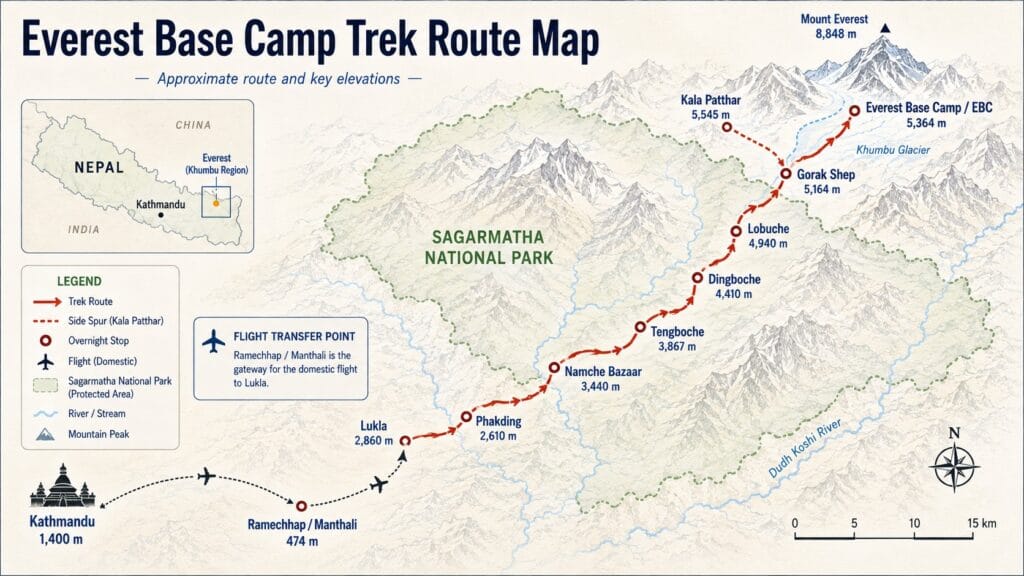
Looking at Everest Base Camp on a map can be slightly misleading. It does not appear particularly far from Kathmandu in straight-line distance, but there is no road that takes you directly there. Most trekkers first reach Lukla, usually by air, and continue through the Khumbu on foot.
The standard route broadly follows:
Lukla → Phakding → Namche Bazaar → Tengboche → Dingboche → Lobuche → Gorak Shep → Everest Base Camp.
The route takes you progressively deeper into the Khumbu, moving from the forested valleys around Lukla and Phakding to the exposed glacial terrain around Gorak Shep and Base Camp.
That transition is a large part of the experience. Base Camp may be the destination on the map, but the journey through the Khumbu is what gives the place its context.
South Everest Base Camp sits at 5,364 metres (17,598 feet) above sea level.
At this altitude, atmospheric pressure is much lower than at sea level. The percentage of oxygen in the air remains roughly the same, but lower pressure means less oxygen is available to your body with every breath.
That changes how even ordinary effort feels. Walking uphill becomes slower. You stop more often. Recovery takes longer.
This is also why the distance of the Everest Base Camp trek never tells the full story. Walking 10 kilometres at low altitude and walking 10 kilometres after several nights above 4,000 metres are not the same thing.
You may occasionally see slightly different altitude figures for Everest Base Camp depending on the map, GPS device, or exact point being measured. For practical purposes, the standard figure to remember is 5,364 metres.
There are two main Everest Base Camps: South Base Camp in Nepal and North Base Camp in Tibet (China). Both are used by climbing expeditions, but the experience of reaching them is very different.
| Feature | South Base Camp (Nepal) | North Base Camp (Tibet) |
| Elevation | 5,364 m / 17,598 ft | 5,200 m / 17,060 ft |
| Arrival Style | Multi-day mountain trek on foot | Paved asphalt road (driveable by vehicle) |
| Historic Significance | Hillary & Tenzing 1953 route | Mallory & Irvine 1920s expeditions |
| Travel Style | Traditional Sherpa teahouse trekking | Overland vehicle-based tour |
| Permits | Local park & municipal permits | Chinese Visa + Tibet Travel Permit (TTP) |
The Nepal side is the one most people mean when they talk about the Everest Base Camp Trek. It involves walking through the Khumbu, staying in teahouses, and gradually climbing through places such as Namche Bazaar, Tengboche, Dingboche, and Gorak Shep.
The Tibetan side is a very different kind of journey, with road access much closer to the mountain and tighter travel controls.
For the rest of this guide, Everest Base Camp refers to South Base Camp in Nepal.
The southern approach to Everest only became important after Nepal opened to foreign mountaineering expeditions in the early 1950s. Before that, British expeditions attempting Everest in the 1920s had approached the mountain from Tibet.
The 1953 British expedition changed the story of the southern route. Edmund Hillary and Tenzing Norgay reached the summit of Everest on 29 May 1953, using the approach through the Khumbu and the Southeast Ridge.
The glacier area below the mountain became the natural staging point for expeditions attempting Everest from Nepal. Over time, Base Camp developed into something far more organised.
Today, during the main spring climbing season, expedition teams build temporary camps across the glacier with sleeping tents, kitchens, communications equipment, medical support, and supplies.
But this is important: Everest Base Camp is still temporary. There is no permanent town sitting there throughout the year.
Everest Base Camp can look almost like two different places depending on when you arrive.
April and May are when the version of Base Camp you have probably seen in documentaries appears.
Expedition teams establish camps across the glacier. You may see:
Helicopter activity also increases as people and equipment move through the area. For a few weeks, Base Camp can feel like a small temporary settlement built on ice and rock.
This is the famous expedition atmosphere people often imagine when they hear the words Everest Base Camp.
Come at another time of year, and much of that disappears. The expedition tents are removed. The kitchens disappear. The climbing teams leave.
What remains is much more exposed: rock, ice, moraine, prayer flags, the Khumbu Glacier, and the marker where trekkers stop for photographs.
So if you trek there in autumn expecting the huge camp you saw on television, you may initially wonder where everything has gone. Nothing is wrong. You are simply seeing Everest Base Camp without the temporary expedition infrastructure.
Not properly. This surprises a lot of people. You spend days trekking towards Mount Everest, finally reach Base Camp, and then discover that the summit is not standing clearly in front of you.
Surrounding terrain, particularly Nuptse, blocks much of the summit view from Base Camp. What you do see is the glacial environment around Everest: the Khumbu Glacier, the Khumbu Icefall, massive surrounding peaks, and the area from which Everest expeditions begin moving higher onto the mountain.
For the classic Everest panorama, trekkers normally head to Kala Patthar.
They are not competing viewpoints. They give you completely different experiences.
Everest Base Camp is about reaching the foot of the mountain and seeing the expedition environment up close. Kala Patthar is about the view. That is why most standard EBC itineraries include both.
If you only went to Base Camp expecting the best photograph of Everest, you would probably be disappointed. If you understand what Base Camp represents, the experience makes much more sense.
You cannot really understand Everest Base Camp without understanding the glacier around it.
The Khumbu Glacier flows down from the high mountains above Base Camp. Much of its surface is covered with rock and debris, so it does not always look like the clean blue-white glacier you might imagine. In places, it can resemble a huge field of loose rock.
But there is ice underneath. The glacier is constantly moving, melting, and changing. Because the glacier is constantly changing, Base Camp cannot function like a permanent settlement. The layout of the expedition camp changes from season to season.
Above Base Camp, the glacier becomes far more broken. Huge blocks of ice, crevasses, and seracs form what is known as the Khumbu Icefall.
Trekkers do not continue through it; Everest climbers do. For climbers following the South Col route, the Icefall is one of the first major obstacles above Base Camp on the way towards Camp 1.
This is where the difference between trekking to Everest and climbing Everest becomes very obvious. You may have spent days pushing yourself just to reach Base Camp. And then you look above you: for the climbers, that is where the mountain really begins.
Because Everest Base Camp is not a normal settlement. There are no permanent teahouses or trekking lodges there.
During spring, the tents spread across the glacier belong to expedition operations rather than functioning as ordinary accommodation for trekkers. Most trekkers therefore visit Base Camp during the day and return to Gorak Shep to sleep.
There is another practical reason this makes sense: Gorak Shep has teahouses where you can eat, rest, and sleep. Base Camp does not. So although Base Camp may be the symbolic destination of the trek, Gorak Shep remains the practical base for most trekkers visiting the area.
Gorak Shep sits at around 5,164 metres and is the final high-altitude settlement with teahouse accommodation before Everest Base Camp.
It is not a large village. At this altitude, things are basic. But after several days of walking through the mountains, having somewhere warm enough to sit, eat, and sleep matters.
Gorak Shep is also the starting point for two of the most important excursions at the end of the trek:
That gives the settlement a unique role. It is tiny, but almost everyone trekking to EBC passes through it. By Gorak Shep, the altitude is impossible to ignore. The landscape is exposed, vegetation is extremely limited, and even simple movement can require noticeably more effort than it did lower in the valley.
Spring Base Camp is not simply a collection of tents waiting for summit day. Expeditions can spend weeks operating from there. Climbers do not arrive and immediately head towards the summit; their bodies have to adjust, equipment has to be checked, and conditions on the mountain have to be monitored.
That is why some Everest expeditions spend weeks around Base Camp even though trekkers may only visit the same location for a relatively short time.
Everest Base Camp lies inside Sagarmatha National Park. The protected area covers around 1,148 square kilometres of the Everest region, was established in 1976, and later became a UNESCO World Heritage Site.
The park is not just ice and giant mountains. At lower elevations, you walk through forests, river valleys, and settlements. As you move higher, the environment becomes progressively harsher: trees disappear, vegetation becomes sparse, and eventually the landscape becomes dominated by exposed rock, ice, and glaciers.
Wildlife found within the wider park includes Himalayan tahr and musk deer, while snow leopards also inhabit the broader mountain environment. Vegetation and visible wildlife become increasingly sparse in the high glacial environment around Base Camp.
The journey to Everest Base Camp passes through the traditional homeland of the Sherpa people. That is easy to forget when Everest is the main reason you came. But the Khumbu is not simply a trekking corridor built for tourists.
People live here. Families have farmed, traded, worshipped, and travelled through these valleys for generations.
Tibetan Buddhism has a strong influence across the region, which is why you repeatedly encounter prayer wheels, mani walls, chortens, monasteries, and prayer flags as you move through the valley.
Namche Bazaar is the main commercial centre of the Khumbu. It sits at around 3,440 metres and has long been an important trading point in the region.
Today, it acts as one of the major trekking and expedition hubs, offering cafés, bakeries, accommodation, and equipment shops that become increasingly limited higher up.
For many trekkers, Namche is where the journey starts to feel properly Himalayan.
Tengboche sits at around 3,860 metres and is best known for Tengboche Monastery, one of the most important Buddhist centres in the Khumbu. Its location also makes Tengboche one of the most memorable points on the route, with major Himalayan peaks surrounding the settlement.
This cultural side of the trek matters. Everest may dominate the skyline, but the Khumbu existed long before trekking companies and international expeditions arrived.
There is no single answer. Everest Base Camp changes enormously throughout the year.
Two people can both say they visited Everest Base Camp and describe completely different places depending on the month they went.
If your only reason for going is to get the best photograph of Mount Everest, Base Camp probably is not the place you are imagining. Kala Patthar gives you the better view.
Base Camp gives you something different. It is where days of walking through the Khumbu finally bring you to the edge of the glacier. It is where the trekking route meets the world of high-altitude mountaineering.
You can look towards the Khumbu Icefall and understand that climbers heading for Everest still have almost the entire mountain above them. And after spending days walking there yourself, 5,364 metres stops being just another altitude written on a website—you understand what it took to reach it.
That is what makes Everest Base Camp special.
Planning to trek to Everest Base Camp?
Understanding what Base Camp is and planning how to reach it are two different things. If you are working out when to go, how many days you need, which route to choose, permits, insurance, altitude, budget, packing, and preparation, read our complete How to Plan an Everest Base Camp Trek guide.
Looking for a guided trek? See our Everest Base Camp Trek.
Everest Base Camp is also the starting point for some of the most important climbing achievements in mountaineering history. Over the years, Sherpa climbers and international mountaineers have set records for repeated summits, speed, age, and first ascents.