

The highest mountain in Africa is Kilimanjaro in Tanzania, whose summit, Uhuru Peak, stands at 5,895 m. It is followed by Mount Kenya (5,199 m) and Mount Stanley in the Rwenzori range (5,109 m at Margherita Peak). Seven of Africa’s ten highest mountains are in East Africa’s Rwenzori and volcanic highlands, and only Kilimanjaro and Mount Meru can be climbed without technical skills.
This guide ranks the ten highest mountains in Africa with verified heights, then explains the routes, difficulty, best time to climb and approximate park fees for each. Fees change often, so treat the figures as a guide and confirm with the park authority or your operator.
The 10 highest mountains in Africa at a glance
| Rank | Mountain (highest point) | Height | Country | Difficulty |
|---|---|---|---|---|
| 1 | Kilimanjaro (Uhuru Peak, Kibo) | 5,895 m | Tanzania | Non-technical trek; very high altitude |
| 2 | Mount Kenya (Batian) | 5,199 m | Kenya | Technical rock climb; Point Lenana (4,985 m) is a trek |
| 3 | Mount Stanley (Margherita Peak) | 5,109 m | DR Congo / Uganda border | Glacier climb with crampons and rope |
| 4 | Mount Speke (Vittorio Emanuele) | 4,890 m | Uganda | Technical scramble, glacier remnants |
| 5 | Mount Baker (Edward Peak) | 4,843 m | Uganda | Steep rock and scrambling |
| 6 | Mount Emin | 4,798 m | DR Congo | Remote, technical; currently inaccessible |
| 7 | Mount Gessi | 4,715 m | Uganda | Hard trek with scrambling |
| 8 | Mount Luigi di Savoia | 4,627 m | Uganda | Hard trek with scrambling |
| 9 | Mount Meru | 4,562 m | Tanzania | Steep, non-technical trek |
| 10 | Ras Dashen (Simien Mountains) | 4,550 m | Ethiopia | Non-technical trek; currently off limits |
Just outside the top ten is Mount Karisimbi (4,507 m) on the Rwanda–DR Congo border, the highest of the Virunga volcanoes, which we also cover below.
How the ranking works
Lists of Africa’s highest mountains vary because some count every summit and others count mountains. We rank by mountain (or massif) and give its highest point. That means Mawenzi (about 5,149 m), the jagged second summit of Kilimanjaro, is treated as part of Kilimanjaro rather than as a separate mountain, and Nelion (5,188 m) is treated as part of Mount Kenya.
The Rwenzori are a range of six separate massifs: Stanley, Speke, Baker, Emin, Gessi and Luigi di Savoia. Each has several named peaks. Margherita Peak on Mount Stanley (5,109 m) is the highest point of the range. Older lists often skip Luigi di Savoia, which is why you will see Mount Meru or Karisimbi ranked higher elsewhere. Heights also differ slightly between surveys; for example, a 2008 GPS survey put Kilimanjaro at about 5,892 m, but 5,895 m remains the official figure.
1. Kilimanjaro, Tanzania (5,895 m)

Kilimanjaro is the highest mountain in Africa and the world’s tallest free-standing mountain, rising about 4,900 m above the surrounding plains. It is a dormant volcano with three cones: Kibo (the summit), Mawenzi and Shira. The climb passes through five distinct zones: farmland, montane rainforest, heath and moorland, alpine desert and the arctic summit zone, where the last remnants of its glaciers are shrinking fast. Kilimanjaro National Park is a UNESCO World Heritage Site.
The first recorded ascent was in 1889 by Hans Meyer and Ludwig Purtscheller, with local guide Yohani Kinyala Lauwo. Today tens of thousands of people attempt it every year.
Kilimanjaro routes compared
| Route | Typical days | Accommodation | Character |
|---|---|---|---|
| Marangu | 5–6 | Huts | Gentle gradient but fast ascent; same way up and down |
| Machame | 6–7 | Camping | Very popular and scenic; “climb high, sleep low” profile |
| Lemosho | 7–8 | Camping | Quieter western approach; good acclimatisation |
| Northern Circuit | 8–9 | Camping | Longest route; most time to acclimatise |
| Rongai | 6–7 | Camping | From the north; drier and less crowded |
| Umbwe | 5–6 | Camping | Steep and direct; only for those already acclimatised |
Summit night usually starts around midnight from Barafu or Kibo Hut and takes six to eight hours to reach Uhuru Peak. The biggest single factor in reaching the top is time: longer itineraries give your body more chance to adjust to the altitude. Operators publish their own summit success rates, but there is no independent official figure, so treat any percentages with caution and choose a route of seven days or more if you can.
Kilimanjaro rules, fees and best time
- Guides: independent climbing is not allowed. Every climb must be booked with a licensed operator and led by registered guides, with porters carrying camp equipment.
- Park fees: at the time of writing, non-residents pay a conservation fee of about US$70 per day, plus a camping fee of about US$50 per night (or about US$60 per night in Marangu huts), a one-off rescue fee and 18% VAT. On a seven-day climb that is roughly US$950–1,000 (about £710–750) in park fees alone, before operator costs.
- Best time: the drier seasons from late December to mid-March and from June to October. April and May bring the long rains, and November the short rains.
- Health: altitude sickness affects fit and unfit people alike. Ascend slowly, learn the symptoms and descend if they worsen. Speak to your doctor before travelling, especially about preventative medication.
2. Mount Kenya, Kenya (5,199 m)

Mount Kenya is an eroded extinct volcano on the equator and the second highest mountain in Africa. Its three main peaks are Batian (5,199 m), Nelion (5,188 m) and Point Lenana (4,985 m). Batian and Nelion are serious technical rock climbs, usually done in the dry seasons with experienced climbing partners or a mountain guide. Point Lenana is the trekkers’ summit and is reached without ropes.
The main trekking routes are Sirimon (gradual, from the north-west), Naro Moru (the shortest and steepest, from the west) and Chogoria (the most scenic, from the east, with views of the Gorges Valley and Lake Michaelson). Most treks to Lenana take four to six days; a popular choice is up Sirimon and down Chogoria. The park, with its giant lobelias and groundsels, is a UNESCO World Heritage Site.
- Best time: January to February and July to September.
- Fees: Kenya Wildlife Service entry for non-resident adults is about US$80 per day for 2026 (about £60), with additional climbing and camping fees.
3. Mount Stanley, DR Congo and Uganda (5,109 m)

Mount Stanley is the highest of the Rwenzori massifs, the legendary “Mountains of the Moon”. It straddles the border between Uganda and the Democratic Republic of the Congo, and its highest summit, Margherita Peak (5,109 m), sits right on the border. Neighbouring Alexandra Peak is only slightly lower. The Rwenzori are not volcanic but a block of ancient rock pushed up by the rifting of the African plate.
Reaching Margherita is a mountaineering expedition rather than a trek. You need crampons, an ice axe, harness and rope for the Stanley Glacier and the final rock section, and a climbing guide. The glaciers are retreating quickly, which is changing the route year by year. The approach is famously wet, with deep bogs, moss-draped forest, giant heathers and lobelias.
- Routes (Uganda side): the Central Circuit from Nyakalengija and the Kilembe route from the south. Allow at least seven days on the mountain for Margherita, and nine for a more comfortable Kilembe itinerary.
- Best time: the drier months, December to February and June to August. Expect rain at any time.
- Fees: Rwenzori Mountains National Park entry for foreign non-residents has been about US$35 per day (about £26); climbing packages with guides, porters and huts cost much more. Confirm current rates with the Uganda Wildlife Authority.
- Safety: the UK FCDO advises against all travel to the DR Congo provinces bordering Uganda, so the Congolese side is out of bounds. The Ugandan side is open, but the FCDO notes attacks in Kasese and Bundibugyo districts in late 2025 and advises vigilance. Check the latest advice before booking.
4. Mount Speke, Uganda (4,890 m)
Mount Speke, named after the British explorer John Hanning Speke, lies entirely in Uganda just north of Mount Stanley. Its highest point is Vittorio Emanuele Peak (4,890 m). The ascent from the Central Circuit involves steep rock, scrambling and, in places, glacier remnants, so most climbers use a guide, helmet and sometimes a rope. It is a good alternative for those who want a high Rwenzori summit without the full glacier climb of Margherita, although it is still demanding.
5. Mount Baker, Uganda (4,843 m)
Mount Baker, named after the explorer Samuel Baker, rises on the southern side of the Central Circuit opposite Mount Stanley. Its highest point is Edward Peak (4,843 m). The usual route climbs from Kitandara or the Scott Elliot Pass area over steep rock and slabs, and needs a guide and a head for exposure. Days on Baker are often in cloud, but on a clear morning the views across to Stanley’s glaciers are outstanding.
6. Mount Emin, DR Congo (4,798 m)
Mount Emin, named after the explorer and administrator Emin Pasha, lies in the north of the range on the Congolese side. Its highest summit is Umberto Peak. It is remote, rarely climbed and involves technical ground. Because the UK FCDO currently advises against all travel to this part of the DR Congo, Mount Emin should be treated as inaccessible for now.
7. Mount Gessi, Uganda (4,715 m)
Mount Gessi, named after the Italian explorer Romolo Gessi, is the northern neighbour of Emin on the Ugandan side. Its highest point is Iolanda Peak. It is less technical than Stanley, Speke or Baker and is usually approached on a separate route from the north-east, which means very few visitors. Expect a long, wet and wild expedition with scrambling near the top.
8. Mount Luigi di Savoia, Uganda (4,627 m)
The southernmost Rwenzori massif is named after Prince Luigi Amedeo, Duke of the Abruzzi, whose 1906 expedition made the first ascents of many Rwenzori peaks and mapped the range. Its summits can be reached on the Kilembe route, and some operators run a shorter six-day trek that targets Luigi di Savoia rather than Margherita. It is often left off lists of Africa’s highest mountains, but at 4,627 m it is higher than Mount Meru.
9. Mount Meru, Tanzania (4,562 m)

Mount Meru is a dormant stratovolcano in Arusha National Park, about 70 km west of Kilimanjaro. Its summit, Socialist Peak, sits on the rim of a huge horseshoe-shaped crater, with a young ash cone below. The only standard route, from Momella Gate, takes three or four days, using huts along the way. You walk through forest with buffalo, giraffe and colobus monkeys, so an armed park ranger accompanies groups.
The final ridge is steep and exposed in places but not technical. Many people climb Meru a week before Kilimanjaro, because it is a superb acclimatisation trek and much quieter.
- Best time: June to October and late December to February.
- Fees: Arusha National Park conservation fees for non-residents are roughly US$50–60 per day including VAT in 2026 (about £38–45), plus hut and rescue fees.
10. Ras Dashen, Ethiopia (4,550 m)

Ras Dashen (also spelt Ras Dejen) is the highest point in Ethiopia and in the Simien Mountains, which some older lists call “Mount Semien”. Most sources give 4,550 m, though older figures of 4,533 m and higher are still quoted. The Simien Mountains National Park, a UNESCO World Heritage Site, is known for dramatic escarpments and for wildlife found nowhere else, including the gelada monkey, Ethiopian wolf and walia ibex.
Ras Dashen is a non-technical trek, usually part of a multi-day route from Debark, with an armed scout accompanying groups. However, the UK FCDO currently advises against all travel to Ethiopia’s Amhara region, which includes the Simien Mountains, because of armed conflict. Until that changes, this trek is not an option.
Also worth knowing: Mount Karisimbi, Rwanda and DR Congo (4,507 m)
Karisimbi is the highest of the eight Virunga volcanoes, on the border between Rwanda and the DR Congo, and the 11th highest mountain in Africa by our count. From the Rwandan side, in Volcanoes National Park, it is a two-day guided hike with an overnight camp, through bamboo forest and mountain gorilla habitat to a summit that is often cold and misty. The Rwanda Development Board charges non-residents about US$400 (about £300) for the hike. Do not attempt it from the DR Congo side, which falls under the FCDO’s advice against all travel.
Which African mountains can you actually climb?
| Mountain | Skill needed | Typical duration | Current access |
|---|---|---|---|
| Kilimanjaro | Fit trekker | 6–9 days | Open, licensed operator required |
| Mount Kenya (Point Lenana) | Fit trekker | 4–6 days | Open |
| Mount Kenya (Batian) | Rock climber | 5–7 days | Open |
| Mount Stanley (Margherita) | Basic glacier skills | 7–9 days | Open from Uganda only |
| Speke, Baker, Gessi, Luigi di Savoia | Scrambling, some rope work | 6–9 days | Open from Uganda |
| Mount Meru | Fit trekker | 3–4 days | Open, ranger required |
| Mount Karisimbi | Fit hiker | 2 days | Open from Rwanda |
| Mount Emin, Ras Dashen | Varies | Varies | Not advised (FCDO) |
Preparing for a high African peak
- Train for long days. Summit days on Kilimanjaro and Mount Kenya can last 12 hours or more. Build up to back-to-back hill days with a loaded pack.
- Respect the altitude. Every peak in this list is high enough to cause acute mountain sickness, and the dangerous forms (HAPE and HACE) can develop quickly. Read our guide to altitude sickness and talk to your doctor or a travel clinic before you go.
- Get the right insurance. Make sure your policy covers trekking or climbing to the altitude you plan to reach, including evacuation. See do I need travel insurance for trekking?
- Pack for every climate. You will go from tropical heat to well below freezing on the same mountain. Layering is essential, and in the Rwenzori so are gaiters and rubber boots.
- Check travel advice. Conditions in East Africa change quickly. Check your government’s travel advice before booking and again before you fly.
From Kilimanjaro to the Himalaya
Africa’s highest mountains are a brilliant introduction to high-altitude walking, and many trekkers use Kilimanjaro as a stepping stone to the Himalaya. The two experiences are different, though. Kilimanjaro’s summit is higher than Everest Base Camp (about 5,364 m), but a typical Kilimanjaro climb is over in a week, with one very long summit night. A Himalayan trek is longer, and you spend many more days above 3,500 m. That slower ascent gives your body more time to adjust, but it also means a longer stretch of cold nights, simple food and sustained effort.
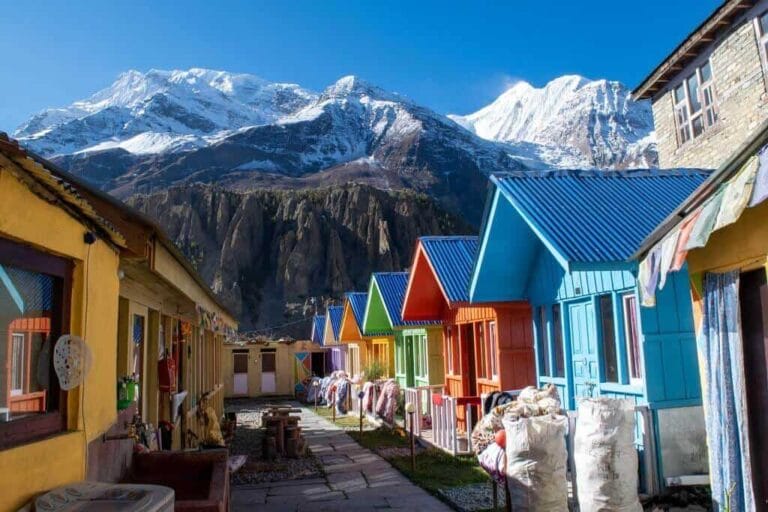
The other big difference is the way you travel. On Kilimanjaro you camp with a full crew. In Nepal you walk from village to village, sleeping in family-run teahouses, which brings you much closer to the people and culture of the mountains. Our guide to trekking in Nepal compares the main routes, from short treks to long circuits. Annapurna Base Camp (4,130 m) is a lower, gentler first Himalayan trek, while Everest Base Camp is the natural next step after Kilimanjaro. If you are new to multi-day walking, start with our explainer on hiking vs trekking, and use our EBC training guide to prepare.
When you are ready, look at our 16-day Everest Base Camp Trek or our 15-day Annapurna Base Camp Trek, both run with licensed Nepali partners. For more ideas around the world, see our pick of the best treks in the world.
Frequently asked questions
What is the highest mountain in Africa?
Kilimanjaro in Tanzania is the highest mountain in Africa. Its summit, Uhuru Peak on the Kibo crater rim, is 5,895 m above sea level.
What is the second highest mountain in Africa?
Mount Kenya is the second highest, with its main summit, Batian, at 5,199 m. Batian needs technical rock-climbing skills, but trekkers can reach Point Lenana (4,985 m) without ropes.
How long does it take to climb Kilimanjaro?
Most climbs take six to nine days, depending on the route. Short five-day trips exist, but longer routes such as Lemosho and the Northern Circuit allow better acclimatisation and give you a better chance of reaching the summit.
Can you climb Kilimanjaro without a guide?
No. Tanzania National Parks requires every climber to book through a licensed operator and climb with registered guides. Park fees are paid per person per day.
Is Kilimanjaro harder than Everest Base Camp?
Kilimanjaro’s summit is higher and the summit night is harder, but the trip is shorter. Everest Base Camp is lower but takes about two weeks, with many consecutive days at altitude. Many people find Kilimanjaro tougher on the body and EBC tougher on stamina.
Is Mount Stanley a technical climb?
Yes. Reaching Margherita Peak (5,109 m) involves glacier travel and a short rock section, so you need crampons, an ice axe, a harness and a qualified climbing guide. It is usually climbed from Uganda over seven to nine days.
Which African mountains can beginners climb?
Fit beginners with no climbing skills can trek Kilimanjaro, Point Lenana on Mount Kenya, Mount Meru and Mount Karisimbi. Good preparation, a slow ascent and an experienced guide matter more than mountaineering experience.
When is the best time to climb mountains in East Africa?
The driest months are generally January to early March and June to October. The long rains in April and May make trails muddy and summits cloudy, especially in the Rwenzori.