
For the Annapurna Base Camp trek you need kit for two climates in one bag: warm, wet, often leechy forest between roughly 1,000 m and 2,500 m, and freezing nights at Machhapuchhre Base Camp (about 3,700 m) and Annapurna Base Camp (4,130 m). Pack a four-part layering system, broken-in boots, poles for the thousands of stone steps, a sleeping bag rated to about -10°C comfort (colder in winter), a refillable bottle with water treatment, and enough cash for the whole trek.
Your porter allowance is usually 10–12 kg per trekker, so everything below is chosen to fit that limit. If you are also weighing up Everest, our Everest Base Camp packing list covers the colder, higher Khumbu, and our free printable trek packing checklist is the tick-box version for any teahouse trek in Nepal.
Annapurna Base Camp packing list at a glance
| Category | The essentials | ABC-specific reason |
|---|---|---|
| Bags | Porter duffel (60–80 L), 25–35 L daypack, rain cover, dry bags | Rain is possible in every season below Chhomrong |
| Layers | Wicking T-shirts, thermal base layer, fleece, down jacket, waterproof shell | Shorts-and-T-shirt days near Nayapul, below-freezing nights at ABC |
| Legs | 2 pairs trekking trousers, thermal leggings, waterproof overtrousers | Leech season and monsoon showers |
| Feet | Waterproof boots, 4–5 pairs of socks, sandals or lodge shoes | Wet stone steps and stream crossings |
| Trail kit | Trekking poles, head torch, 2 L water capacity, purification | Steep descents, no plastic bottles sold past Chhomrong |
| Sleep | Sleeping bag around -10°C comfort (spring/autumn), liner | Unheated rooms at MBC and ABC |
| Sun and snow | Category 3–4 sunglasses, SPF 50, sun hat, lip balm | Glare from snowfields in the Sanctuary |
| Health | Personal medication, blister kit, ORS, basic first aid | Days from a road once you pass Chhomrong |
| Money and power | Nepali rupees in cash, power bank, Type C/D adaptor | Plan for no ATMs on the trail; charging costs extra higher up |

Why packing for ABC is different
Most Nepal packing lists are written with the Everest region in mind. The Annapurna Sanctuary is lower, but in some ways it is trickier to pack for, because the climate changes so quickly over a short distance.
The temperature range is huge
Classic routes begin at Nayapul (around 1,070 m) or nearby road-heads, in terraced, subtropical farmland where daytime temperatures in spring and autumn often sit in the high teens to mid-20s°C. Four or five days later you are at ABC, where night-time temperatures in spring and autumn commonly fall to around -5°C to -10°C, and lower in winter. You will be in a T-shirt one day and a down jacket the next, so layers beat bulky single garments every time.
Rain, humidity and leeches below Chhomrong
The forest between Jhinu Danda, Sinuwa, Bamboo and Dovan is damp for much of the year. In the monsoon (roughly June to September) and the shoulder weeks either side, leeches are common on this stretch. A waterproof shell, overtrousers, a pack cover and a few dry bags are not optional, and leech socks or salt are worth adding for summer. Our guide on how to protect yourself from leeches covers what actually works.
Stone steps, all day
The Annapurna region is famous for its stone staircases: the climb to Ulleri if you go via Ghorepani, and the long drop and re-climb around Chhomrong on every route. This is hard on knees, especially going down. Trekking poles, well-fitted boots and good socks matter more here than an extra gadget. Our ABC difficulty guide explains which days are toughest.
Cold, bright and high in the Sanctuary
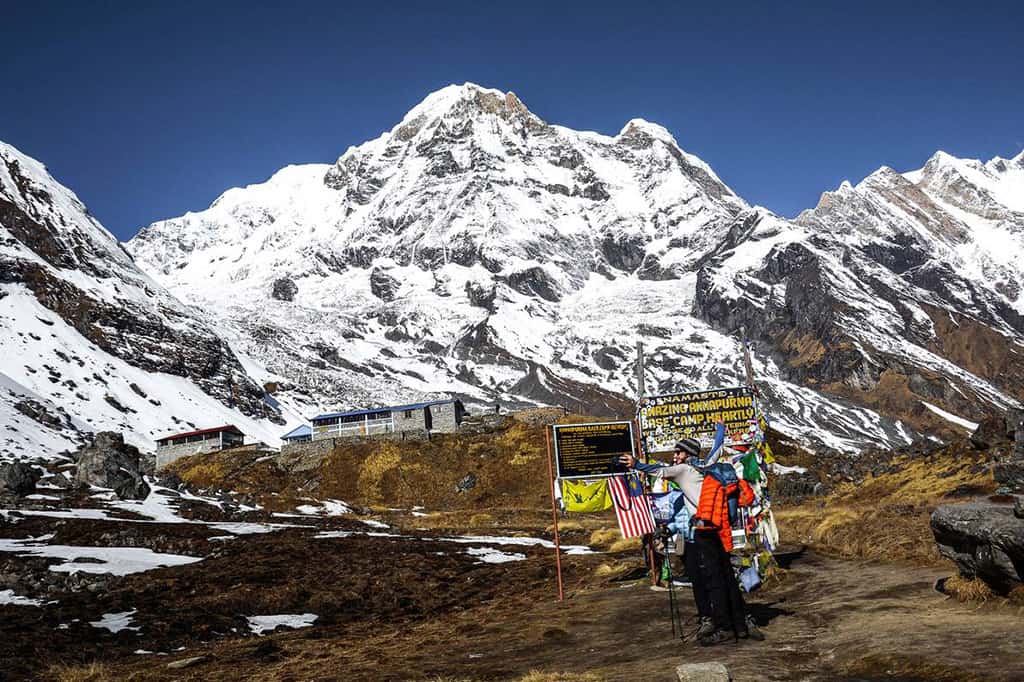
Above Deurali (about 3,200 m) the valley opens into a bowl of snow peaks. Sun reflected off snow is intense, the air is thin and the lodges at MBC and ABC are unheated. Good sunglasses, sunscreen and a proper sleeping bag earn their weight here.
How much can you take? Porter limits and bag sizes
Since 1 April 2023, foreign trekkers in the Annapurna Conservation Area must trek with a licensed guide arranged through a registered Nepali agency. Most organised ABC treks also include porters, typically one porter shared between two trekkers.
A porter carrying for two people usually takes 20–25 kg in total, which works out at about 10–12 kg per trekker for your main bag. Operators set their own limits, so check your trip notes. On our 15-day Annapurna Base Camp trek, plan on the figure in your confirmed pre-departure information and pack to the lower end if in doubt. A lighter bag is kinder to your porter and easier for you on the steps.
| Bag | Size | Target weight | Who carries it |
|---|---|---|---|
| Porter duffel | 60–80 L, soft and lockable | 10–12 kg (check your operator) | Porter |
| Daypack | 25–35 L with hip belt and rain cover | 4–6 kg including water | You |
| City bag | Small holdall or suitcase | Anything else | Left at your Pokhara or Kathmandu hotel |
Your porter walks at their own pace and may arrive before or after you, so anything you need during the day must be in your daypack.
What goes where
- Daypack: waterproof jacket, fleece or light insulated layer, water (about 2 L), purification, snacks, sunscreen, sunglasses, hat and gloves, toilet paper and hand sanitiser, small first aid kit, phone, power bank, cash for the day, passport copy and permit (your guide may carry permits).
- Porter duffel: sleeping bag, down jacket (once you are low), spare clothes, lodge shoes, toiletries, charger and adaptor, spare snacks and the rest of your cash, packed in a dry bag inside the duffel.
- Leave in Pokhara: city clothes, laptop, spare cash and cards beyond what you need, anything valuable you will not use on the trail.
Clothing: a layering system for 1,000 m to 4,130 m
Think in layers you can add or strip as the day warms up and cools down. Avoid cotton for anything you walk in: it stays wet with sweat and rain, which is miserable in the forest and dangerous in the cold higher up. Merino wool and synthetics dry faster and smell less.
Upper body
- 2–3 short-sleeved wicking T-shirts: for the warm, humid lower days.
- 1–2 long-sleeved base layers: a lightweight one for walking and a warmer thermal top kept dry for evenings and sleeping.
- 1 fleece or light synthetic insulated jacket: your main walking warmth above Himalaya (about 2,900 m) and on cool mornings.
- 1 down or synthetic insulated jacket: for evenings at MBC and ABC, and the early start for sunrise. Hooded and roughly 600-fill down or equivalent is ample for spring and autumn.
- 1 waterproof, breathable shell with hood: essential at every altitude. A long-sleeved shirt or thin layer under it also helps against insects lower down.
Lower body
- 2 pairs of trekking trousers: lightweight and quick-drying. Zip-off trousers work well on warm lower days.
- 1 pair of thermal leggings: for cold evenings and nights in the Sanctuary, or under trousers on a cold sunrise.
- 1 pair of waterproof overtrousers: light, packable and essential in monsoon and shoulder seasons.
- 4–6 pairs of underwear: quick-drying, so you can wash and dry them overnight in warmer lodges.
- Optional shorts: handy on the lower trail; modest length is more respectful in villages.
Head and hands
- Sun hat or cap with a wide brim or neck flap.
- Warm beanie for evenings and mornings.
- Buff or neck gaiter: dust, sun and cold all in one.
- Thin liner gloves for walking, plus insulated gloves or mitts for MBC, ABC and winter.
Footwear for wet stone steps
Your boots are the most important item you bring. On ABC they need grip on wet, polished stone, support on long descents and enough waterproofing for rain and stream splashes.
- Waterproof mid-cut trekking boots: broken in with at least 30–50 km of walking, including steep downhill, before you fly. Do not plan to buy or rent boots in Nepal. Our guide to choosing trekking shoes covers fit.
- 4–5 pairs of trekking socks: merino or synthetic, plus one thick warm pair kept for sleeping at altitude.
- Sandals or lightweight lodge shoes: to give your feet a break in the evenings and for the hot springs at Jhinu Danda.
- Gaiters (optional): useful in mud or leech season, and in snow after a winter or spring storm.
- Microspikes (sometimes): only needed if there is snow or ice on the trail above Deurali, which can happen in winter and early spring. Your guide will advise, and they can be rented in Pokhara.
Trim your toenails before the trek. Long nails turn the endless descents into a slow, painful business.
Sleeping bag and warmth at MBC and ABC
ABC teahouses provide a bed, a mattress, a pillow and usually a blanket, but rooms have no heating and blankets are not always clean or warm enough. Bring your own sleeping bag, or rent one in Pokhara or Kathmandu.
| Season | Suggested comfort rating | Notes |
|---|---|---|
| Spring (Mar–May) | About -5°C to -10°C | Early March is colder; late May is milder |
| Autumn (Sep–Nov) | About -10°C | Late November nights are noticeably colder |
| Winter (Dec–Feb) | About -15°C or warmer | Add a liner and sleep in thermals |
| Monsoon (Jun–Aug) | About 0°C to -5°C | Keep it in a dry bag; damp down loses warmth |
Look for the comfort rating, not the “extreme” or “limit” figure, which describes survival rather than a decent night’s sleep. A silk or fleece liner adds a few degrees and keeps a rented bag clean. A sleeping mat is not needed on a teahouse trek.
A good trick: ask for a bottle of boiling water at night, seal it well, and put it in your sleeping bag as a hot water bottle. In the morning, it is ready to drink.
Trekking poles and knee care
If you only take one piece of advice from this list, take poles. On the steps around Chhomrong and the long descent from ABC to Bamboo, poles take a real share of the load off your knees and help you balance on wet stone.
- Bring a pair of adjustable poles with rubber tips for the stone steps.
- If you have knee problems, a knee support or strapping tape is worth packing, but talk to a physio before relying on it.
- Shorten your poles going uphill and lengthen them on descents.
- Practise on stairs at home, including going down.
Water: refills, purification and the plastic rule
The Annapurna Conservation Area Project (ACAP) and local lodge committees have worked to cut plastic waste in the Sanctuary. Travel guides report that plastic bottled water is not sold beyond Chhomrong, so you need your own bottles from the start. Rules and their enforcement can change, so treat this as the norm and plan to refill rather than buy.
- Capacity: carry about 2 litres. Two 1-litre bottles, or a bottle plus a hydration bladder, work well. Insulated bottles help stop water freezing at ABC.
- Refill options: community safe-drinking-water stations have been reported at villages on the lower trail such as Ghandruk, Jhinu and Chhomrong. Lodges also sell boiled or filtered water by the litre. Prices rise with altitude; budget roughly NPR 100–200 (about £0.50–£1) a litre higher up.
- Treatment: bring purification tablets, a filter bottle or a UV pen so you can safely use tap or stream water. A filter alone does not remove viruses, so combine it with tablets or UV if you use untreated sources.
- Electrolytes: rehydration sachets help on the hot, humid lower days when you sweat heavily.
Sun and snow glare
At 4,000 m the sun is far stronger than at sea level, and the snowfields around ABC bounce it back at you. The UK FCDO advises trekkers to carry SPF 20+ sunscreen and sunglasses; we recommend going higher.
- Sunglasses with UV400 protection, category 3, or category 4 if you are sensitive to glare or trekking after snowfall. Wraparound styles block light from the sides.
- SPF 50 sunscreen and an SPF lip balm.
- A sun hat and buff to protect your ears and neck.
First aid and personal medication
Your guide will carry a basic group kit, but you should bring your own personal supplies. This is general guidance only: speak to your doctor or a travel clinic about vaccinations, medicines and whether altitude medication is right for you.
- Any prescription medicines, with extra for delays, in original packaging, plus a copy of the prescription.
- Blister plasters, zinc oxide tape and a small pair of scissors.
- Painkillers you know you tolerate.
- Oral rehydration salts.
- Anti-diarrhoea and indigestion remedies, as advised by your doctor.
- Antiseptic wipes or cream and a few dressings.
- Throat lozenges: the dry, cold air at altitude often causes a cough.
- Insect repellent for the lower, warmer trail.
- Altitude medication only if prescribed. It is not a substitute for a sensible ascent, and descending is the treatment if symptoms worsen.
Toiletries and hygiene
- Biodegradable soap or a small bottle of travel wash.
- Quick-dry travel towel.
- Toothbrush and small toothpaste.
- Wet wipes (pack used ones out) and hand sanitiser.
- Toilet paper: not always provided in lodge toilets. Pack used paper out where there are no bins.
- Small zip bags for rubbish.
- Moisturiser: the air in the Sanctuary is dry and cold.
- Earplugs: teahouse walls are thin.
Hot showers are available at most lodges on the lower trail and some higher up, usually for a small fee, often a few hundred rupees. At MBC and ABC, many trekkers skip showering altogether because of the cold.
Electronics, charging and connectivity
Nepal uses 230 V with Type C, D and M sockets, so bring a universal adaptor. Most lodges charge for charging devices, and the price goes up with altitude. Reports put it at roughly NPR 200–400 (about £1–£2) per device higher up. Some upper lodges rely on solar power, so charging may be limited in bad weather.
- Phone and charging cable.
- Power bank of 10,000–20,000 mAh to cut down on paid charging.
- Head torch with spare batteries or a charging cable: you will need it for the pre-dawn walk if you go to Poon Hill, and at night in lodges.
- Camera and spare batteries. Cold drains batteries fast, so keep them in your sleeping bag at night.
Wi-Fi is available at many lodges, usually for a fee, but it is slow and unreliable in the Sanctuary. A Nepali SIM card bought in Kathmandu or Pokhara gives you data on parts of the trail, though coverage has gaps.
Documents, cash and ATMs
Budget for cash, because lodges on the trail do not take cards and you should not count on finding a working ATM after the road-head. There are occasional reports of machines in larger villages, but they are not reliable. Withdraw what you need in Pokhara before you set off, in a mix of notes, including small ones.
- Passport, valid for at least six months, plus your Nepal visa.
- Photocopies or photos of your passport, visa, insurance and permits, stored separately from the originals.
- Travel insurance details. Your policy should cover trekking to 4,130 m and helicopter evacuation. Read do I need travel insurance for trekking?
- Your ACAP permit (NPR 3,000, about £15, for most foreign nationals), usually arranged by your agency. TIMS card requirements have changed several times; sources conflict on whether it is still needed for ABC, so your agency will confirm what applies at the time.
- Cash in Nepali rupees for extras such as drinks, snacks, charging, Wi-Fi, showers and tips. On an all-inclusive organised trek, around NPR 2,000–3,000 (£10–£15) a day for extras is a reasonable guide, before tips.
Our Annapurna Base Camp trek cost guide breaks down permits, guide fees and daily spending in more detail.
Snacks
Lodges sell chocolate bars and biscuits, but prices rise the higher you go and choice is limited. Bring a few favourite snacks from home or buy in Pokhara: nuts, dried fruit, energy bars and electrolyte sachets. A few treats on the cold day up to ABC go a long way.
Women-specific packing list
Women trekkers can pack mostly the same kit, with a few additions that make life easier on the trail and in basic lodges.
- 2–3 supportive sports bras that are comfortable under a rucksack hip belt and straps.
- Menstrual products for the whole trek plus a spare margin, as altitude and exertion can change your cycle. A menstrual cup or period pants reduce waste; bring opaque bags for packing out used products. See our guide to trekking on your period.
- A pee funnel or cloth, useful where toilets are far apart.
- A sarong or lightweight scarf: privacy screen, towel, shawl and cover-up for villages and the Jhinu hot springs.
- Modest clothing for villages: shoulders covered and shorts or skirts at knee length or longer.
- Hair ties, a small brush and dry shampoo.
- Any medication for urinary tract infections that your doctor is happy to prescribe, as dehydration makes them more likely.
Season-by-season adjustments
The core list stays the same year-round. These are the changes to make for each season. For the full picture, see our guide to the best time to trek Annapurna Base Camp.
| Season | Conditions | Add or change |
|---|---|---|
| Spring (Mar–May) | Mild lower trail, rhododendrons in bloom, afternoon cloud and showers, possible late snow at ABC early in the season | Light rain gear handy every afternoon; microspikes if your guide reports snow; strong sun protection |
| Monsoon (Jun–Aug, into September) | Hot, humid and wet below Chhomrong; leeches; slippery steps; clouds often hide the peaks; landslides can affect roads | Full waterproofs, pack cover, dry bags for everything, leech socks or salt, quick-dry clothes, extra socks, insect repellent |
| Autumn (Sep–Nov) | Most stable weather and clearest views; cold nights higher up, getting colder through November; busiest season | Standard list; warmer bag and gloves for late November |
| Winter (Dec–Feb) | Cold and mostly dry; snow and ice above Deurali; fewer lodges open higher up; avalanche risk on the stretch between Deurali and MBC after heavy snow | Sleeping bag around -15°C comfort, warmer down jacket, insulated mitts, microspikes, gaiters, insulated bottles |
The UK FCDO notes that the monsoon normally runs from June and can bring flooding and landslides that close roads at short notice. Pack with delays in mind: a spare day’s medication and some extra cash.
What to rent or buy in Pokhara and Thamel
Most ABC treks start from Pokhara, and the Lakeside area has many trekking shops. Thamel in Kathmandu has even more. Renting the bulky items saves luggage space on your international flight and money on gear you may only use once.
| Item | Typical rental per day | Approximate GBP | Rent or bring? |
|---|---|---|---|
| Sleeping bag | NPR 200–330 | £1–£1.65 | Rent is fine; check the comfort rating and smell it |
| Down jacket | NPR 200–400 | £1–£2 | Rent is fine; check zips and fill |
| Trekking poles (pair) | About NPR 150 | About £0.75 | Rent or bring; test the locks |
| Microspikes | About NPR 150 | About £0.75 | Rent only if needed |
| Rucksack or duffel | NPR 150–200 | £0.75–£1 | Many operators lend a duffel; ask first |
| Waterproof jacket or trousers | About NPR 150 each | About £0.75 | Better to bring your own |
| Boots | About NPR 300 | About £1.50 | Bring your own, broken in |
These rates are indicative, based on 2025–26 Pokhara shop surveys. Shops usually ask for a deposit (often several thousand rupees, sometimes more for expedition-grade items) or a passport copy. Agree the return date, deposit and any damage terms before you leave the shop, and keep the receipt. Bargaining of 10–20% is normal, especially for longer rentals.
Buy and test these at home: boots, socks, base layers, underwear, sports bras, daypack, sunglasses and water treatment. Locally made fleeces, hats, gloves and buffs are cheap in Pokhara and Thamel and fine for a teahouse trek, but quality varies, and “branded” items are often copies.
What not to pack
- Cotton jeans and hoodies: heavy, slow to dry, cold when wet.
- Brand-new boots.
- Large toiletry bottles: decant into small containers.
- A tent, stove or camping kit: ABC is a teahouse trek.
- Too many spare clothes: you will wear the same trousers for days, and that is normal.
- Expensive jewellery or unnecessary valuables.
- Single-use plastic water bottles you plan to bin on the trail.
Printable Annapurna Base Camp packing checklist
Use this table as your final check. Quantities assume a 10–14 day trek in spring or autumn. For a tick-box version you can print or save as a PDF, use our free trek packing checklist.
| Item | Qty | Notes |
|---|---|---|
| Porter duffel bag | 1 | 60–80 L, lockable; often lent by your operator |
| Daypack with rain cover | 1 | 25–35 L with hip belt |
| Dry bags or liners | 2–4 | Sleeping bag, clothes, electronics |
| Short-sleeved wicking T-shirts | 2–3 | No cotton |
| Long-sleeved base layers | 1–2 | Keep one dry for evenings |
| Fleece or light insulated jacket | 1 | Main walking warmth higher up |
| Down or synthetic jacket | 1 | Hooded; can be rented |
| Waterproof shell jacket | 1 | With hood; essential in every season |
| Trekking trousers | 2 | Quick-dry; zip-offs useful |
| Thermal leggings | 1 | For MBC and ABC nights |
| Waterproof overtrousers | 1 | Essential in monsoon |
| Underwear | 4–6 | Quick-drying |
| Sports bras (if needed) | 2–3 | Comfortable under pack straps |
| Trekking boots | 1 pair | Waterproof, broken in |
| Trekking socks | 4–5 pairs | Plus one warm pair for sleeping |
| Sandals or lodge shoes | 1 pair | Evenings and hot springs |
| Gaiters | 1 pair | Optional; mud, leeches, snow |
| Microspikes | 1 pair | Only if snow or ice is reported |
| Sun hat | 1 | Wide brim or neck flap |
| Warm hat | 1 | For evenings and mornings |
| Buff or neck gaiter | 1–2 | Sun, dust and cold |
| Liner gloves | 1 pair | For walking |
| Insulated gloves or mitts | 1 pair | Essential in winter |
| Sunglasses | 1 | UV400, category 3–4 |
| Sleeping bag | 1 | About -10°C comfort; -15°C in winter |
| Sleeping bag liner | 1 | Extra warmth, keeps rentals clean |
| Trekking poles | 1 pair | With rubber tips |
| Head torch | 1 | Plus spare batteries or cable |
| Water bottles | 2 x 1 L | At least one insulated |
| Water treatment | 1 set | Tablets, filter or UV pen |
| Sunscreen and lip balm | 1 each | SPF 50 |
| Personal first aid kit | 1 | Blister kit, painkillers, ORS, own medicines |
| Insect repellent | 1 | Lower trail; leech salt in summer |
| Toiletries | 1 kit | Travel size, biodegradable soap |
| Quick-dry towel | 1 | Small or medium |
| Toilet paper and hand sanitiser | 1 each | Plus zip bags for rubbish |
| Power bank | 1 | 10,000–20,000 mAh |
| Universal adaptor | 1 | Type C/D sockets |
| Passport, visa, insurance, copies | 1 set | Copies stored separately |
| Cash in Nepali rupees | Enough for the whole trek | Withdraw in Pokhara |
| Snacks | To taste | Nuts, bars, electrolyte sachets |
Do the 10-minute weigh-in test
Two weeks before you fly, pack your duffel exactly as you would on the trail and weigh it. If it is over the limit, the usual culprits are spare clothes, full-size toiletries and electronics. Then walk for an hour with your loaded daypack, ideally including stairs, to check the hip belt, the straps and your boots together.
Ready to trek?
Our 15-day Annapurna Base Camp trek runs via Ghorepani and Poon Hill with licensed guides, porters and permits arranged by our ground partners in Nepal. Use our ABC itinerary guide to see how each day unfolds. Prefer a different trek or dates? Tell us what you have in mind and we can arrange a tailor-made trek.
Frequently asked questions
What should I pack for the Annapurna Base Camp trek?
Pack a layering system (wicking T-shirts, thermal base layer, fleece, down jacket and waterproof shell), two pairs of trekking trousers, thermal leggings, waterproof overtrousers, broken-in waterproof boots, trekking poles, a head torch, a sleeping bag rated to about -10°C comfort, 2 litres of water capacity with purification, sun protection, a personal first aid kit and enough Nepali rupees in cash for the trek.
How heavy should my bag be for Annapurna Base Camp?
Most operators allow about 10–12 kg per trekker in the porter duffel, with one porter shared between two people. Keep your daypack to around 4–6 kg including water. Check the exact limit in your trip notes, as it varies by operator.
Do I need a sleeping bag for Annapurna Base Camp?
Yes, for most trekkers. Lodges give you a bed, mattress and usually a blanket, but rooms at Machhapuchhre Base Camp and ABC are unheated and nights drop well below freezing. A bag rated to about -10°C comfort suits spring and autumn; go to around -15°C in winter. You can rent one in Pokhara for roughly NPR 200–330 (£1–£1.65) a day.
Can I rent trekking gear in Pokhara?
Yes. Lakeside in Pokhara has many rental shops for sleeping bags, down jackets, poles, microspikes and duffels, usually for NPR 150–400 (about £0.75–£2) a day per item plus a deposit. Bring your own boots, socks, base layers and waterproofs, as these need to fit well and be reliable.
Are there ATMs on the Annapurna Base Camp trek?
Do not count on any. Lodges on the trail work in cash, and any machines in larger villages are not reliable. Withdraw enough Nepali rupees in Pokhara before you start to cover drinks, snacks, charging, showers, Wi-Fi and tips.
Can I buy bottled water on the ABC trek?
Plastic bottled water is reportedly not sold beyond Chhomrong in the Annapurna Sanctuary, so bring reusable bottles. Refill with boiled or filtered water from lodges or community safe-water stations on the lower trail, or treat tap water with tablets, a filter or a UV pen.
Do I need crampons for Annapurna Base Camp?
Usually not. Microspikes are only needed when snow or ice covers the trail above Deurali, which is most likely in winter and early spring. Your guide will tell you before you leave Pokhara, and microspikes can be rented there for around NPR 150 (about £0.75) a day.
What should women pack for trekking in Nepal?
Add 2–3 supportive sports bras, menstrual products for the whole trek plus spare (or a cup or period pants), opaque bags to pack out used products, a pee funnel or cloth, a sarong or scarf for privacy and village visits, and modest clothing that covers shoulders and knees.