

The Annapurna Base Camp trek is moderate: no climbing skills are needed, but you walk 5–7 hours a day for a week or more, on thousands of stone steps, up to an altitude of 4,130 m (13,550 ft). Most reasonably fit, well-prepared beginners can do it, provided they train beforehand and ascend at a sensible pace.
The challenge comes from three things working together: steep ups and downs on uneven steps, consecutive long days, and the thinner air above 3,000 m. This guide covers the height, distance, altitude profile, hardest days and how to prepare. For the full route overview, see our Annapurna Base Camp trek guide.
Annapurna Base Camp trek difficulty at a glance
| Factor | What to expect |
|---|---|
| Overall grade | Moderate; harder than Poon Hill, easier than Everest Base Camp |
| Annapurna Base Camp height | 4,130 m (13,550 ft) |
| Total walking distance | About 55–70 km with jeep transfers at both ends; about 100–115 km walking the full route from Nayapul via Poon Hill |
| Trekking days | Typically 6–11 days, depending on route and road use |
| Daily walking | Usually 5–7 hours; 4–5 hours on the higher days |
| Technical skills | None in the main seasons; microspikes may help on snow in winter |
| Terrain | Stone steps, forest trails, river crossings on bridges, moraine near ABC |
| Altitude sickness risk | Moderate; most people feel the altitude above 3,000 m |
| Accommodation | Teahouse lodges throughout; basic and cold higher up |
| Guide | Licensed guide required for foreign trekkers in the Annapurna region since April 2023 |
How high is Annapurna Base Camp?
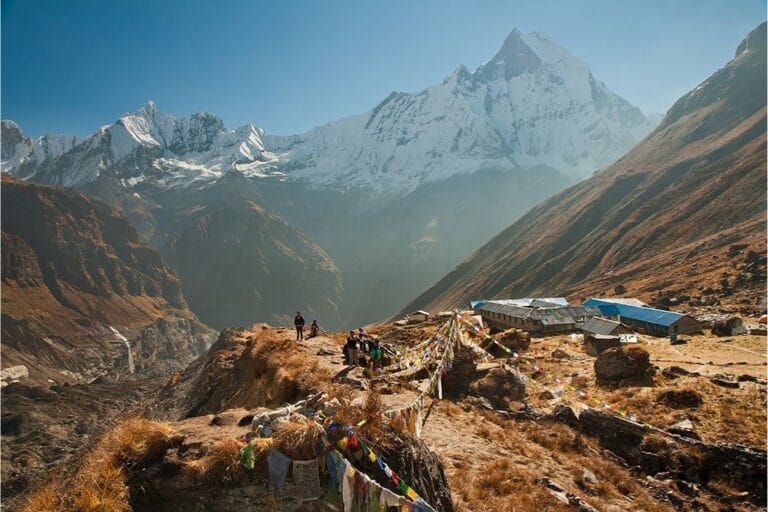
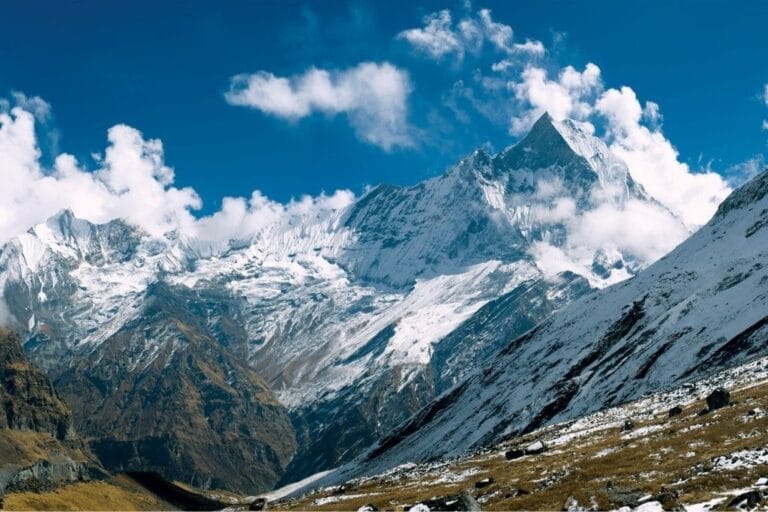
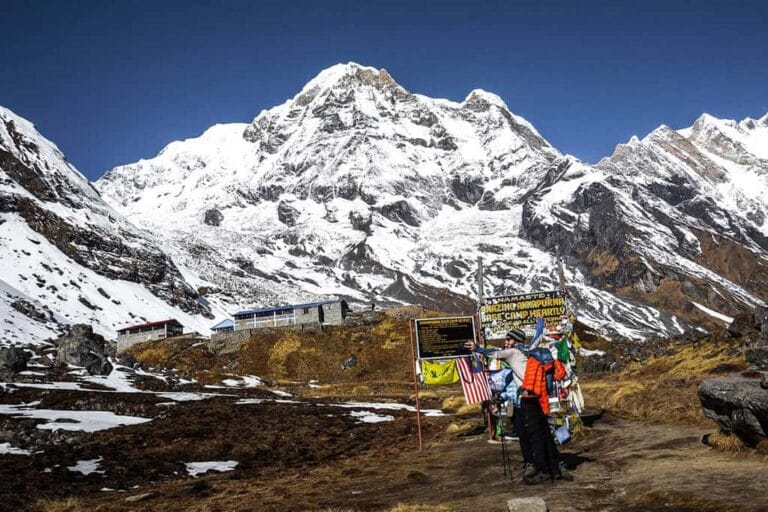
Annapurna Base Camp stands at 4,130 m (13,550 ft) above sea level, at the head of the Modi Khola valley in the Annapurna Sanctuary. It is the highest point of the trek and where most itineraries spend one night. The base camp sits below the south face of Annapurna I (8,091 m), the tenth-highest mountain in the world.
For context, ABC is about 1,200 m lower than Everest Base Camp (5,364 m) and about 1,300 m lower than Thorong La (5,416 m) on the Annapurna Circuit. That lower maximum is a large part of why ABC is considered more achievable for first-time high-altitude trekkers.
Annapurna Base Camp trek distance
There is no single distance for the trek, because roads now reach several points along the lower route. The table shows typical round-trip walking distances. Figures vary between sources by 10–20 km, depending on exact start and end points and whether side trips are counted.
| Route option | Typical walking distance (round trip) | Trekking days |
|---|---|---|
| Jeep from Pokhara to Siwai or Jhinu Danda, straight up the Modi Khola to ABC and back | About 55–70 km (34–43 miles) | 6–8 |
| Jeep to Ghandruk, via Chhomrong to ABC, return via Jhinu | About 70–85 km (43–53 miles) | 7–9 |
| Full walk: Nayapul, Ulleri, Ghorepani, Poon Hill, Tadapani, Chhomrong, ABC, return via Jhinu | About 100–115 km (62–71 miles) | 10–12 |
Daily stages are rarely more than 10–15 km, but distance is a poor guide to effort here. A 7 km day on steep steps can feel harder than a 15 km day on flatter ground. Our Annapurna Base Camp itinerary guide sets out day-by-day stages for each route.
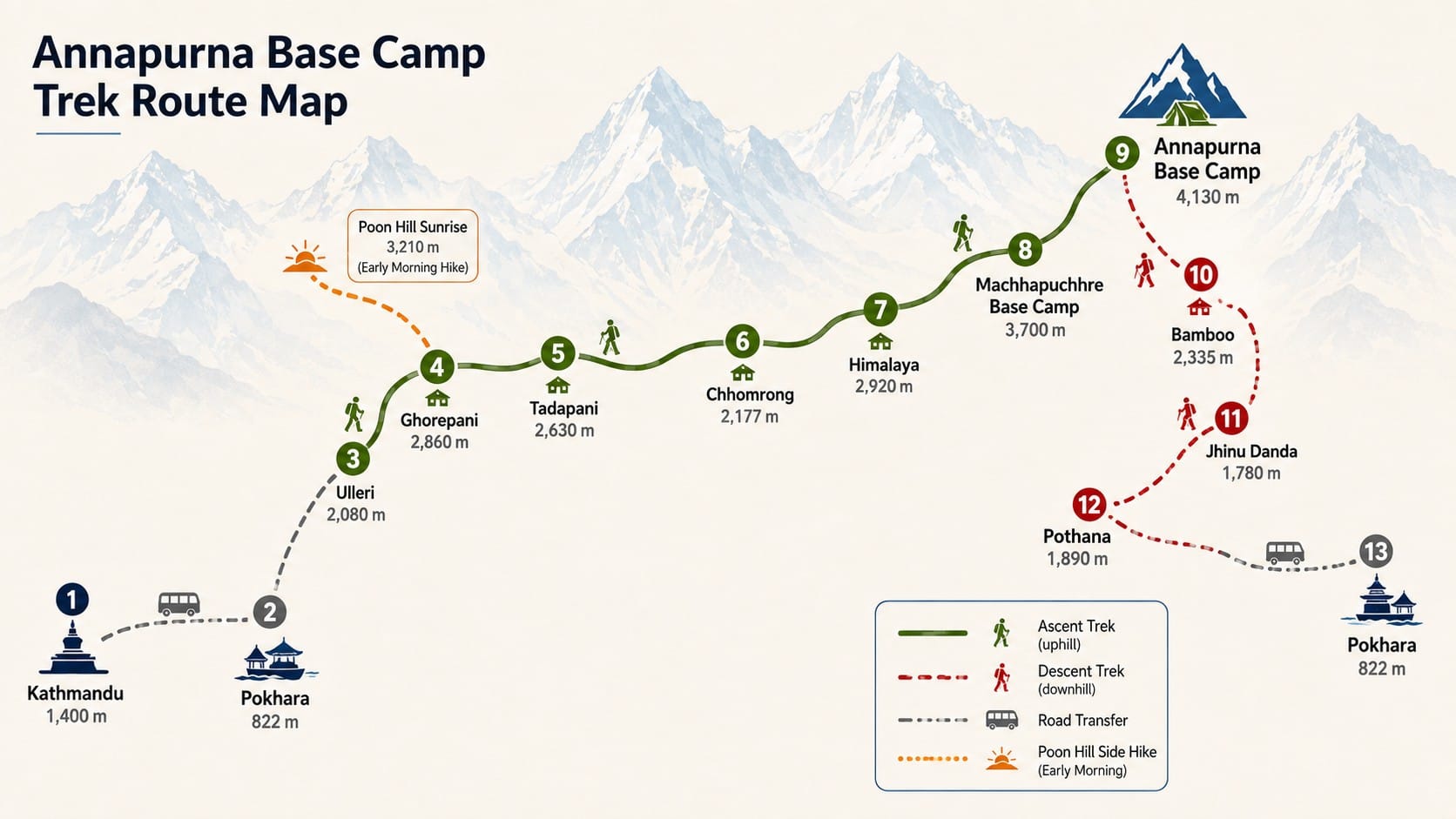
Annapurna Base Camp elevation profile
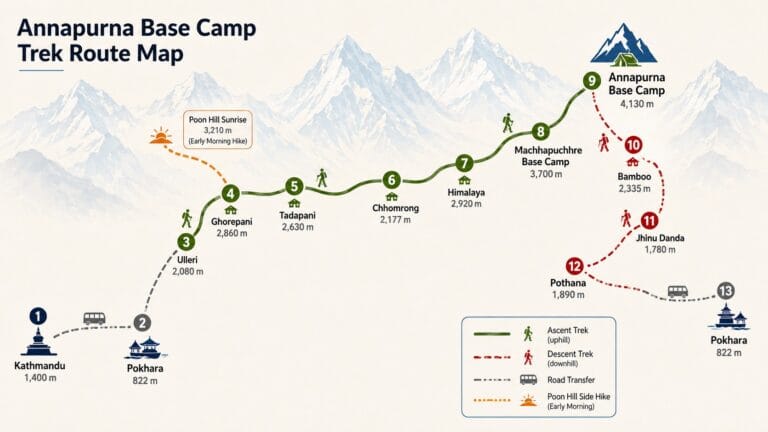
The ABC trek is not a steady climb. You gain and lose height repeatedly, especially on the Poon Hill loop and around Chhomrong, before the long, steady ascent of the Modi Khola gorge to the sanctuary. Altitudes below are approximate; published figures differ by up to 100 m.
| Point | Altitude (approx.) | Notes |
|---|---|---|
| Pokhara | 820 m | Start and finish |
| Nayapul / Birethanti | 1,050–1,100 m | Traditional trailhead; ACAP checkpoint at Birethanti |
| Tikhedhunga | 1,540 m | Foot of the Ulleri steps |
| Ulleri | 2,020 m | Top of the long stone staircase |
| Ghorepani | 2,860 m | Rhododendron ridge village |
| Poon Hill | 3,210 m | Pre-dawn sunrise viewpoint |
| Tadapani | 2,630 m | Forest junction |
| Ghandruk (alternative start) | 1,940 m | Large Gurung village, road access |
| Chhomrong | 2,170 m | Last large village; steps down to the river |
| Sinuwa | 2,360 m | After the climb from Chhomrong Khola |
| Bamboo | 2,310 m | Forest lodges in the gorge |
| Dovan | 2,600 m | Small lodge cluster |
| Himalaya | 2,920 m | Start of the avalanche-prone section |
| Deurali | 3,230 m | Valley narrows and opens towards the sanctuary |
| Machhapuchhre Base Camp (MBC) | 3,700 m | Common last night before ABC |
| Annapurna Base Camp | 4,130 m | Highest point |
| Jhinu Danda | 1,780 m | Hot springs by the river; road access |
The figure that matters most for altitude is the climb from Chhomrong (2,170 m) to ABC (4,130 m): nearly 2,000 m of gain, usually in three days. Including the Poon Hill loop and the return, the total cumulative ascent of the full trek is commonly estimated at around 5,000 m or more.
What makes the ABC trek hard?
The stone steps
Steps are the defining feature of the ABC trek. If you start via Poon Hill, the staircase from Tikhedhunga to Ulleri is often quoted at around 3,300 steps and climbs about 500 m in one push. Around Chhomrong, you descend a long flight of steps to the Chhomrong Khola suspension bridge and climb straight back up to Sinuwa, then repeat it in reverse on the way down. These sections test calves, thighs and especially knees.
Repeated ups and downs
Between Ghorepani and Chhomrong, and again between Chhomrong and Bamboo, the trail rises and falls repeatedly through forest. On paper the net gain may be small; in practice you might climb 700 m and descend 400 m in a day. This is why the trek feels harder than its maximum altitude suggests.
Consecutive long days
Walking 5–7 hours is manageable for one day. Doing it for eight to ten days in a row, with limited recovery at altitude, is the real endurance test. Fitness for back-to-back days matters more than speed.
Altitude above 3,000 m
From Deurali upwards, the air has noticeably less oxygen. Walking pace slows, breathing is harder on climbs and sleep can be disturbed. At ABC, each breath holds roughly 60% of the oxygen it would at sea level.
Cold and basic lodges
Lodges at MBC and ABC are simple, with shared rooms in peak season and no heating apart from a dining-room stove. Cold nights affect sleep, which affects recovery. See our month-by-month guide to the best time to trek Annapurna Base Camp for typical temperatures.
Which days are the hardest?
| Section | Why it is demanding |
|---|---|
| Tikhedhunga to Ulleri and Ghorepani (Poon Hill route) | The Ulleri staircase, then a further steady climb through forest to 2,860 m: well over 1,000 m of ascent on one of the first days |
| Poon Hill sunrise and on to Tadapani | Pre-dawn start, 350 m climb in the dark, then a long day of ups and downs |
| Chhomrong to Bamboo or Himalaya | Steep descent to the river and immediate climb to Sinuwa; long forest stretches with roots and wet rock |
| Deurali or MBC to Annapurna Base Camp | Altitude: a gentle gradient, but every step feels slower above 3,700 m |
| ABC down to Bamboo | About 1,800–1,900 m of descent in a day; hard on knees and quads |
| Return climb into Chhomrong (or Jhinu to Landruk) | After days of descent, a steep staircase climb at the end of the trek |
Trekking poles make a real difference on the descents. Our guide on how to pick trekking poles explains what to look for, and good boots matter too: see how to choose trekking shoes.
Altitude sickness risk on the ABC trek
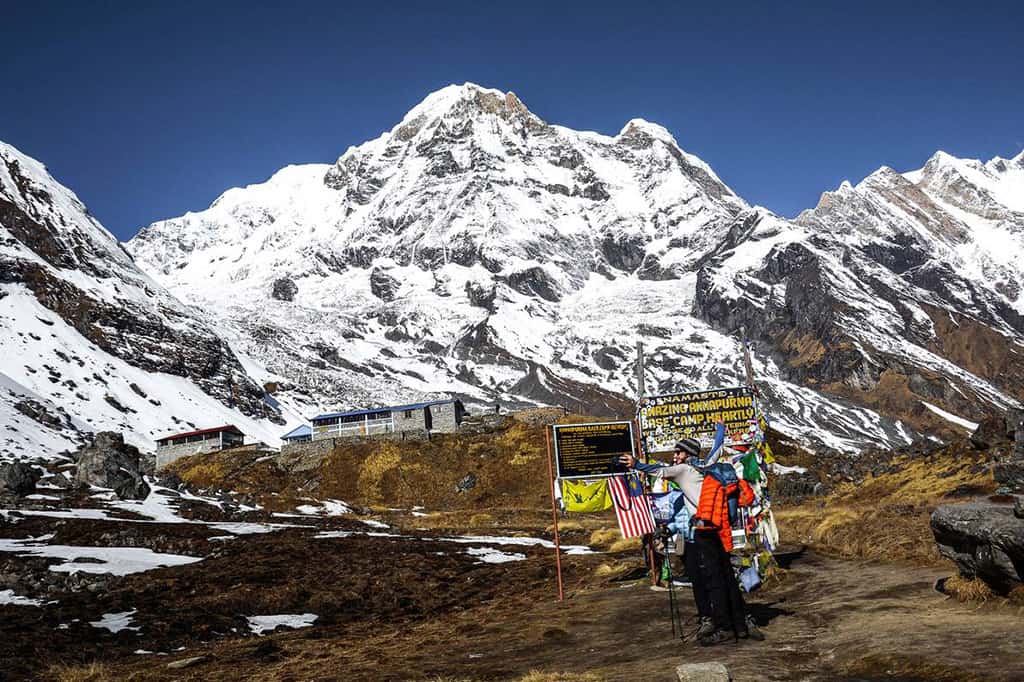
Acute mountain sickness (AMS) can affect anyone above about 2,500 m, regardless of fitness. On the ABC trek, most people notice the altitude from Deurali (3,230 m) upwards. Mild symptoms such as headache, poor appetite and disturbed sleep are common at MBC and ABC. Serious altitude illness (HACE or HAPE) is less common at 4,130 m than on higher treks, but it does happen.
The main risk factor on ABC is speed of ascent. Because the trek is shorter than EBC and the maximum altitude is lower, itineraries often climb quickly, for example from Bamboo (2,310 m) to Deurali (3,230 m) and then straight to ABC. International mountain medicine guidance, such as the Wilderness Medical Society’s, suggests that above 3,000 m you should not increase your sleeping altitude by more than about 500 m a day. Most ABC itineraries exceed that on one or two days, so pacing matters.
- Spend your last night before ABC at MBC (3,700 m) rather than Deurali if you can.
- Walk slowly, drink regularly and avoid alcohol at altitude.
- Tell your guide about any symptoms early. Worsening headache, vomiting, confusion, unsteady walking or breathlessness at rest are reasons to descend.
- Discuss acetazolamide (Diamox) with your doctor before travel; it is a prescription medicine.
- Check your travel insurance covers trekking to 4,130 m and helicopter evacuation.
Our altitude sickness guide was written for Everest but the symptoms, prevention and response apply equally to the Annapurna Sanctuary.
Can beginners do the Annapurna Base Camp trek?
Yes. ABC is one of the most popular first multi-day treks in Nepal, and many trekkers with no previous high-altitude experience complete it. What matters is preparation, a realistic itinerary and a willingness to walk slowly. Our guide to trekking for beginners covers the basics.
Signs you are ready
- You can walk 5–6 hours with a light daypack, with a few hundred metres of climbing, and feel fine the next day.
- You can climb several flights of stairs repeatedly without knee pain.
- You are comfortable with basic lodges, shared bathrooms and simple food for a week or more.
When to get more advice
If you have heart or lung conditions, knee problems, or a history of altitude illness, talk to your doctor before booking. A shorter trek such as Poon Hill is a good first step if you are unsure.
Annapurna Base Camp difficulty compared with other treks
| Trek | Max altitude | Typical trekking days | Approx. distance | Difficulty | Main challenge |
|---|---|---|---|---|---|
| Poon Hill (Ghorepani) | 3,210 m | 3–5 | About 35–50 km | Easy to moderate | Ulleri steps |
| Mardi Himal | About 4,200–4,500 m (viewpoint / base camp) | 4–6 | About 40–55 km | Moderate | Steep ridge, exposed high camp, fast ascent |
| Annapurna Base Camp | 4,130 m | 6–11 | About 55–115 km | Moderate | Steps, ups and downs, altitude |
| Everest Base Camp | 5,364 m (Kala Patthar higher) | 12–14 | About 130 km from Lukla | Moderate to challenging | Altitude, cold, length |
| Annapurna Circuit | 5,416 m (Thorong La) | 10–16 | About 150–230 km, depending on road use | Challenging | High pass, long days, altitude |
ABC sits in the middle: a clear step up from Poon Hill, and a gentler introduction to altitude than EBC or the Annapurna Circuit. For a detailed head-to-head, read our Annapurna Base Camp vs Everest Base Camp comparison.
How itinerary and support change the difficulty
Route choice
Taking a jeep to Siwai or Jhinu Danda removes the Poon Hill loop and the Ulleri steps, saving two to three days. It also means a faster climb to altitude, with less time to acclimatise. The longer route via Poon Hill is harder in total but spreads the ascent more gently.
Porters and pack weight
Carrying only a daypack of 5–7 kg makes a large difference on the steps. Most organised treks include porters, usually one for every two trekkers.
Season
Wet steps in the monsoon and snow above Deurali in winter both make the trek harder. In winter, heavy snowfall can close the Deurali–MBC section because of avalanche risk.
Guide
A licensed guide is required for foreign trekkers in the Annapurna region and makes the trek safer: guides know where to rest, how to manage the descent, and when altitude symptoms need action. Our Annapurna Base Camp trek uses a licensed guide and porter support, with 15 days in total including the Poon Hill route.
How to train for the Annapurna Base Camp trek
Start training 8–12 weeks before you fly. The aim is to build leg strength for steps, endurance for consecutive days and confidence on descents. Our full guide on how to get in shape for trekking has a detailed plan; the key elements are:
- Weekly long walks: build up to 5–6 hours on hilly ground, ideally on two consecutive days.
- Stairs or step-ups: two to three sessions a week, with a light pack, building to 45–60 minutes.
- Descents: practise walking downhill steadily; strong quads protect your knees.
- Leg and core strength: squats, lunges, step-downs and planks twice a week.
- Cardio: cycling, running or swimming for 30–45 minutes, two to three times a week.
- Kit testing: wear your boots and daypack on training walks well before the trek.
Questions to ask before booking
- Where does the itinerary sleep the night before ABC: Deurali or MBC?
- Is there a spare day for weather or slow acclimatisation?
- How much does the porter carry for me, and what is the weight limit?
- What is the plan if someone in the group develops altitude symptoms?
- Is the guide licensed, and are permits included?
Our Annapurna Base Camp trek cost guide sets out what permits, guides and lodges cost so you can compare quotes.
Frequently asked questions
How hard is the Annapurna Base Camp trek?
It is a moderate trek. You need good general fitness to walk 5–7 hours a day for a week or more on steep stone steps, and you must manage altitude up to 4,130 m. No technical climbing is involved in the main seasons.
How high is Annapurna Base Camp in feet?
Annapurna Base Camp is 13,550 ft (4,130 m) above sea level.
How long is the Annapurna Base Camp trek in km?
Using jeeps to Siwai or Jhinu Danda, the round-trip walk is about 55–70 km. Walking the full route from Nayapul via Poon Hill and back is about 100–115 km. Exact figures vary by source and start point.
Is Annapurna Base Camp harder than Everest Base Camp?
Generally no. EBC is higher (5,364 m), longer and colder, so altitude is a bigger factor. ABC has more steep steps and up-and-down sections in a shorter time, so some trekkers find individual days just as tiring, but overall EBC is the harder trek.
Can a beginner do the Annapurna Base Camp trek?
Yes, with preparation. Many first-time trekkers reach ABC. Train for 8–12 weeks with long hill walks and stair work, choose an itinerary that sleeps at MBC before ABC, and trek with a licensed guide.
Do people get altitude sickness at Annapurna Base Camp?
Yes, mild altitude sickness is common at MBC (3,700 m) and ABC (4,130 m), particularly on fast itineraries. Serious cases are less common than on higher treks but do occur. Ascend steadily, report symptoms early and descend if they worsen.
How many steps are there on the ABC trek?
There is no official count. The staircase from Tikhedhunga to Ulleri on the Poon Hill route is often quoted at around 3,300 steps, and there are long flights around Chhomrong and Sinuwa. Over the whole trek, you climb and descend many thousands of steps.
How fit do you need to be for Annapurna Base Camp?
You should be able to walk 5–6 hours on hilly terrain with a light pack and recover well overnight. Leg strength for steps and descents matters more than running speed. Trekkers starting from a lower fitness level can still succeed with a longer itinerary and proper training.