
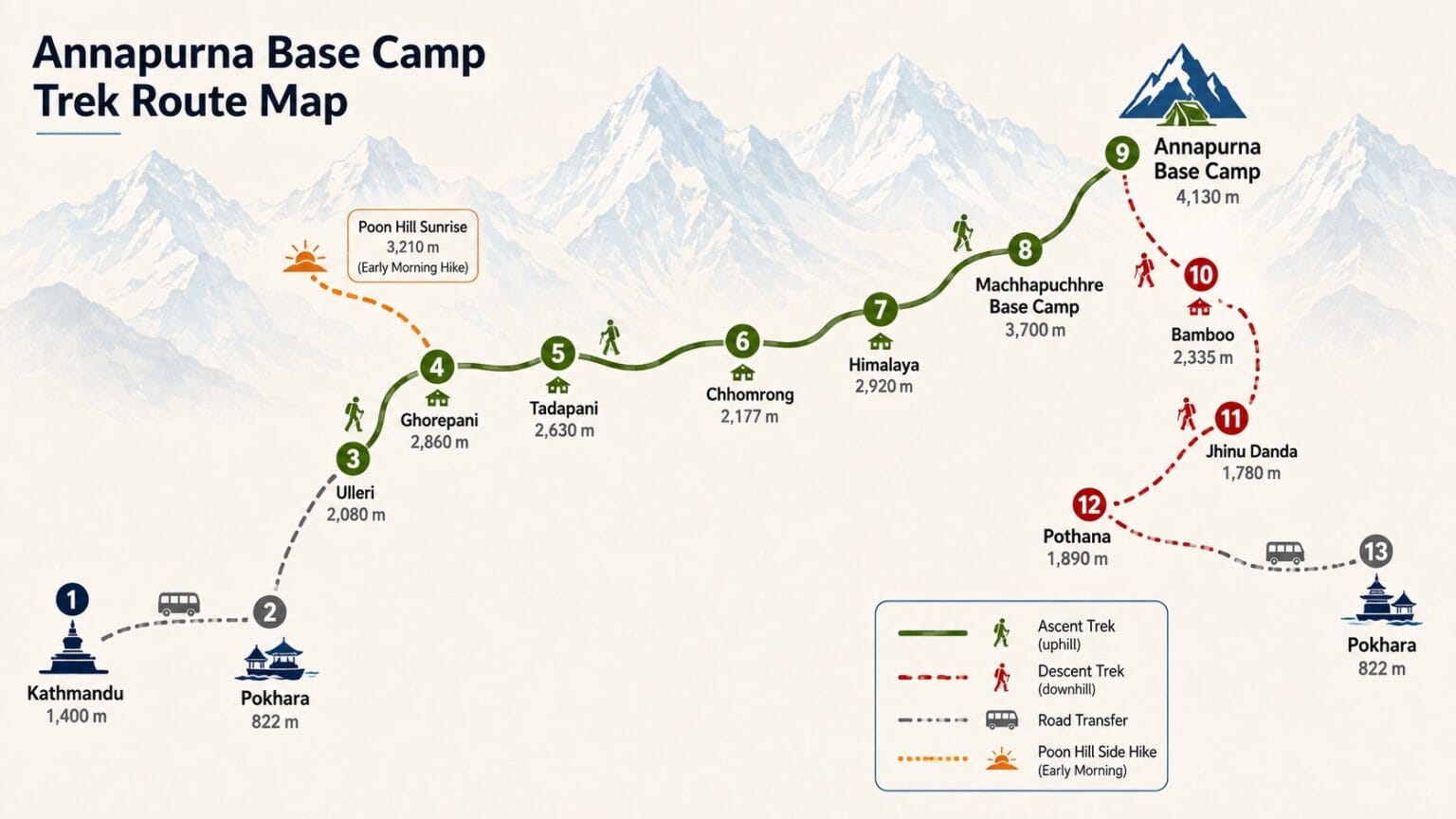
Most people trek to Annapurna Base Camp (4,130 m) in 7 to 10 days from Pokhara, or 10 to 14 days door to door from Kathmandu. Thanks to jeep roads up the Modi Khola valley, a fit, experienced trekker can do it in 5 days, while adding Poon Hill and Ghandruk turns it into a relaxed 10- to 12-day loop.
Below are four tried-and-tested itineraries with day-by-day tables showing route, overnight altitude, walking time and approximate distance, plus advice on jeep roads, acclimatisation and which option to choose. For permits, background and a route overview, see our main Annapurna Base Camp trek guide.
ABC itinerary options at a glance
| Option | Start and finish | Trailheads | Approx. walking distance | Best for |
|---|---|---|---|---|
| 5 days | Pokhara to Pokhara | Jeep to and from Jhinu Danda | 45–55 km | Fit trekkers short on time, ideally already acclimatised |
| 7 days | Pokhara to Pokhara | Jeep to and from Jhinu Danda or Siwai | 50–60 km | Most people with a week to spare |
| 10 days | Pokhara to Pokhara | Nayapul in, Jhinu Danda out | 80–95 km | ABC with Poon Hill sunrise and Ghorepani |
| 12 days | Pokhara to Pokhara | Nayapul in, Ghandruk out | 85–100 km | A slower pace, better acclimatisation, more village time |
Add two days for Kathmandu (arrival and the drive or flight to Pokhara) and at least one spare day before your flight home. Distances on this trail vary a lot between sources because of road extensions and route variations, so treat all figures as approximate.
Annapurna Base Camp route, map and distance
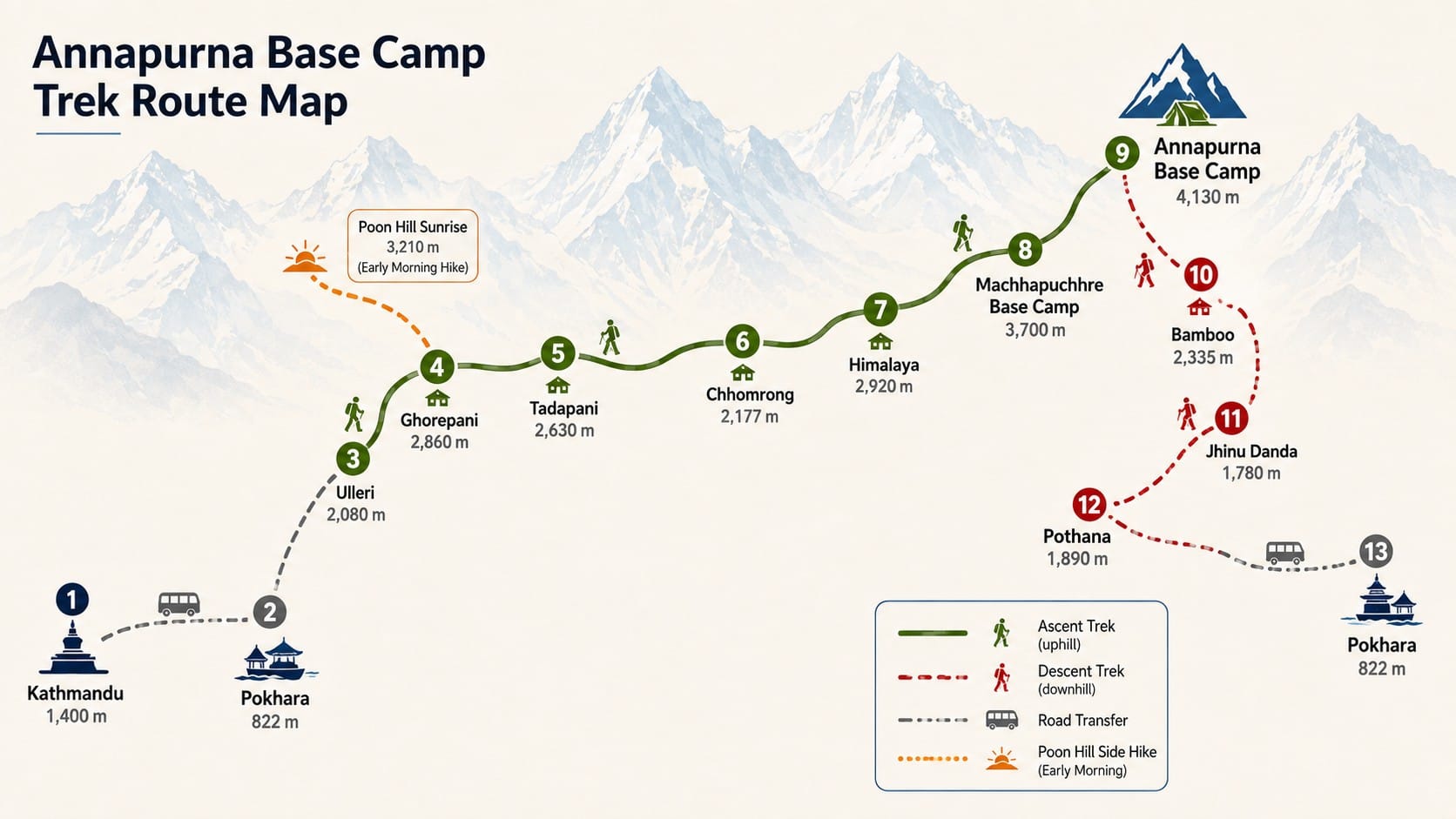
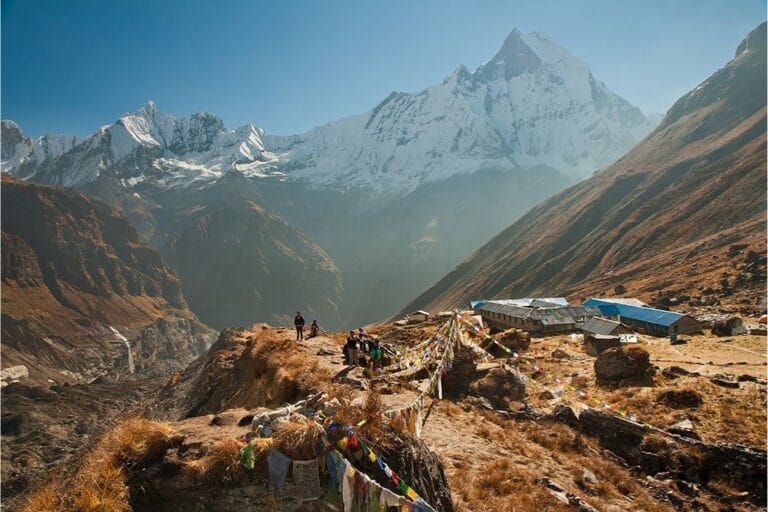
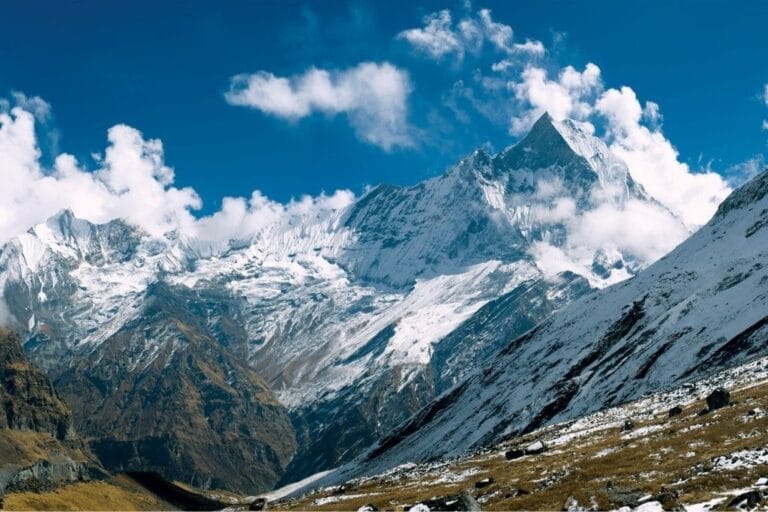
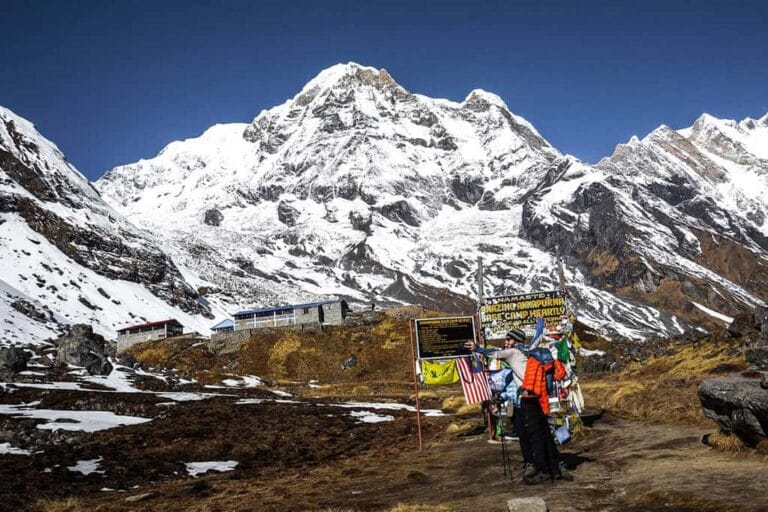
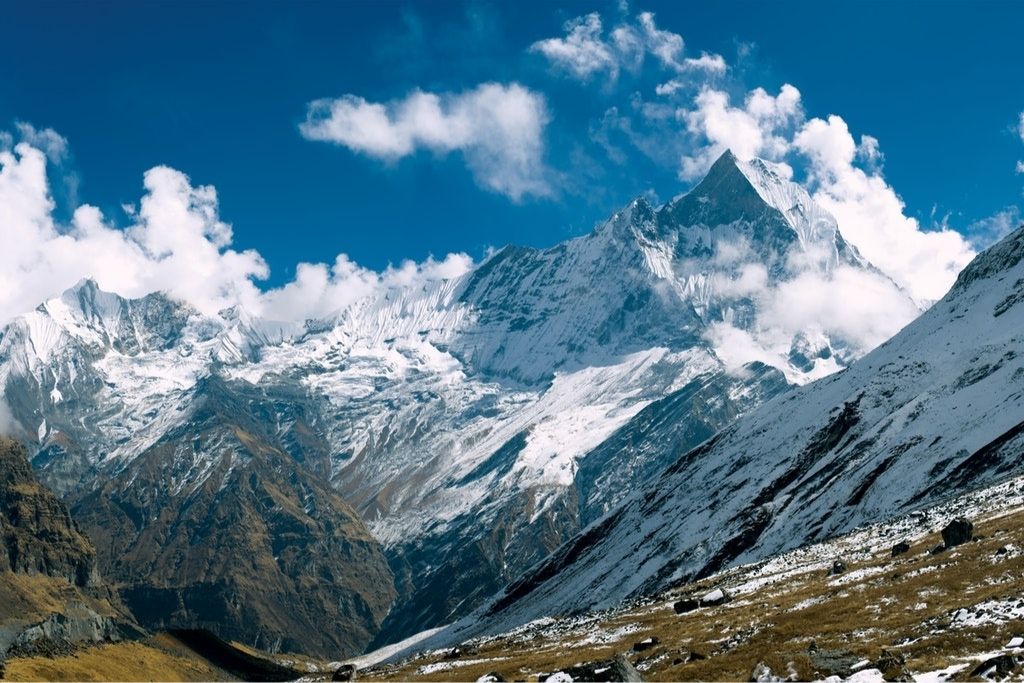
Every ABC itinerary shares the same upper section. From Chhomrong (2,170 m), the gateway village, the trail drops to the Chhomrong Khola, climbs to Sinuwa, then follows the deep, forested Modi Khola gorge through Bamboo, Dovan and Himalaya to Deurali (3,230 m). Above Deurali the valley opens out to Machhapuchhre Base Camp (3,700 m) and finally Annapurna Base Camp (4,130 m), surrounded by Annapurna I, Annapurna South, Hiunchuli, Gangapurna and the fishtail summit of Machhapuchhre.
Where the itineraries differ is how you reach Chhomrong:
- Via Ghorepani and Poon Hill (from Nayapul): the longest approach, about 3 days to Chhomrong, with the famous Poon Hill sunrise.
- Via Ghandruk (from Kimche or Ghandruk road-head): about 1–2 days, through one of the region’s best-preserved Gurung villages.
- Via Jhinu Danda or Siwai (jeep up the Modi Khola): the shortest approach, reaching Chhomrong within a few hours of leaving the jeep.
The total ABC trek distance is roughly 50–60 km on the short jeep-assisted route and 80–100 km on a full loop including Poon Hill, though published figures range from about 70 km to over 110 km depending on start point and side trips. The elevation gain is significant either way: from around 1,780 m at Jhinu Danda or 1,070 m at Nayapul to 4,130 m, with many ups and downs on stone steps.
Pokhara to Annapurna Base Camp: the jeep road options
Road building over the past decade has changed ABC itineraries more than anything else. All trailheads are reached from Pokhara; drive times are for dry conditions.
| Road-head | Drive from Pokhara | Walk to Chhomrong | Notes |
|---|---|---|---|
| Nayapul / Birethanti | 1.5–2.5 hrs | About 3 days via Ghorepani | Classic start for ABC with Poon Hill. Jeeps can now continue to Hile, Tikhedhunga and towards Ulleri, shortening day one. |
| Kimche / Ghandruk | 2–3 hrs | 1 day (5–6 hrs) from Ghandruk | Good for a cultural start or finish in Ghandruk. |
| Siwai / Matkyu (Modi Khola road) | 2.5–3.5 hrs | Same day (3–5 hrs) | Used by many short itineraries; road continues up the valley towards Jhinu. |
| Jhinu Danda (New Bridge area) | 3–4 hrs | Same day (2–3 hrs) | The shortest approach and the usual exit point after the hot springs. |
Shared jeeps run from Pokhara’s bus parks; private jeeps take about six people and are easily arranged through your guide or agency. Upper sections of these roads are unpaved and can close after heavy rain, especially from June to September, so build in a buffer. Jeep prices are covered in our Annapurna Base Camp trek cost guide.
5-day Annapurna Base Camp itinerary (short ABC trek)
This is the fastest realistic Pokhara-to-Pokhara option and is what most “short Annapurna Base Camp trek” packages offer. It relies on jeeps both ways and long walking days.
| Day | Route | Overnight altitude | Walking time | Distance (approx.) |
|---|---|---|---|---|
| 1 | Drive Pokhara to Jhinu Danda (3–4 hrs); trek to Sinuwa | 2,340 m | 4–5 hrs | 7–8 km |
| 2 | Sinuwa to Deurali via Bamboo, Dovan and Himalaya | 3,230 m | 6–7 hrs | 12–14 km |
| 3 | Deurali to Annapurna Base Camp via Machhapuchhre Base Camp | 4,130 m | 4–5 hrs | 8–9 km |
| 4 | Sunrise at ABC; descend to Bamboo | 2,310 m | 6–7 hrs | 12–13 km |
| 5 | Bamboo to Jhinu Danda (via Chhomrong); drive to Pokhara | 820 m (Pokhara) | 4–5 hrs + 3–4 hrs drive | 9–10 km |
Total walking: roughly 25–29 hours over five days.
Who it suits: fit, regular hill walkers who have trekked at altitude recently, or who have already spent a few days above 3,000 m elsewhere in Nepal. It is not the itinerary we would recommend for a first high-altitude trek.
The altitude problem: days 2 and 3 involve sleeping-altitude jumps of about 900 m each (2,340 m to 3,230 m to 4,130 m). Widely used mountain-medicine guidance suggests that above 3,000 m you should not increase your sleeping altitude by more than about 500 m per night. If anyone in the group develops a headache, nausea or unusual breathlessness at Deurali, stay put or descend rather than pushing on. A sensible variation is to sleep at MBC on day 3 and walk up to ABC for sunrise on day 4, which turns this into a 6-day trek.
7-day ABC trek itinerary from Pokhara
For most people with one week in the Annapurna region, this is the best balance of time, cost and safety. You still use jeeps, but you sleep at MBC before ABC and spend a night in the sanctuary.
| Day | Route | Overnight altitude | Walking time | Distance (approx.) |
|---|---|---|---|---|
| 1 | Drive Pokhara to Jhinu Danda or Siwai road-head (3–4 hrs); trek up to Chhomrong | 2,170 m | 2–3 hrs | 3–5 km |
| 2 | Chhomrong to Dovan via Sinuwa and Bamboo | 2,600 m | 5–6 hrs | 9–10 km |
| 3 | Dovan to Machhapuchhre Base Camp (MBC) via Himalaya and Deurali | 3,700 m | 5–6 hrs | 10–11 km |
| 4 | MBC to Annapurna Base Camp; afternoon and sunset in the sanctuary | 4,130 m | 2–3 hrs | 3–4 km |
| 5 | Sunrise at ABC; descend to Bamboo | 2,310 m | 6–7 hrs | 12–13 km |
| 6 | Bamboo to Jhinu Danda; optional hot springs | 1,780 m | 5–6 hrs | 9–10 km |
| 7 | Short walk to the road; jeep to Pokhara | 820 m | 0.5–1 hr + 3–4 hrs drive | 1–2 km |
Total walking: about 30–35 hours.
Why it works: the biggest altitude jump is Dovan to MBC (about 1,100 m), but you then gain only 430 m to ABC and spend an easy afternoon resting there, which helps your body adjust. Sleeping at ABC also gives you both sunset and sunrise on the peaks, rather than a rushed arrival and departure.
Variation: if the group feels the altitude at Dovan, stop at Deurali (3,230 m) on day 3 and continue to ABC on day 4, descending to Bamboo or Dovan on day 5 as normal.
10-day ABC trek with Poon Hill
Combining Annapurna Base Camp with Ghorepani and Poon Hill is the classic loop, and it is our pick for most first-time visitors with 10 days in Pokhara. The extra days on the Poon Hill side also act as a gentle warm-up for your legs before the sanctuary.
| Day | Route | Overnight altitude | Walking time | Distance (approx.) |
|---|---|---|---|---|
| 1 | Drive Pokhara to Nayapul/Birethanti (1.5–2 hrs); trek to Ulleri | 1,960 m | 5–6 hrs | 9–10 km |
| 2 | Ulleri to Ghorepani through rhododendron forest | 2,860 m | 5–6 hrs | 9–10 km |
| 3 | Pre-dawn hike to Poon Hill (3,210 m) for sunrise; trek to Tadapani | 2,630 m | 6–7 hrs | 12–13 km |
| 4 | Tadapani to Chhomrong via Kimrong Khola | 2,170 m | 4–5 hrs | 8–10 km |
| 5 | Chhomrong to Dovan via Sinuwa and Bamboo | 2,600 m | 5–6 hrs | 9–10 km |
| 6 | Dovan to Machhapuchhre Base Camp | 3,700 m | 5–6 hrs | 10–11 km |
| 7 | MBC to Annapurna Base Camp; sunset | 4,130 m | 2–3 hrs | 3–4 km |
| 8 | Sunrise at ABC; descend to Bamboo | 2,310 m | 6–7 hrs | 12–13 km |
| 9 | Bamboo to Jhinu Danda; hot springs | 1,780 m | 5–6 hrs | 9–10 km |
| 10 | Walk to the road-head; jeep to Pokhara | 820 m | 0.5–1 hr + 3–4 hrs drive | 1–2 km |
Total walking: about 45–55 hours.
Highlights: sunrise over Dhaulagiri and Annapurna South from Poon Hill, rhododendron forest around Ghorepani (spectacular in March and April), the Gurung village of Chhomrong, and the hot springs at Jhinu Danda on the way out.
Tip: the stone steps between Tikhedhunga and Ulleri are notoriously relentless, at over 3,000 steps by common estimates. A jeep to Hile or Tikhedhunga shaves off the dull road walking but not the steps.
12-day Annapurna Base Camp itinerary (relaxed loop)
This version covers the same highlights as the 10-day trek but adds an acclimatisation-friendly half day at MBC and an exit through Ghandruk. It is the best choice for older trekkers, families with teenagers, or anyone who wants to enjoy the trek rather than race it.
| Day | Route | Overnight altitude | Walking time | Distance (approx.) |
|---|---|---|---|---|
| 1 | Drive Pokhara to Nayapul (1.5–2 hrs); trek to Tikhedhunga | 1,540 m | 3–4 hrs | 8–9 km |
| 2 | Tikhedhunga to Ghorepani via the Ulleri stone steps | 2,860 m | 6–7 hrs | 10–12 km |
| 3 | Poon Hill sunrise (3,210 m); trek to Tadapani | 2,630 m | 6–7 hrs | 12–13 km |
| 4 | Tadapani to Chhomrong | 2,170 m | 4–5 hrs | 8–10 km |
| 5 | Chhomrong to Bamboo | 2,310 m | 4–5 hrs | 7–8 km |
| 6 | Bamboo to Deurali via Dovan and Himalaya | 3,230 m | 5–6 hrs | 9–10 km |
| 7 | Deurali to Machhapuchhre Base Camp (short day to acclimatise) | 3,700 m | 2–3 hrs | 4–5 km |
| 8 | MBC to Annapurna Base Camp; sunset and a night in the sanctuary | 4,130 m | 2–3 hrs | 3–4 km |
| 9 | Sunrise at ABC; descend to Bamboo | 2,310 m | 6–7 hrs | 12–13 km |
| 10 | Bamboo to Jhinu Danda; hot springs | 1,780 m | 5–6 hrs | 9–10 km |
| 11 | Jhinu Danda to Ghandruk, the largest Gurung village on the route | 1,940 m | 3–4 hrs | 6–7 km |
| 12 | Morning in Ghandruk; jeep to Pokhara | 820 m | 0–1 hr + 2–3 hrs drive | 0–2 km |
Total walking: about 50–60 hours.
Why choose it: after reaching Deurali your sleeping altitude rises by only about 450 m a night (to MBC, then ABC), you get two short, easy days near the top, and the Ghandruk finish avoids repeating the same trail. It also leaves room for weather delays.
If you are flying in from abroad, add arrival and transfer days in Kathmandu: our own Annapurna Base Camp trek is a 15-day trip built around this kind of relaxed loop, with Poon Hill, a night at Machhapuchhre Base Camp and a free day in Pokhara.
ABC with Poon Hill or without?
| ABC only (via Jhinu/Siwai) | ABC with Poon Hill (via Ghorepani) | |
|---|---|---|
| Days from Pokhara | 5–7 | 9–12 |
| Walking distance | About 45–60 km | About 80–100 km |
| Main extras | Jhinu hot springs | Poon Hill sunrise, Ghorepani rhododendron forest, Tadapani |
| Acclimatisation | Tighter; needs careful pacing | Gentler build-up on the lower trail |
| Cost | Lower (fewer guide and teahouse days) | Roughly 30–40% higher on the trail |
If you have the time, Poon Hill is worth it. If you have already done Poon Hill, or just want the sanctuary, the shorter route through Jhinu Danda is the way to go. Our guide to the best treks from Pokhara compares these with other options such as Mardi Himal.
Acclimatisation on the ABC trek
At 4,130 m, ABC is lower than Everest Base Camp, but short itineraries make altitude sickness a genuine risk because you climb from Pokhara (820 m) to over 4,000 m in as little as three days. Follow these principles:
- Sleep at MBC before ABC where possible; it is the single best acclimatisation choice on this trek.
- Above 3,000 m, aim to increase your sleeping altitude by no more than about 300–500 m per night. No ABC itinerary does this perfectly, which is why slower options are safer.
- Know the symptoms. Headache, nausea, loss of appetite, dizziness and poor sleep are early signs of acute mountain sickness. Do not go higher with symptoms; descend if they worsen.
- Drink plenty, avoid alcohol and walk slowly. Your guide sets the pace for a reason.
- Talk to your doctor about acetazolamide (Diamox) before you go, especially for the 5-day itinerary.
Our article on altitude sickness explains symptoms and prevention in more detail; the same rules apply in the Annapurna Sanctuary. For how tough the days feel, see our ABC trek difficulty guide.
Avalanche risk between Deurali and MBC
The trail between Himalaya, Deurali and MBC runs beneath steep slopes that can release avalanches, particularly after heavy snowfall from December to April. In January 2020 an avalanche near Deurali killed several trekkers and guides. In winter and early spring, set off early, follow your guide’s advice and local lodge reports, and be willing to wait a day if the route is closed. This is one more reason to keep a spare day in your plans and to trek with a licensed guide.
Which ABC itinerary should you choose?
- You have 5–6 days in Pokhara and plenty of altitude experience: the 5-day trek, ideally extended to 6 days with a night at MBC.
- You have a week and this is your first trek above 4,000 m: the 7-day itinerary.
- You want the classic Nepal trekking experience in one trip: the 10-day ABC with Poon Hill.
- You prefer a gentle pace, are trekking with family, or want more village time: the 12-day loop.
Season matters as much as itinerary. October–November and March–April offer the most reliable weather; see the best time to trek Annapurna Base Camp. If you are still deciding between the big two, our Annapurna Base Camp vs Everest Base Camp comparison will help. New to multi-day hiking? Read our trekking for beginners guide and start training six to eight weeks before you go with our trekking fitness tips.
Plan your ABC trek
For most trekkers we recommend the 7-day option from Pokhara or the 10-day loop with Poon Hill, plus two days for Kathmandu and a buffer day at the end. Pack with our free trek packing checklist, and if you would like the guide, porter, permits and transport arranged with a licensed Nepali partner, see our Annapurna Base Camp trek or tell us your dates.
Frequently asked questions
How many days do you need for the Annapurna Base Camp trek?
Most trekkers take 7 to 10 days from Pokhara, or 10 to 14 days including travel to and from Kathmandu. A 5-day trek is possible using jeeps, but it is only advisable for fit trekkers with recent altitude experience.
Can you do the ABC trek in 5 days?
Yes, by taking a jeep from Pokhara to Jhinu Danda and back. The days are long and you gain around 900 m of sleeping altitude on two consecutive nights, so the risk of altitude sickness is higher. Adding a night at Machhapuchhre Base Camp makes it safer.
How far is Annapurna Base Camp from Pokhara?
The trailheads are 35–60 km by road from Pokhara (2–4 hours by jeep). From the Jhinu Danda road-head, ABC is roughly 25–30 km on foot one way; from Nayapul via Ghorepani it is about 45–55 km one way.
What is the total distance of the Annapurna Base Camp trek?
Roughly 50–60 km round trip on the short jeep-assisted route, and 80–100 km on the full loop with Poon Hill. Published figures vary from about 70 km to over 110 km depending on where you start and how much road you walk.
Is it worth adding Poon Hill to the ABC trek?
If you have three extra days, yes. Poon Hill gives one of Nepal’s best sunrise panoramas, the Ghorepani forests are beautiful in spring, and the gentler lower-trail days help your legs and acclimatisation before the sanctuary.
Should I sleep at Annapurna Base Camp or Machhapuchhre Base Camp?
Ideally both: sleep at MBC (3,700 m) first, then spend a night at ABC (4,130 m) for sunset and sunrise. If you feel unwell at MBC, you can walk up to ABC for sunrise and descend the same day instead of sleeping higher.
Do I need a guide for the ABC trek?
Since April 2023 Nepal’s rules require foreign trekkers in the Annapurna Conservation Area to trek with a licensed guide, although enforcement has been inconsistent. We recommend one, particularly for avalanche-zone judgement above Himalaya and for altitude decisions on short itineraries.
What is the hardest day on the Annapurna Base Camp trek?
For many people it is the long descent from ABC to Bamboo (around 1,800 m down) or, on the Poon Hill loop, the climb up the Ulleri stone steps. On short itineraries, the day to Deurali or MBC is tough because of the altitude gain.