
Get Lost Forever Logo Plan my trek

Bhaktapur Travel Guide

The best-preserved royal city of the Kathmandu Valley: Newar temples, pottery squares and king curd, with up-to-date entry fees, transport and itineraries.

Altitude

About 1,400 m

From kathmandu

13 km, 45–75 min

Time needed

1 day or 1 night

Entry fee

NPR 2,000 / US$15

Best time

Oct–Nov, Mar–Apr

Known for

Nyatapola, king curd

Why visit Bhaktapur

Bhaktapur is the best-preserved of the three old royal cities of the Kathmandu Valley, and for many travellers it is the most memorable day of their time in Nepal. Its old core is a dense grid of red-brick houses, carved wooden windows, stone-paved squares and working temples, home to roughly 80,000 people, around nine in ten of them Newar. Cars are kept out of most of the centre, so you hear bells, potters’ wheels and children rather than horns.

The city sits at about 1,400 m on the eastern side of the valley, roughly 13 km from central Kathmandu. Locals call it Khwopa; the Sanskrit name Bhaktapur means “city of devotees”. It was the capital of the whole valley under the Malla kings until the kingdom split in 1482, and most of the temples and palaces you see today date from the 15th to 18th centuries.

What it is like

Compared with Kathmandu’s Durbar Square, Bhaktapur feels less like a monument zone and more like a living town that happens to be full of monuments. People dry grain and chillies on temple plinths, women fetch water from sunken stone fountains, and festivals are run by the neighbourhoods themselves, not staged for visitors. The whole historic centre charges a single entry fee for foreigners, which funds conservation, waste collection and the restoration work that followed the 2015 earthquake.

That earthquake damaged many of the city’s heritage structures, and you will still see scaffolding in places. Most of the major landmarks have been repaired or rebuilt, though, and the reconstruction itself, done largely with traditional brick, timber and craftsmen, is worth noticing.

Who it suits

  • First-time visitors to Nepal who want one place that shows Newar architecture and daily life at its best.
  • Photographers, especially at dawn and dusk, when the squares are quiet and the light is warm on the brick.
  • Trekkers with a spare day or two in the valley before or after a trek, who want something calm after Thamel.
  • Families and slower travellers: the centre is flat, compact and largely traffic-free.

Quick orientation

Think of the old town as a long, gently sloping east–west strip about 2 km across, with three main squares strung along it. Durbar Square, the old royal palace square, is at the western end. A few minutes’ walk south-east brings you to Taumadhi Square and the five-storey Nyatapola temple. Pottery Square is just south of Taumadhi, down a lane towards the river. The main street then winds east for about 15 minutes to Dattatreya Square (Tachupal), the oldest part of town. Siddha Pokhari, the large pond by the main bus stop, marks the western edge; the Hanumante river runs along the south side.
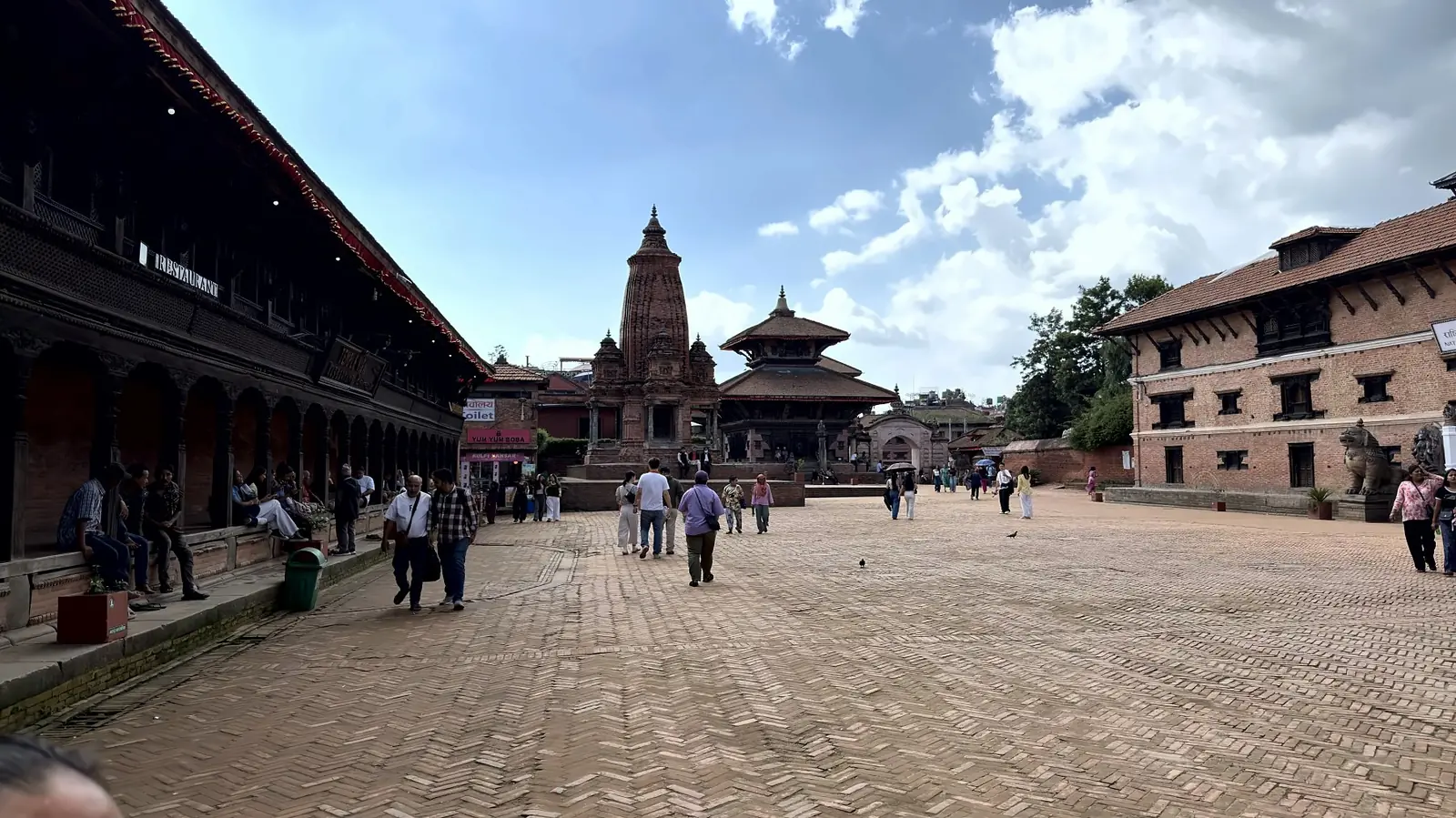
Wide view across the brick-paved Bhaktapur Durbar Square towards its temples
Durbar Square, the heart of old Bhaktapur. Photo: Govind Rai.

Things to do in Bhaktapur

The old town is compact enough to walk end to end in 20 minutes, but there is easily a full day of sights, food and craft workshops. These are the essentials, roughly in west-to-east walking order.

Bhaktapur Durbar Square

The former royal square is the city’s showpiece: a broad paved space lined with temples, pavilions and the long brick front of the old palace. Highlights include the octagonal Chyasilin Mandap (rebuilt in 1987 and still standing after 2015), the stone Siddhi Lakshmi temple guarded by pairs of animals, the Vatsala temple with its “barking dog” bell, and the Yaksheshwar temple, known locally as the Pashupati of Bhaktapur for its carved roof struts.

Time needed: 1–1.5 hours. Best time: before 9am or after 4pm, when tour groups thin out. Tip: keep your entry ticket handy; it is checked at gates around the old town, not just here.
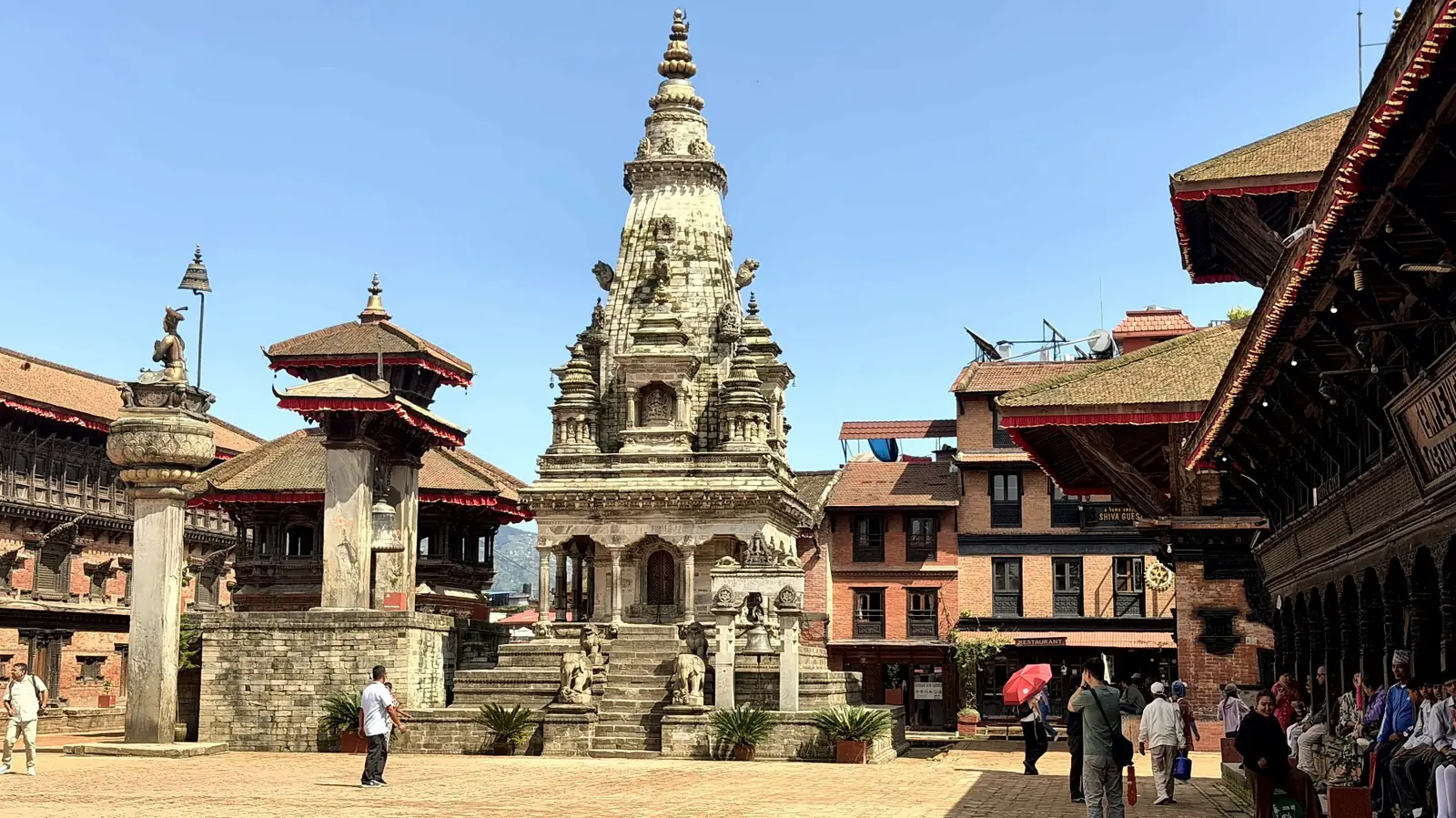
Stone Vatsala Durga temple and King Bhupatindra Malla's column in Bhaktapur Durbar Square
Vatsala Durga temple and King Bhupatindra Malla’s column, Durbar Square. Photo: Govind Rai.

The 55-Window Palace

The long brick palace on the north side of Durbar Square is named for its upper gallery of 55 carved wooden windows. The building was commissioned by King Bhupatindra Malla in the late 17th century after an earlier palace was damaged by an earthquake; its top floor fell in 1934 and was later rebuilt. The cornice carries more than a hundred small carved figures.

You cannot go inside the gallery itself, but the façade is best studied from the steps of the temples opposite. Time needed: 15–20 minutes. Tip: the soft afternoon light from the west brings out the carving detail best.
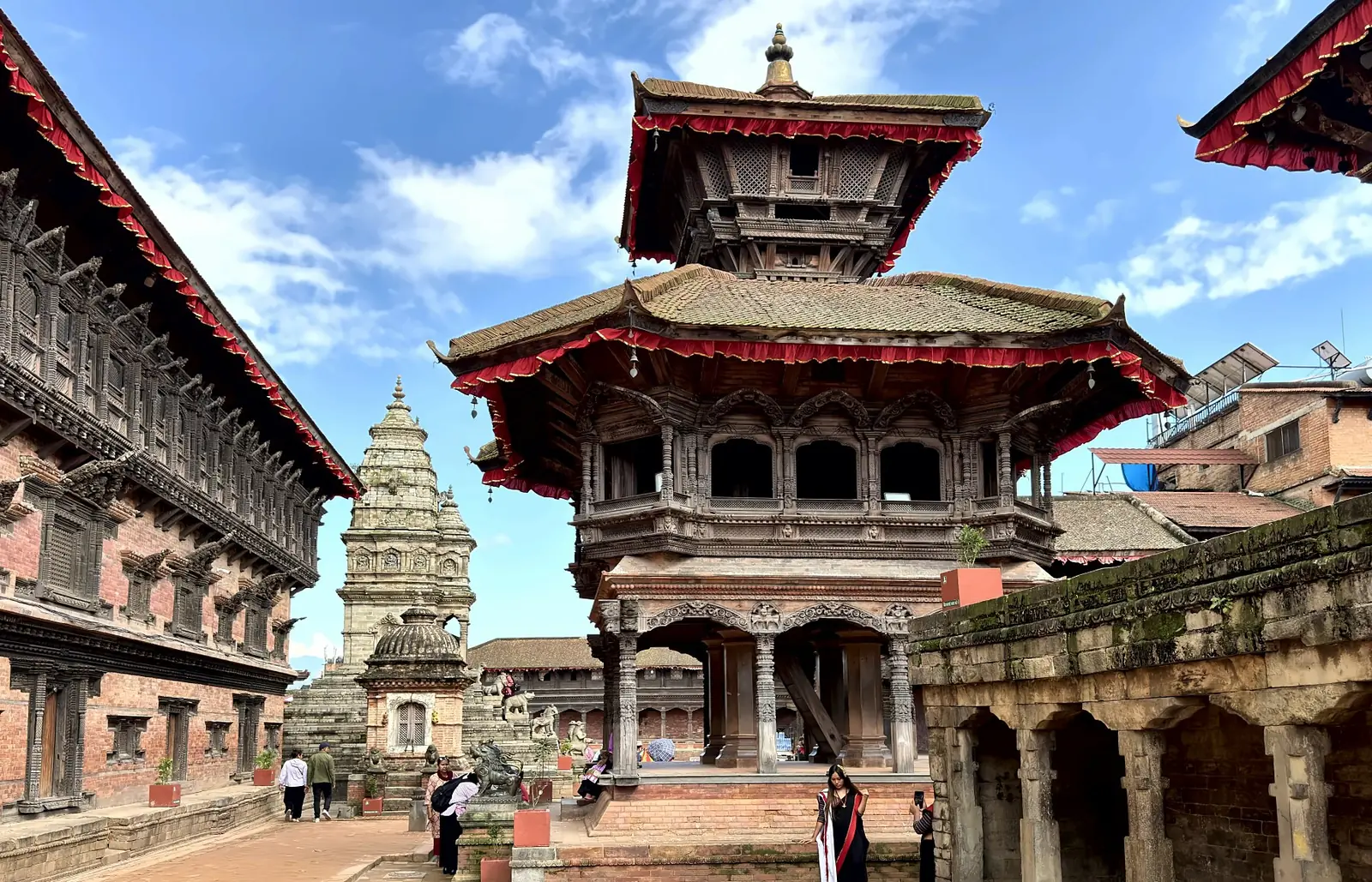
Two-tiered pagoda temple with carved wooden windows in Bhaktapur Durbar Square
Carved timber and tiered roofs on Durbar Square. Photo: Govind Rai.

The Golden Gate (Sun Dhoka)

Set into the palace wall beside the 55-Window Palace, the gilded copper Golden Gate is one of the finest pieces of metalwork in Nepal. It was commissioned by King Ranajit Malla and completed in the 1750s, and shows the goddess Taleju with Garuda above. It leads into the courtyards of the Taleju temple, the royal family’s protective goddess.

Important: the inner Taleju shrine is open to Hindus only, and photography beyond the gate is not allowed. You can still photograph the gate from outside and usually look through towards the courtyard and the royal bath (Naga Pokhari). Time needed: 15 minutes.

National Art Gallery

Part of the old palace houses the National Art Gallery, one of Nepal’s earliest museums, with Hindu and Buddhist paintings, palm-leaf manuscripts, stone sculpture and paubha (scroll) paintings. It is small, a little dusty and often quiet, which makes it a good escape at midday.

Fee: a separate small charge (recent visitors report around NPR 150, roughly £0.75, covering the gallery and the city’s woodcarving and brass museums). Hours: typically closed on Tuesdays and public holidays; check at the door. Time needed: 30–45 minutes.
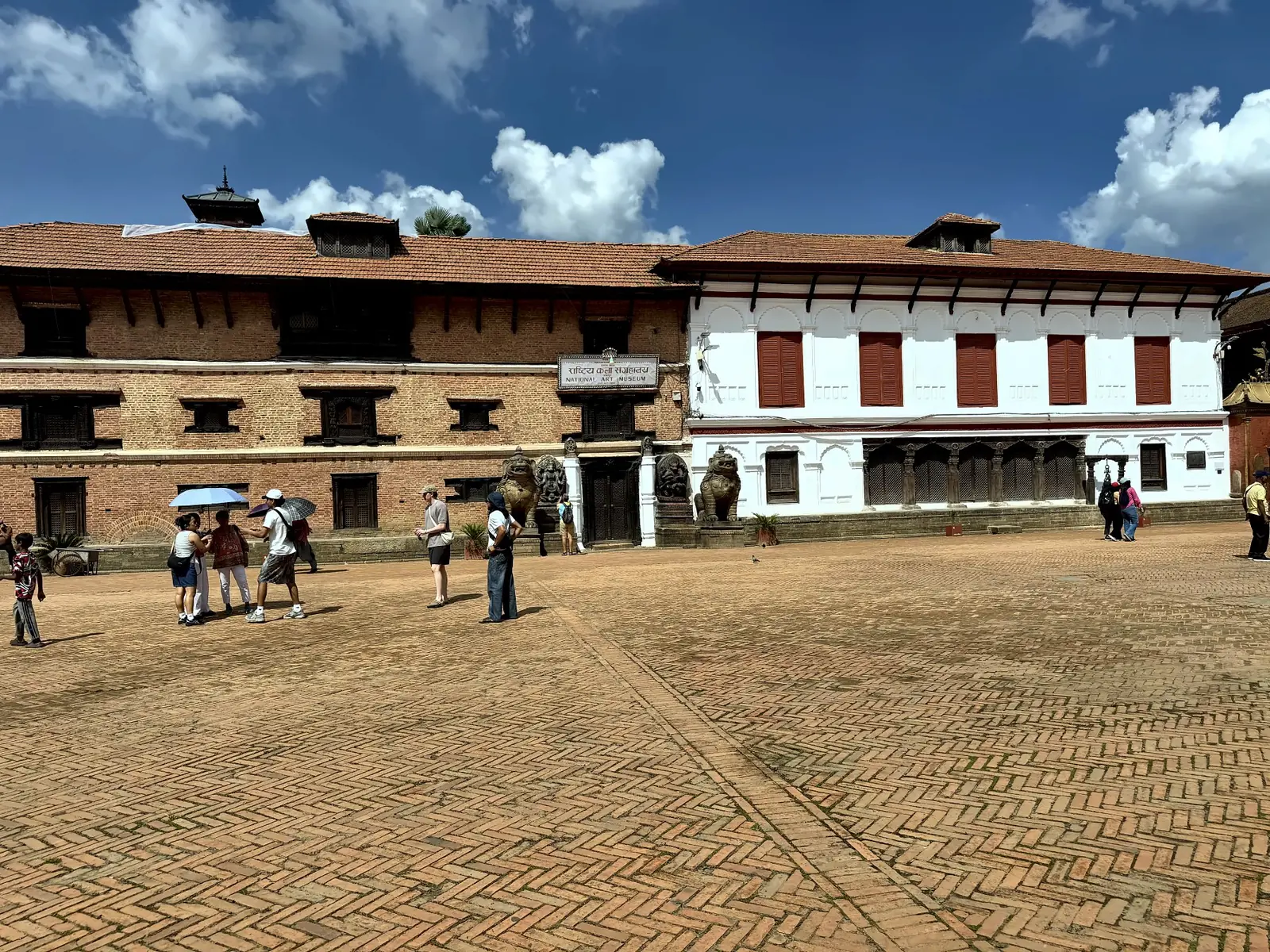
Brick and whitewashed royal palace buildings on Bhaktapur Durbar Square
Old royal palace buildings on Durbar Square, part of which houses the National Art Gallery. Photo: Govind Rai.

Taumadhi Square and Nyatapola Temple

Nyatapola is the tallest pagoda in Nepal, a five-roofed temple of around 30 m built in 1701–02 for King Bhupatindra Malla. It is dedicated to the goddess Siddhi Lakshmi, whose image is kept hidden. Its steep staircase is lined with guardians, each pair said to be ten times stronger than the pair below: wrestlers, elephants, lions, griffins and finally two goddesses. It survived the earthquakes of 1934 and 2015 almost unscathed.

Next door is the three-storey Bhairavnath temple, focus of the Bisket Jatra chariot festival. Time needed: 30–45 minutes, longer if you sit with a tea on one of the surrounding rooftops. Tip: climbing the steps is allowed, but the shrine is not open to visitors.
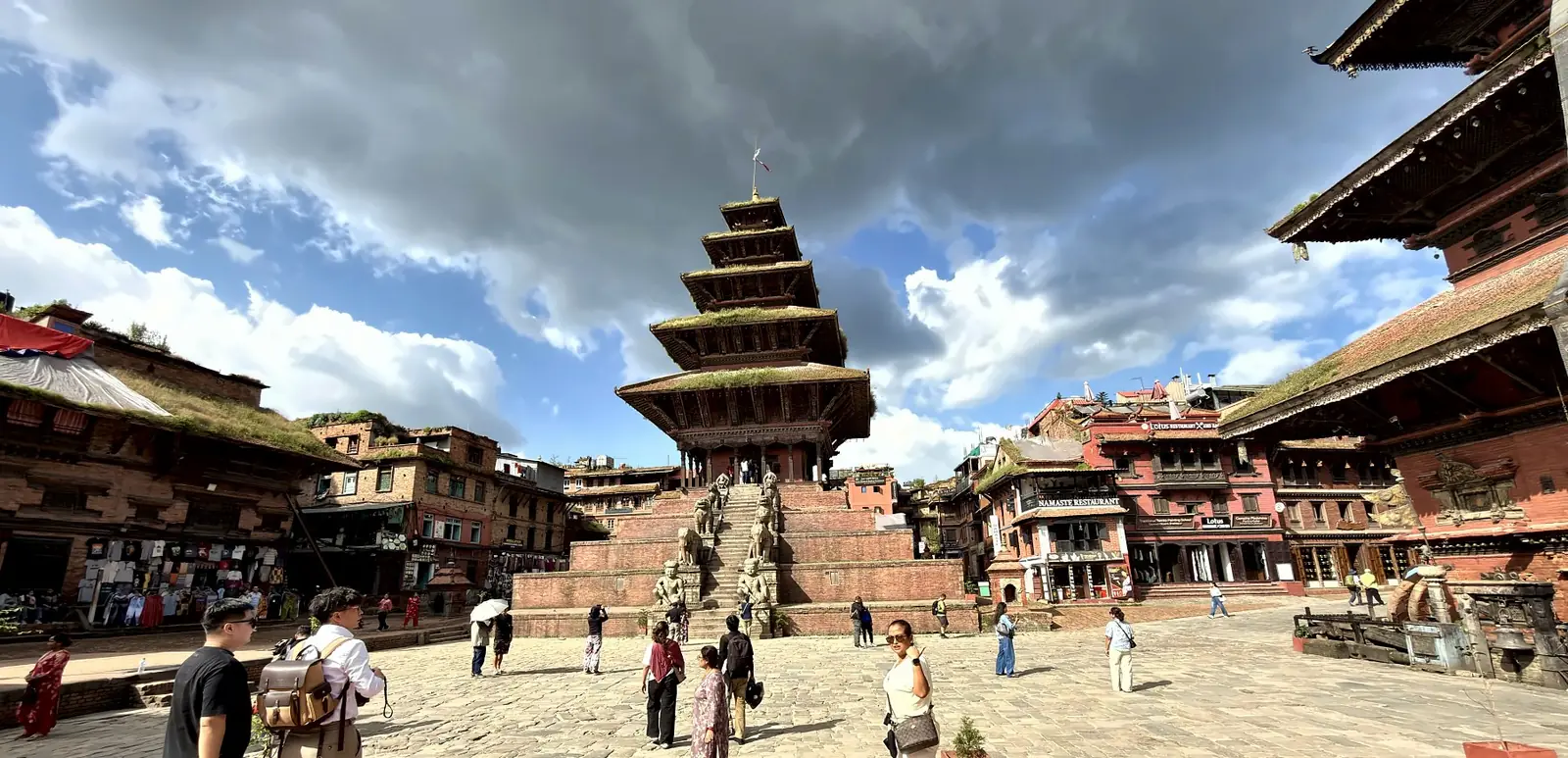
The five-tiered Nyatapola Temple above Taumadhi Square in Bhaktapur
Nyatapola Temple rises over Taumadhi Square. Photo: Govind Rai.

Pottery Square

A short walk south of Taumadhi, Pottery Square (Talako) is where Bhaktapur’s potter caste, the Prajapati, still throw pots on wheels and dry hundreds of them in rows across the open ground. You will see flowerpots, water jars, oil lamps and the small clay cups used for juju dhau. Smoke from straw-and-ash kilns often hangs over the square in the morning.

Several workshops offer short wheel sessions for visitors; agree the price and what is included before you start. Time needed: 30 minutes, or 1–2 hours with a lesson. Tip: mid-morning on a dry day is when most pots are out drying. Ask before photographing people at work.

Dattatreya Square (Tachupal)

The eastern end of the old town is its oldest quarter, and it feels noticeably more residential. The three-tiered Dattatreya temple, built in the 15th century during the reign of Yaksha Malla and traditionally said to come from the timber of a single tree, is fronted by two stone wrestlers and a Garuda on a pillar. Around the square are old priests’ houses (maths) with superb carved windows.

Time needed: 45 minutes including the Peacock Window and museums. Best time: early morning, when locals come to worship. Tip: this is the best area for buying wood carvings, as several workshops are around the square.
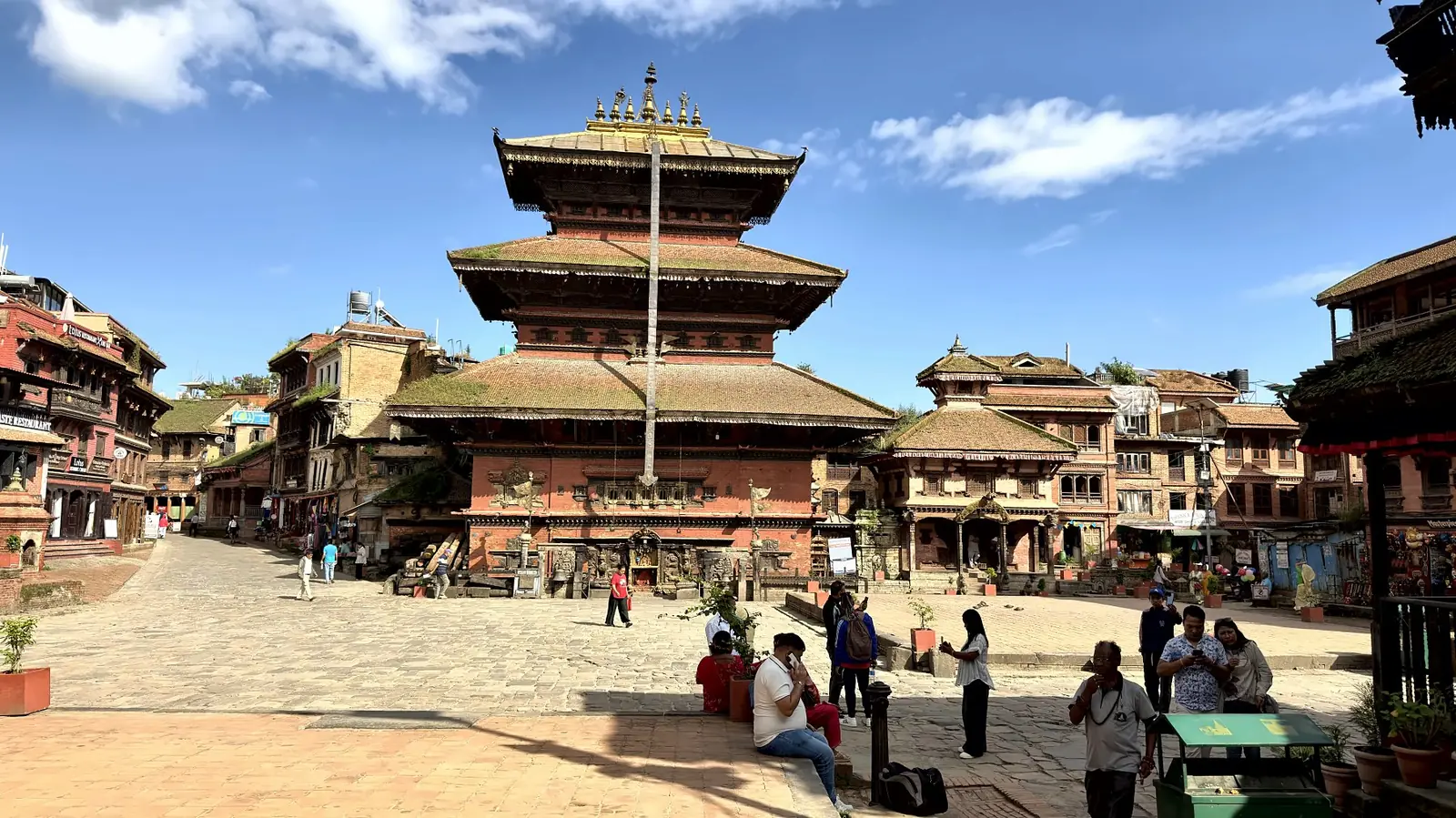
Three-tiered Dattatreya temple in Tachupal (Dattatreya) Square, Bhaktapur
Dattatreya Square (Tachupal), the oldest part of Bhaktapur. Photo: Govind Rai.

The Peacock Window and Pujari Math

In a lane beside the Pujari Math, just off Dattatreya Square, is the Peacock Window (Mhaykha Jhya), a latticed window from about 1750 with a fanned peacock at its centre. It is often called the finest carved window in Nepal, and it is small enough to walk past.

The Pujari Math itself houses the National Woodcraft Museum, with carved struts, windows and doors salvaged from around the city; the Brass and Bronze Museum is opposite. Time needed: 10 minutes for the window, 30 minutes with the museum. Tip: shops in the lane sell miniature peacock-window carvings; quality varies widely, so look at several.

Juju dhau and Newar food

Bhaktapur’s most famous food is juju dhau, “king of curds”: a thick, sweet, set yoghurt made from buffalo milk and cultured in unglazed clay pots that draw out moisture and give it a custard-like texture. It is sold from small shops all over the old town; expect roughly NPR 50–100 (about £0.25–0.50) for a small cup.

Also try bara (lentil patties, sometimes with egg), chatamari (a thin rice-flour crêpe), choila (spiced grilled buffalo or chicken) and samay baji, the ceremonial Newar platter of beaten rice, beans, egg and pickles, typically NPR 300–600 (around £1.50–3) in a local restaurant. Ask for less chilli if needed. Vegetarians are well catered for.

Siddha Pokhari and the city's ponds

Bhaktapur was designed around water. Siddha Pokhari, a large rectangular tank just outside the western gate by the main bus park, dates from the Malla period and is a pleasant place to watch local life, with snack stalls nearby. Inside the old town, look for sunken stone water spouts (hiti), some still used daily for washing and filling pots.

Time needed: 20–30 minutes. Tip: if you arrive by bus, start here and walk east, finishing at Dattatreya Square; you then pick up a taxi on the northern ring road. Do not drink untreated water from the spouts.

Hanuman Ghat and the riverside

On the south-eastern edge of town, where two streams meet the Hanumante river, Hanuman Ghat is a cluster of small shrines, lingams and bathing steps. It is also a cremation site, so you may see funerals. It is far quieter than Pashupatinath in Kathmandu and gives a sense of how religious life continues away from the main squares.

Time needed: 20–30 minutes. Etiquette: keep a respectful distance from cremations, do not photograph mourners, and do not walk through ceremonies. The walk down from Dattatreya Square takes about 10 minutes.

Craft workshops: masks, thangka and wood

Bhaktapur is a working craft town. Besides pottery, look for papier-mâché masks of deities (especially around Taumadhi and in nearby Thimi), thangka and paubha painting studios around Durbar Square, and woodcarving workshops near Dattatreya Square. Many sell directly from where they work, which lets you see quality and process before buying.

Tip: painting “schools” that invite you in are mostly shops; that is fine, but there is no obligation to buy. Prices are negotiable but not hugely inflated in better workshops. For metalwork and jewellery, Patan has the larger selection.

Bhaktapur festivals and Newar culture

Bhaktapur keeps one of the fullest festival calendars in Nepal, and much of it is organised by tol (neighbourhood) guthis, the traditional community trusts that maintain temples and rituals. Timing a visit for a festival is the single best way to see the city at its most alive. Dates follow the lunar or solar Nepali calendar and shift each year, so always confirm locally. For background on Newar religion and customs, see our guide to culture in Nepal.

Bisket Jatra (Nepali New Year, April)

Bhaktapur’s biggest festival runs for about nine days around Nepali New Year in mid-April (in 2026 it ran from roughly 10 to 18 April). A huge wooden chariot carrying the god Bhairav is hauled through Taumadhi Square, and residents of the upper (Thane) and lower (Kone) halves of town fight a tug of war over which direction it goes. A tall wooden pole (yosin) is raised near the river and pulled down on New Year’s eve.

The atmosphere is joyous but the chariot pulling is crowded and genuinely dangerous: keep well back and stand on raised plinths. The next day nearby Thimi holds its own procession with clouds of orange sindoor powder. Book accommodation well ahead for New Year, which normally falls on 13 or 14 April.

Gai Jatra (August/September)

Gai Jatra, the “cow festival”, is held the day after the full moon of Janai Purnima and commemorates family members who died during the year. In Bhaktapur it is especially elaborate: families build tall decorated bamboo and cloth structures called taha macha that are carried in procession, along with costumed dancers, stick dances and comic performances. The procession loops through the old town during the day. In 2026 it fell on 29 August.

Dashain and Navadurga dances (September–October)

During Dashain, the country’s biggest Hindu festival, the Taleju temple and the goddess shrines of Bhaktapur are a focus of worship and sacrifice. The city’s distinctive Navadurga dance troupe, masked dancers who embody nine forms of the goddess, performs a ritual cycle that starts around Dashain and continues through the year. Some days involve animal sacrifice, which may not suit every visitor.

Tihar, Yomari Punhi and smaller festivals

Tihar (October/November; in 2026 from about 6 to 11 November) fills the lanes with oil lamps, marigold garlands and rangoli patterns; Bhaktapur’s lamplit squares are lovely on Laxmi Puja night. Yomari Punhi (December full moon) celebrates the end of the rice harvest with steamed sweet yomari dumplings. Almost any week you will come across a small local procession, temple music or a wedding band.

Newar culture in brief

The Newars are the original people of the Kathmandu Valley, with their own language (Nepal Bhasa, which has a distinct Bhaktapur dialect), cuisine and a blend of Hindu and Buddhist practice that can be confusing at first: many families worship at both. Society was historically organised by hereditary occupation, which is why particular trades cluster in particular quarters, such as potters near Talako and farmers (Jyapu) in the outer tols.

Visitors notice the courtyards (chok), the shared rest houses (phalcha) where elders sit, and the communal feasts. Be respectful around shrines: walk clockwise, remove shoes where others do, do not touch offerings, and avoid leather inside temple precincts.

Where to stay in Bhaktapur

Most visitors see Bhaktapur on a day trip, but staying a night is the single biggest upgrade you can make. Once the day groups leave at around 5pm, the squares empty, oil lamps are lit at shrines, and early next morning you can watch the city wake up: devotees making offerings, bells, and street vendors frying bara. Staying inside the old town also means your entry ticket covers your whole stay; let the counter or your hotel know you are staying overnight.

Accommodation inside the old town is mostly small: family guesthouses and boutique hotels in restored Newar houses, often with rooftop views. Big international hotels are absent. Prices below are approximate per room per night in the October–November and March–April high seasons; expect discounts in the monsoon.

Around Durbar Square

The most atmospheric base, with guesthouses and small heritage hotels overlooking or just off the square. You are steps from the main sights at dawn and dusk. Rooms can be small and steep wooden stairs are common.

Suits: first-timers and photographers. Typical price: around NPR 3,000–10,000 (£15–50), more for restored heritage rooms.

Taumadhi and Pottery Square

The busiest evening area, with rooftop cafés facing Nyatapola and family-run guesthouses in the lanes towards Pottery Square. It is central for everything and a short walk from Durbar Square.

Suits: budget travellers and couples who want lively evenings. Typical price: around NPR 2,000–6,000 (£10–30).

Dattatreya Square

Quieter and more residential, with some well-restored old buildings converted into small hotels and homestays. Fewer day-trippers reach this end, so evenings are calm.

Suits: longer stays, slow travellers and anyone interested in woodcarving. Typical price: around NPR 2,500–8,000 (£12–40).

Homestays and boutique heritage houses

A small number of restored Newar houses operate as boutique hotels with courtyards, carved windows and Newar food; family homestays are more basic but give you a real insight into daily life. Book through reputable platforms and check recent reviews for hot water, heating and noise.

Typical price: homestays around NPR 2,000–4,000 (£10–20); boutique heritage hotels around NPR 10,000–25,000 (£50–125).

Outside the old town (Suryabinayak, ring road)

Newer hotels on the outskirts and along the Araniko Highway offer larger rooms, parking and lifts, but you lose the evening atmosphere and need a short taxi or walk into the centre.

Suits: travellers with mobility needs or a car and driver. Typical price: around NPR 4,000–12,000 (£20–60).

Practical notes: winter nights (December–February) are cold and few small guesthouses have central heating, so ask about heaters and extra blankets. Power cuts are now rare in the valley, but traffic cannot reach most old-town lanes, so expect to walk the last few hundred metres with your bags.

How to get to Bhaktapur

Bhaktapur is about 13 km east of central Kathmandu and around 10 km from Tribhuvan International Airport. There is no airport in Bhaktapur itself and you do not need one: by road it is 30 minutes to well over an hour depending on traffic, which is worst between 8.30am and 11am and from 4pm to 7pm. For an overview of moving around the country, see our things to know before travelling to Nepal.

OptionFromTimeApproximate costNotes
TaxiThamel40–75 minNPR 1,400–1,500 (about £7–8) one wayAgree the fare first; meters are rarely used.
Taxi with waiting timeThamelReturn, half or full dayFrom around NPR 2,000–3,500 (£10–18)Negotiate hours and stops in advance.
Ride-hailing (inDrive, Pathao)Anywhere in Kathmandu40–75 minOften a little cheaper than a street taxiYou propose or accept a fare in the app; useful for the return.
Local bus or microbusRatna Park / Old Bus Park, Kathmandu45–75 minAround NPR 50–80 (under £0.50)Crowded; ask drivers for “Bhaktapur”. Pickpockets operate on busy buses.
Taxi or private carTribhuvan Airport30–50 minAround NPR 1,200–1,800 (£6–9)Use the airport’s prepaid taxi counter or a hotel transfer.
Private car with driverPokhara7–9 hoursVaries widelyBypasses central Kathmandu; can stop at Bandipur.

By local bus

Buses to Bhaktapur leave from the stands around Ratna Park and the Old Bus Park in central Kathmandu, within walking distance of Thamel. Signs are in Devanagari script, so ask conductors; there are also buses from Lagankhel in Patan. Most terminate at the bus park by Siddha Pokhari, on the western edge of the old town, a 10-minute walk from Durbar Square. Others stop at Kamal Binayak on the northern side. Leave early to beat the traffic.

By taxi or private car

Taxis drop you at one of the entry points on the edge of the old town (most commonly near the main ticket office on the western or northern side), from where you walk. If you are combining Bhaktapur with Changu Narayan or Nagarkot, hiring a car and driver for the day is usually the easiest option; your hotel or a local agency can arrange it.

Getting around Bhaktapur

Walking is the only real way to see the old town, and it is easy: the three main squares are within about 15–20 minutes of each other on foot. Motor traffic is restricted in most of the centre. Streets are paved with brick and stone and can be uneven and slippery after rain, so wear decent shoes.
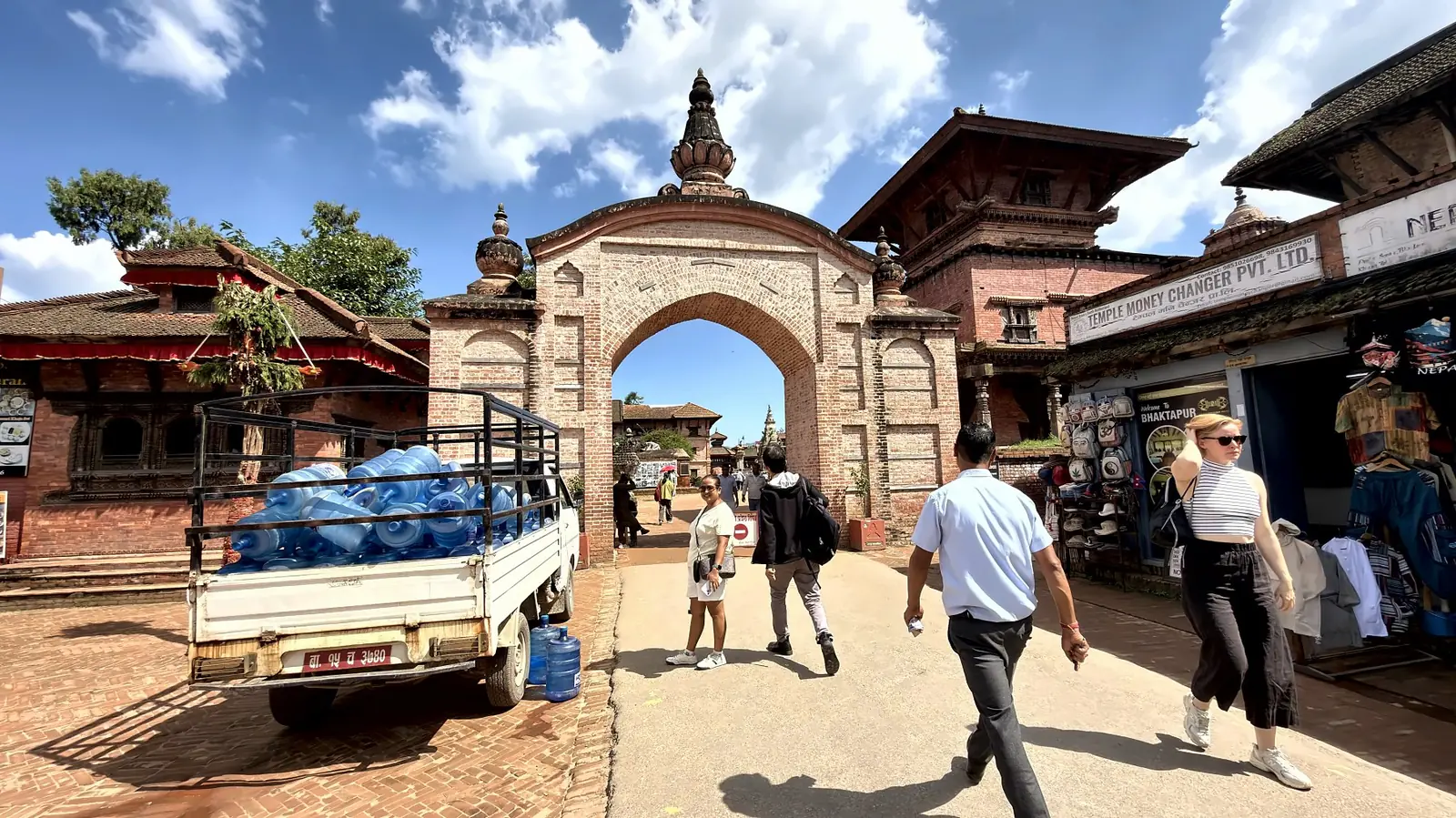
Brick arched gateway into Bhaktapur old town with visitors walking through
One of the gateways into the old town. Photo: Govind Rai.

Best time to visit Bhaktapur

Bhaktapur is a year-round destination: it is low enough (around 1,400 m) that it never gets extreme, and its sights are not weather-dependent in the way mountain views are. The main trade-offs are mountain visibility, rain and crowds. Our wider guide to the best season to travel in Nepal covers the whole country.

SeasonMonthsWeatherProsCons
AutumnOct–NovDry, clear, warm days (around 20–25°C), cool nightsBest overall; Dashain and Tihar; clear Himalayan views from NagarkotBusiest time; book rooms ahead
WinterDec–FebDry, sunny days (around 15–20°C), near-freezing nights, morning fogQuieter, lovely low light, good for photographyCold rooms; fog can delay early starts
SpringMar–MayWarm to hot (up to around 30°C by May), some hazeBisket Jatra in April; flowering treesHaze often hides mountains; pre-monsoon storms in May
MonsoonJun–SepWarm and humid, heavy showers, often in the afternoonFewer visitors, lush green valley, Gai JatraWet, slippery lanes; mountains rarely visible

Best time of day

Arrive early. Between about 6am and 9am the squares belong to locals: worshippers at Nyatapola and Dattatreya, potters setting up, and vendors frying breakfast snacks. Coach groups typically arrive from mid-morning and leave by late afternoon. Late afternoon and the blue hour after sunset are the other golden windows, which is the strongest argument for staying overnight.

Festival timing

If you can, time a visit for Bisket Jatra (mid-April), Gai Jatra (August or September) or the Dashain–Tihar period (October–November). Expect accommodation to fill and prices to rise for Bisket Jatra in particular.
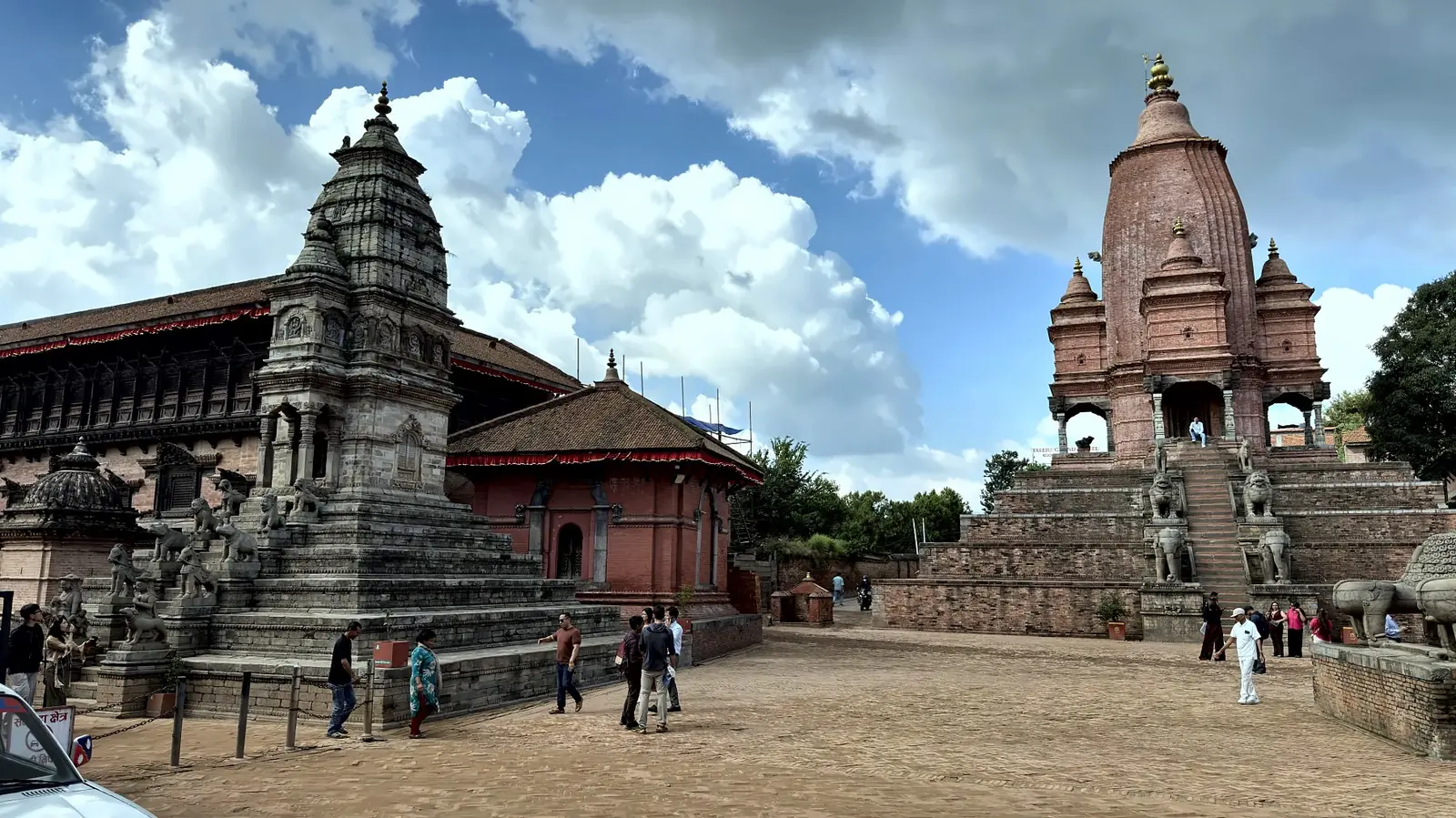
Stone shikhara temples on stepped plinths in Bhaktapur Durbar Square under a blue sky
Stone temples on Durbar Square in late-September sunshine. Photo: Govind Rai.

Bhaktapur itineraries: day trip or overnight

How long do you need in Bhaktapur? A half day covers the three main squares at a brisk pace; a full day lets you slow down, eat well and see the museums; one night gives you the best light and the quiet evening. These plans start from Kathmandu and can be slotted into a wider Nepal itinerary.
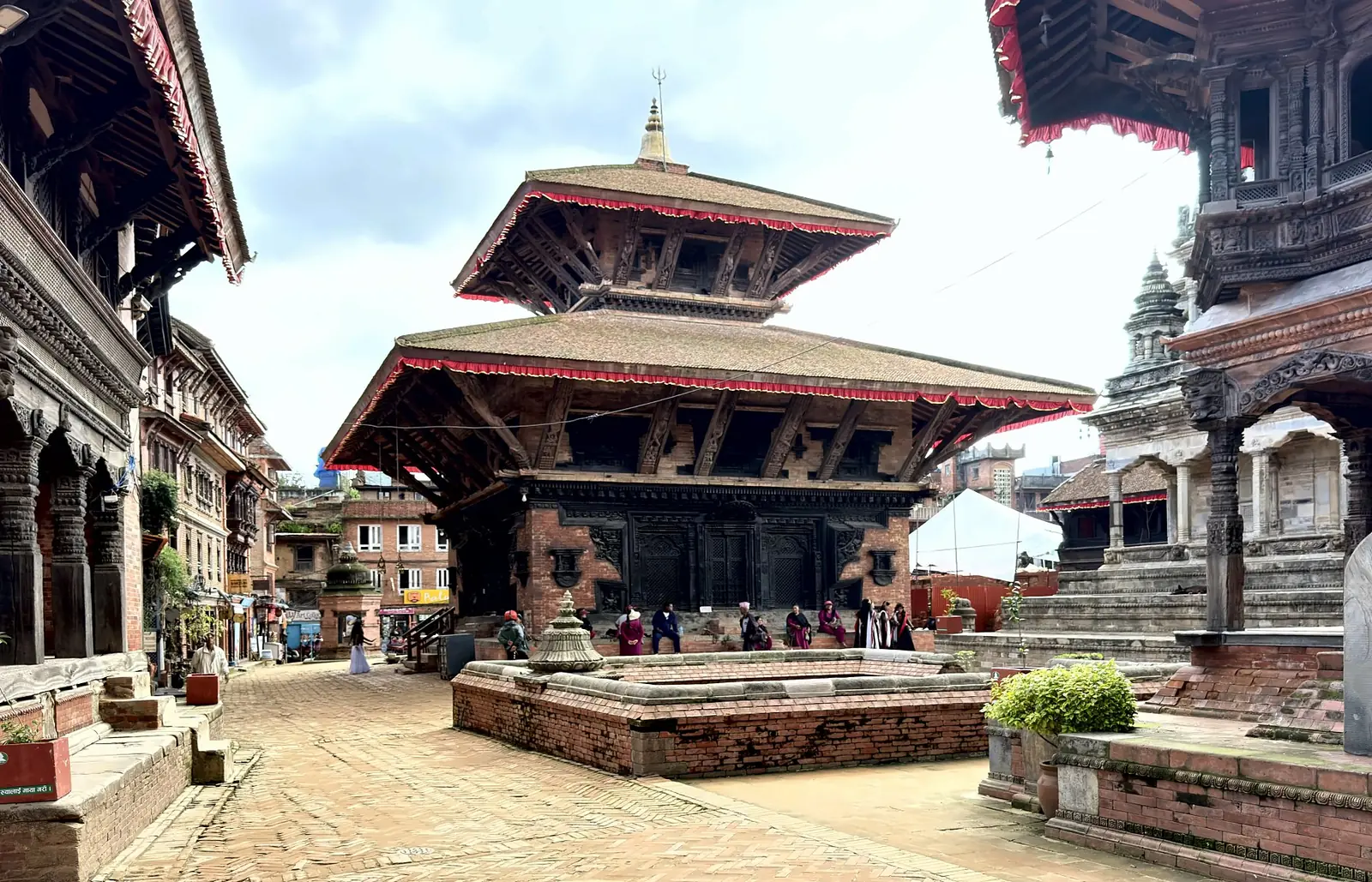
Large two-tiered pagoda temple and paved courtyard in Bhaktapur Durbar Square
Temples around Durbar Square, easy to cover in a half day. Photo: Govind Rai.

Half day: the highlights

  1. Leave Kathmandu by 7.30am to beat traffic; buy your ticket at the western entrance.
  2. Durbar Square: Golden Gate, 55-Window Palace, Vatsala temple and Chyasilin Mandap (1 hour).
  3. Walk to Taumadhi Square for Nyatapola and Bhairavnath (30 minutes).
  4. Pottery Square (20 minutes), then a cup of juju dhau.
  5. Return via Durbar Square, or continue to Dattatreya Square if time allows.

Full day: Bhaktapur properly

  1. Morning: Siddha Pokhari, then Durbar Square and the National Art Gallery.
  2. Late morning: Taumadhi Square and Pottery Square; try a short pottery lesson.
  3. Lunch: samay baji or bara at a local restaurant, juju dhau for dessert.
  4. Afternoon: walk the main street east to Dattatreya Square, the Peacock Window and the woodcarving museum.
  5. Late afternoon: down to Hanuman Ghat, then back to Taumadhi for tea on a rooftop as the light fades.

One night: Bhaktapur and Changu Narayan

Day 1: arrive by early afternoon, check in, see Durbar Square and Taumadhi in the late light and eat in the old town.

Day 2: dawn walk to Dattatreya Square to watch morning worship, breakfast of bara and tea, then a taxi (about 20–30 minutes) or a walk of roughly 1.5–2 hours uphill to the UNESCO-listed temple of Changu Narayan. Return to Kathmandu in the afternoon.

Two nights: Bhaktapur, Changu Narayan and Nagarkot

Day 1: Bhaktapur sights as in the full-day plan; stay overnight.

Day 2: morning in Dattatreya Square, then to Changu Narayan and on to Nagarkot (about 2,175 m) for sunset over the Himalaya; stay overnight. Fit walkers can hike Changu Narayan to Nagarkot in about 4–5 hours.

Day 3: sunrise from Nagarkot, then back to Kathmandu (about 1.5–2 hours), or walk down towards Bhaktapur through villages and terraces.

Day trip or overnight? If you only have one day for the whole valley, a half day here plus Patan or the stupas of Kathmandu works. If you have three or more days around Kathmandu, we strongly recommend one night in Bhaktapur: the evening and early morning are when it is most rewarding, and you avoid two rush-hour journeys.

Bhaktapur practical tips: fees, money and etiquette

Bhaktapur is one of the easier places in Nepal for visitors, but a few practical details make a big difference.

Entry fee and tickets

Foreign visitors pay a single fee covering the whole historic centre, collected by Bhaktapur Municipality at around 14 entry points. Since July 2025 the rate for non-SAARC foreigners has been reported as NPR 2,000 or US$15 (about £10–11). Citizens of SAARC countries and China pay NPR 500 (about £2.50); Nepalis enter free, and children under 10 have historically been free.

The rupee price is tied to the dollar and has risen several times (NPR 1,500 until 2022, NPR 1,800 from 2023), so check at the counter. Keep your ticket all day, as it is checked at gates and on side streets. Validity rules vary in reports: some say same-day, others that you can ask for re-entry over a week. For a longer stay, take your passport (and possibly a photo) to the ticket office and ask about an extended pass.
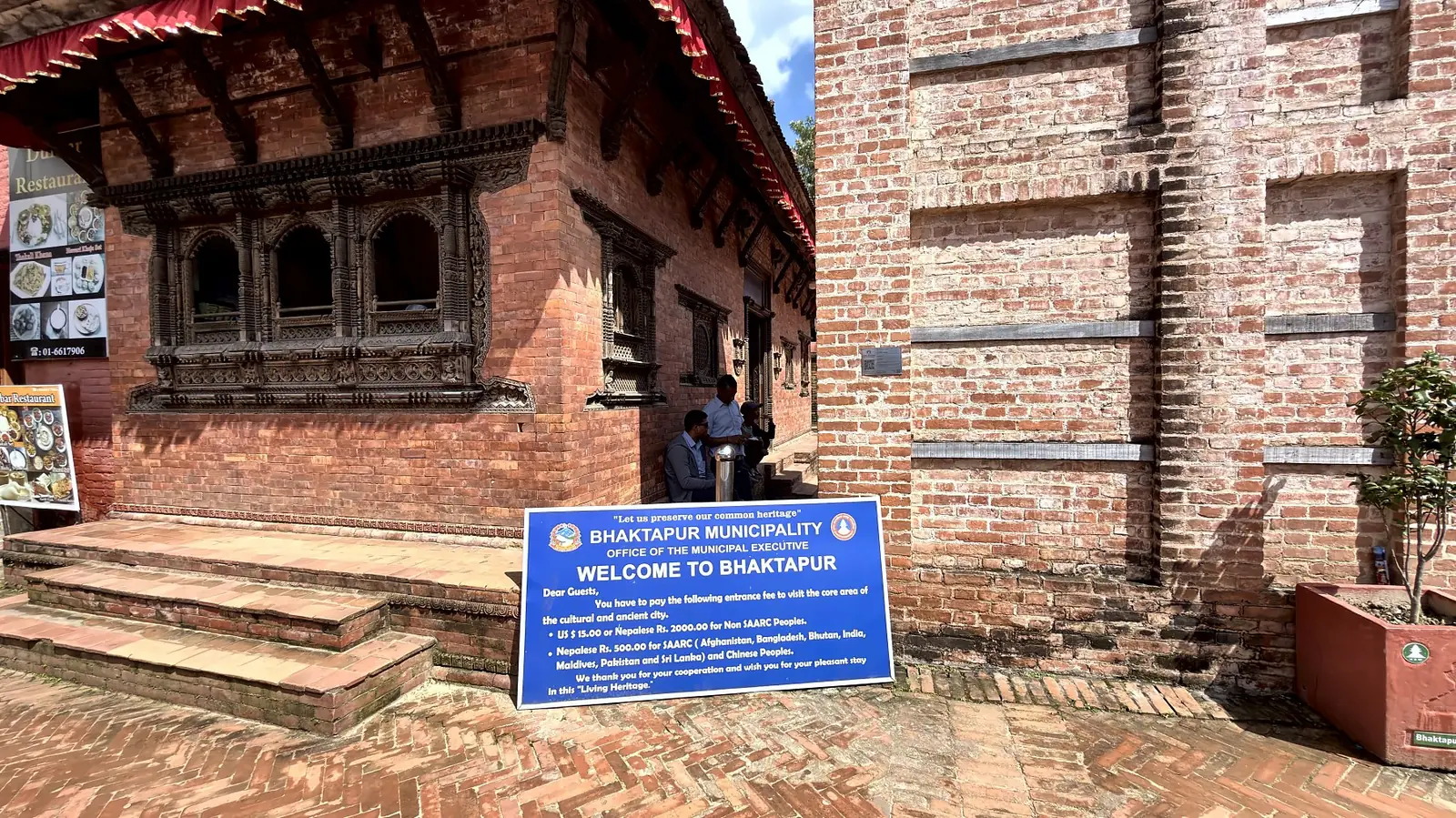
Blue Bhaktapur Municipality welcome board for visitors outside a carved brick building
Bhaktapur Municipality’s welcome board for visitors. Photo: Govind Rai.

Opening hours and museum fees

The old town is a living city, so there are no closing times as such. Ticket counters are staffed roughly from early morning to early evening. Museums (National Art Gallery, Woodcraft Museum, Brass and Bronze Museum) usually open around 10am and close by 4–5pm, with a separate small fee; they typically close on Tuesdays and public holidays. Hours change, so confirm locally.

Money and ATMs

Several ATMs operate around the edges of the old town and near Durbar Square, though they can be out of cash or reject foreign cards; carry enough rupees for the day. Small guesthouses, cafés, potters and snack stalls are cash only. Larger hotels and craft shops may take cards, sometimes with a surcharge. Pay the entry fee in rupees unless you have exact dollars.

SIM cards and internet

Mobile coverage from Nepal Telecom (NTC) and Ncell is good throughout Bhaktapur. Buy a tourist SIM at the airport or in Kathmandu with your passport. Most guesthouses and cafés offer free wi-fi of varying reliability.

Safety and current travel advice

Bhaktapur is generally safe and relaxed, including after dark in the main squares. The usual city precautions apply: watch for pickpockets in festival crowds and on buses, and keep well clear of chariots during Bisket Jatra. Uneven steps and temple plinths are a real hazard at night, so carry a torch.

Political demonstrations occur in Nepal and can escalate; the unrest in Kathmandu in September 2025 led to curfews. The UK Foreign, Commonwealth and Development Office (FCDO) advises avoiding protests and following local authorities, and in 2026 has highlighted monsoon flooding and landslide risks in some districts. Check current FCDO (or your own government’s) advice before you travel.

Health

At around 1,400 m there is no altitude risk. Drink bottled, filtered or treated water rather than tap or spout water, and choose busy food stalls where food is cooked fresh. Juju dhau is generally safe from established shops. Dust and traffic pollution can be heavy in winter and pre-monsoon on the drive in; a mask helps.

Dress and etiquette

Dress modestly, covering shoulders and knees, particularly in temples. Remove shoes before entering shrines and walk clockwise around stupas and temples. Leather items are not welcome inside some Hindu precincts, and the Taleju temple and the inner shrine of several others are closed to non-Hindus. Do not touch offerings, sit on shrines, or step over people or offerings. Always ask before photographing people, especially at work or at prayer, and never at cremations.

Responsible travel

Your entry fee directly funds conservation and civic services, so pay it rather than slipping in through side lanes. Buy crafts directly from workshops, eat in local family-run restaurants, and carry a refillable bottle (many guesthouses refill filtered water for a small fee). Use a licensed local guide if you want depth: the stories behind the carvings are much of the appeal. Drones need permits in Nepal and are not welcome over heritage sites.

Visas and planning

Most nationalities get a tourist visa on arrival or apply online in advance; see our Nepal visa guide. Your passport and visa may also be needed if you want an extended Bhaktapur ticket.

What to combine with Bhaktapur

Bhaktapur combines naturally with the rest of the eastern valley, and with the bigger journeys most people come to Nepal for.

Changu Narayan

A few kilometres north of Bhaktapur on a ridge, Changu Narayan is often described as the oldest temple in the valley, with a stone inscription from the 5th century AD, and is part of the Kathmandu Valley UNESCO World Heritage Site. The two-tiered pagoda and its courtyard of stone sculpture are excellent; a small village and museum surround it. The foreign entry fee was reported as NPR 400 (about £2) in 2025. Allow 1–2 hours plus travel; a taxi takes about 20–30 minutes from Bhaktapur, or you can walk up in roughly 1.5–2 hours.

Nagarkot

Nagarkot is a ridge-top village at about 2,175 m, roughly 12–13 km from Bhaktapur (about 45–60 minutes by car), known for sunrise and sunset views of the Himalaya on clear days, mainly October to March. Many travellers do Bhaktapur, Changu Narayan and Nagarkot as a two- or three-day loop, staying a night at each end.

Patan and Kathmandu

Patan, the valley’s other royal city, has the finest museum in Nepal and a superb Durbar Square, and is easily combined with Bhaktapur on a full-day tour. In Kathmandu, pair Bhaktapur with Pashupatinath and Boudhanath Stupa, which lie on the way back from the east of the valley.

Thimi

Madhyapur Thimi, between Kathmandu and Bhaktapur, is a smaller Newar town known for pottery and papier-mâché masks, and for its sindoor-throwing procession the day after Nepali New Year. It sees very few tourists and has no entry fee. You can reach it by bus or taxi in about 15–20 minutes from Bhaktapur.

Treks after the valley

Bhaktapur is an ideal rest day before or after a trek. If you are heading to the mountains, our Everest Base Camp Trek (16 days, from £1,295) and Annapurna Base Camp Trek (15 days, from £795) both start and end in Kathmandu, so one night in Bhaktapur fits easily at either end. For more ideas, browse our things to do in Nepal.

Plan your trip with Get Lost Forever. We work with licensed ground partners in Nepal and can add Bhaktapur, Nagarkot and the valley’s heritage sites to a trek or build a tailor-made itinerary around them. Tell us your dates and interests on our plan your trip page, or explore more of Nepal.

Photos: Govind Rai, September 2026.

Frequently asked questions about Bhaktapur

Since July 2025 the fee for non-SAARC foreigners has been reported as NPR 2,000 or US$15 (about £10–11). Citizens of SAARC countries and China pay NPR 500 (about £2.50), and Nepalis enter free. One ticket covers the whole historic centre, not just Durbar Square. Fees change, so check at the counter.

Yes. It is the best-preserved of the Kathmandu Valley’s three royal cities, with largely traffic-free streets, outstanding Newar architecture and a strong sense of everyday life. Many travellers rank it as their favourite place in the valley.

A half day covers the main squares; a full day lets you see the museums, Pottery Square and Dattatreya Square without rushing. If you have time, stay one night to enjoy the quiet evening and early morning.

A taxi from Thamel takes about 40–75 minutes and costs roughly NPR 1,400–1,500 (about £7–8) one way. Local buses from Ratna Park and the Old Bus Park cost around NPR 50–80 and take 45–75 minutes. Ride-hailing apps such as inDrive and Pathao also work.

Reports differ. Some recent sources say tickets are valid for the day, others that you can ask for re-entry over about a week. If you are staying longer, take your passport to the ticket office and ask about an extended pass. Tell them if you are staying overnight in the old town.

Its Durbar Square, the five-storey Nyatapola temple, Pottery Square, woodcarving such as the Peacock Window, the Bisket Jatra festival, and juju dhau, the rich “king curd” yoghurt made in clay pots.

Juju dhau, meaning “king of curds”, is a thick, sweet yoghurt made from buffalo milk and set in unglazed clay pots. It is a Bhaktapur speciality sold in small shops across the old town for roughly NPR 50–100 (about £0.25–0.50) a cup.

Bisket Jatra is held around Nepali New Year in mid-April and lasts about nine days. In 2026 it ran from roughly 10 to 18 April, with New Year on 14 April. Dates shift slightly each year, so check before booking.

Yes, and we recommend it. The old town has family guesthouses from around NPR 2,000 (about £10) and boutique heritage hotels from around NPR 10,000 (about £50). Evenings and early mornings are far quieter than the day.

They are different rather than better. Bhaktapur feels more like a complete medieval town and is quieter; Patan has the finer museum, more Buddhist monasteries and better metalwork shopping. With a full day you can see both.

Yes. Changu Narayan is about 20–30 minutes by taxi north of Bhaktapur, and Nagarkot is about 45–60 minutes away. A popular plan is Bhaktapur and Changu Narayan on one day, then sunset and sunrise at Nagarkot.

Plan it with us

Ready to explore Bhaktapur?

Tell us your dates and interests and our team will shape a Bhaktapur trip around you: local guides, small groups and honest advice.

Plan my trip