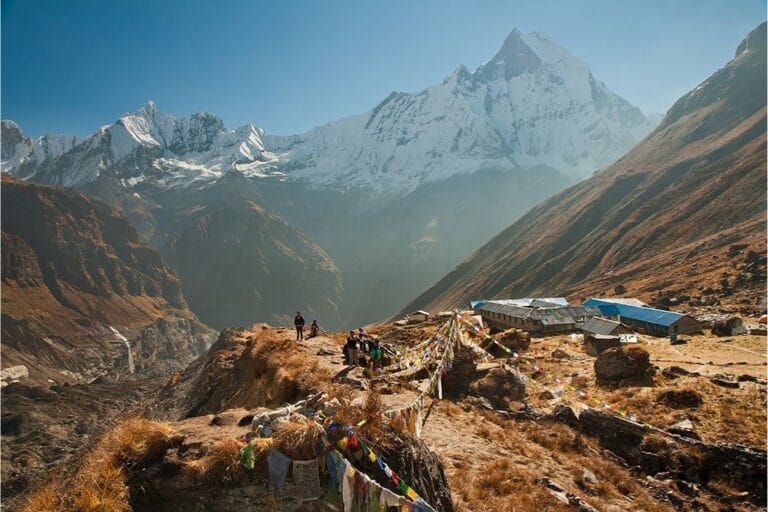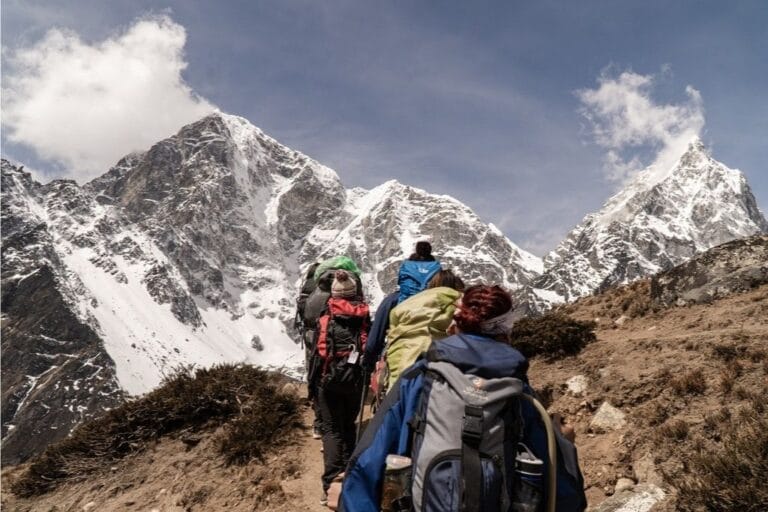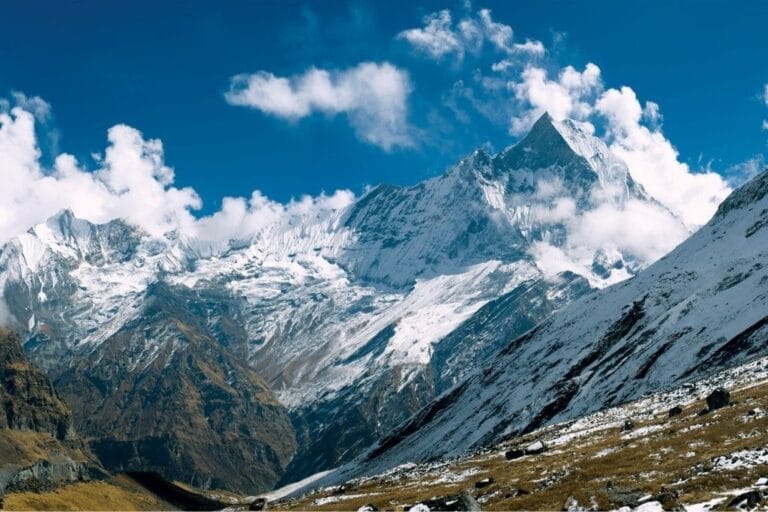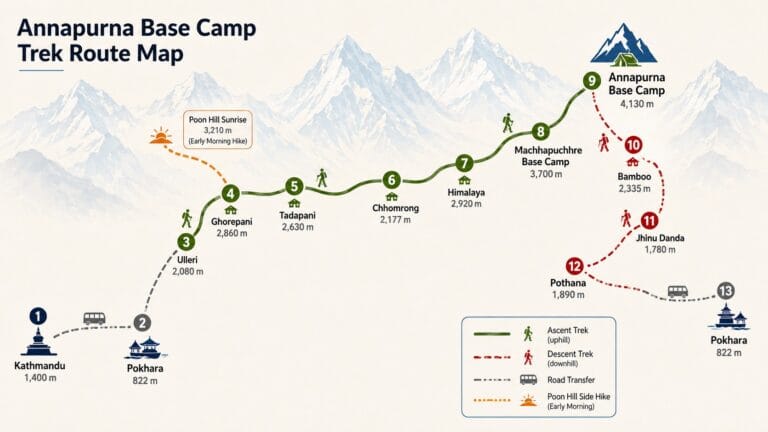

The Annapurna Base Camp trek typically costs US$400–1,200 (about £300–900) per person from Pokhara for a 7–10 day guided trek, and roughly US$1,100–2,000 (about £825–1,500) door to door from Kathmandu once you add domestic transport, insurance, tips and gear, but not international flights. Your biggest variables are trek length, whether you hire a guide and porter privately or book a package, and how you travel between Kathmandu, Pokhara and the trailhead.
This guide breaks down every cost line for 2026/27, from the ACAP permit and guide wages to dal bhat prices at 4,130 m, with budget, mid-range and comfort tables and sample totals for 7- and 10-day treks. For the full route overview, start with our Annapurna Base Camp trek guide.
Annapurna Base Camp trek cost at a glance
| Cost item | Typical 2026 price | Approx. GBP |
|---|---|---|
| ACAP permit (foreign nationals) | NPR 3,000 | £15 |
| ACAP permit (SAARC nationals, including India) | NPR 1,000 | £5 |
| TIMS card (if asked for) | NPR 2,000 foreign / NPR 1,000 SAARC | £10 / £5 |
| Licensed trekking guide | US$25–40 per day | £19–30 per day |
| Porter (up to about 20 kg, often shared by two) | US$15–30 per day | £11–23 per day |
| Teahouse room | US$5–30 per night (rises with altitude) | £4–23 |
| Food and drinking water | US$20–45 per day | £15–34 per day |
| Kathmandu–Pokhara | US$15–25 bus / US$100–150 flight (one way) | £11–19 / £75–113 |
| Pokhara–trailhead jeep | US$10–30 shared / US$80–150+ private (one way) | £8–23 / £60–113+ |
| Tips (guide and porter) | Roughly 10–15% of their wages | £40–120 per trekker |
| Trekking insurance with helicopter rescue | US$80–200 | £60–150 |
| Gear rental in Pokhara or Kathmandu | About US$1–3 per item per day | £1–2 per item per day |
All figures are approximate and based on 2025–2026 operator price lists and published guides. We convert at NPR 200 ≈ £1 and US$1 ≈ £0.75; check live exchange rates before you travel.
What affects the ABC trek cost?
Annapurna Base Camp is one of the best-value high treks in Nepal because there are no flights to a mountain airstrip. Unlike Everest, where the Lukla flight alone can cost several hundred dollars return, you can reach the ABC trailheads by road from Pokhara in two to four hours. That is the main reason ABC usually works out cheaper than Everest Base Camp; our ABC vs EBC comparison looks at the trade-offs in detail.
Five things move your total the most:
- Number of days. Guide, porter, room and food costs are all charged per day, so a 10-day itinerary costs roughly 40% more on the trail than a 7-day one. See our ABC itinerary options for 5- to 12-day plans.
- Package or self-arranged. Agencies bundle permits, staff, transport and often meals, and add a margin. Arranging it yourself is cheaper but takes more time and organisation.
- Transport choices. Flying Kathmandu–Pokhara and taking a private jeep to the trailhead can add US$300–400 (£225–300) compared with the tourist bus and a shared jeep.
- Season. Rooms fill up in October–November and March–April, and some lodges charge more at peak times. Our guide to the best time to trek Annapurna Base Camp covers the seasons.
- Your spending habits. Hot showers, charging, Wi-Fi, bottled drinks, beer and snacks add up quickly above Chhomrong, where everything is carried in by porter or mule.
Package price vs independent cost
There are three common ways to do the trek, and the price gap between them is smaller than many people expect once a guide is included.
| Approach | Typical price (per person) | What you get | Best for |
|---|---|---|---|
| Guide only, self-arranged | US$150–350 (£115–265) for the guide, plus your own food, rooms and transport | A licensed guide; you pay teahouses directly | Experienced trekkers who want control over pace and spending |
| Local Nepali agency package | US$450–1,100 (£340–825) for 7–12 days from Pokhara or Kathmandu | Guide, porter (often), permits, ground transport, rooms; meals vary | Most first-timers and small groups |
| Overseas operator / tour company | US$900–2,500 (£675–1,875) | Pre-trip support, fixed departures, hotels, more meals, UK or US booking protection | Travellers who want everything arranged and a home-country point of contact |
Our own Annapurna Base Camp trek is a 15-day land-only trip from Kathmandu, priced from £795 per person at the time of writing, with hotels, teahouses, private ground transfers, a trek leader and porter service included. It is run with a licensed Nepali partner. Always compare what is included rather than the headline price: some cheap packages exclude permits, meals or the jeep back to Pokhara.
Can you trek ABC without a guide?
Since 1 April 2023 the Nepal Tourism Board has required foreign trekkers in most of Nepal’s protected trekking areas, including the Annapurna Conservation Area, to go with a licensed guide arranged through a registered agency. Enforcement on the ABC trail has been inconsistent and independent trekkers are still reported on the route, but the rule has not been formally withdrawn. We recommend budgeting for a licensed guide: it keeps you within the rules, and a guide is valuable for altitude and avalanche-zone judgement above Deurali.
Annapurna Base Camp permit costs
The whole ABC route sits inside the Annapurna Conservation Area, so the key permit is the Annapurna Conservation Area Project (ACAP) entry permit, managed by the National Trust for Nature Conservation (NTNC).
| Permit | Foreign nationals | SAARC nationals (incl. India) | Notes |
|---|---|---|---|
| ACAP entry permit | NPR 3,000 (about £15 / US$20–23) | NPR 1,000 (about £5) | Children under 10 free. Single entry, non-transferable, non-refundable. |
| ACAP bought at a trail checkpoint | Reported at double the fee (NPR 6,000) | Double the fee | Buy in advance to avoid this. |
| TIMS card | NPR 2,000 | NPR 1,000 | Status disputed on ABC (see below). |
You can get the ACAP permit at the Nepal Tourism Board office in Kathmandu (Bhrikutimandap) or the NTB/ACAP counter in Pokhara, with your passport, two passport photos and cash in rupees. NTNC also runs an online e-permit system, which adds a card charge of around 2.9%. If you book with an agency, the permit is normally included.
Do you need a TIMS card for Annapurna Base Camp?
This is the most confusing permit question on the route, and published sources genuinely disagree. Some 2025–2026 guides say the TIMS card is no longer required in the Annapurna region since the 2023 guide rule; others say it is still officially listed but rarely checked, with checkpoints only inspecting the ACAP permit. Agencies issue it as part of their paperwork where needed. Our advice: if you book through an agency, let them handle it; if you are arranging the trek yourself, budget NPR 2,000 (about £10) and ask at the NTB office when you collect your ACAP permit.
Nepal visa (not an ABC cost, but part of your budget)
Most nationalities, including UK, US and Australian passport holders, buy a tourist visa on arrival: US$30 for 15 days, US$50 for 30 days or US$125 for 90 days. A 15-day visa is tight for anything but the shortest ABC itinerary once arrival and departure days are added, so most trekkers need the 30-day visa (about £38). See our things to know before travelling to Nepal for entry details.
ABC trek cost for Indian and SAARC trekkers
Indian trekkers are the biggest group searching for ABC prices, and costs are noticeably lower for them:
- No visa. Indian nationals do not need a visa for Nepal. Other SAARC citizens (except Afghanistan) can usually get a free 30-day visa on their first visit in a visa year.
- Lower ACAP fee. SAARC nationals pay NPR 1,000 (about ₹625) rather than NPR 3,000.
- Overland travel. Many Indian trekkers travel by bus or train to the Sunauli/Bhairahawa or Raxaul/Birgunj borders and continue by road to Pokhara, skipping Kathmandu altogether.
- Same trail costs. Teahouse rooms, food, guides and porters cost the same for everyone. Some agencies offer separate, lower “Indian packages”, typically with shared rooms and simpler meals.
As a rough guide, a 7-day guided ABC trek from Pokhara for an Indian trekker on a budget comes to around ₹35,000–55,000 (about £280–440) per person on the ground, depending on whether the guide and porter costs are shared within a group. The Indian rupee is pegged at about 1.6 Nepali rupees; carry Nepali rupees for the trail, as lodges may not accept larger Indian notes.
Guide and porter costs
Guide and porter wages are usually the largest single on-trail cost, but they are split between your group, so they fall sharply per person for two or more trekkers.
| Staff | Typical daily rate (2026) | Approx. GBP | 7 days | 10 days |
|---|---|---|---|---|
| Licensed trekking guide | US$25–40 (NPR 3,500–6,000) | £19–30 | US$175–280 (£130–210) | US$250–400 (£190–300) |
| Porter | US$15–30 (NPR 2,000–4,500) | £11–23 | US$105–210 (£80–160) | US$150–300 (£115–225) |
| Porter-guide (carries some kit and guides) | US$25–30 | £19–23 | US$175–210 (£130–160) | US$250–300 (£190–225) |
When you hire through a reputable agency, the daily rate should cover the staff member’s food, accommodation and insurance. Confirm this in writing, along with who pays their transport to and from the trailhead. A porter normally carries up to about 20 kg, which is why two trekkers often share one porter with a combined bag. Many packages, including ours, limit each trekker’s porter bag to around 10–12 kg.
Please do not overload or underpay porters. Ask your agency whether porters have proper footwear, warm clothing and insurance; this is part of responsible trekking, and a lower price can sometimes mean corners are being cut on staff welfare.
Teahouse accommodation and food costs by altitude
ABC is a teahouse trek: you sleep in simple lodges and eat in their dining rooms. Prices climb steadily with altitude because supplies above Chhomrong are carried in on foot. In the conservation area, teahouse menus and prices are generally set by local lodge management committees, so prices are similar between lodges in the same village.
| Trail section | Altitude | Room per night | Food per day |
|---|---|---|---|
| Ghandruk, Jhinu Danda, Chhomrong, Ulleri, Ghorepani | 1,780–2,860 m | US$5–12 (£4–9) | US$18–25 (£14–19) |
| Sinuwa, Bamboo, Dovan | 2,340–2,600 m | US$8–15 (£6–11) | US$25–32 (£19–24) |
| Himalaya, Deurali, Machhapuchhre Base Camp | 2,920–3,700 m | US$15–25 (£11–19) | US$30–40 (£23–30) |
| Annapurna Base Camp | 4,130 m | US$20–30 (£15–23) | US$35–45 (£26–34) |
Some lodges keep room prices very low on the condition that you eat dinner and breakfast with them, so do not expect to shop around for meals. In peak season, rooms at Machhapuchhre Base Camp and ABC are limited and you may have to share or sleep in the dining room; your guide will usually phone ahead.
Typical menu prices on the ABC trail
| Item | Lower trail | Upper trail (Deurali to ABC) |
|---|---|---|
| Dal bhat (with refills) | NPR 700–900 (£3.50–4.50) | NPR 1,000–1,500 (£5–7.50) |
| Noodles, fried rice, pasta | NPR 500–800 | NPR 800–1,200 |
| Breakfast (porridge, eggs, Tibetan bread) | NPR 500–800 | NPR 700–1,100 |
| Cup of tea | NPR 100–150 | NPR 200–250 |
| Boiled water, per litre | NPR 100–150 | NPR 200–300 |
| Hot shower | NPR 200–300 | NPR 300–500 (where available) |
| Device charging / Wi-Fi | NPR 100–300 | NPR 200–500 |
Two habits save real money: eat dal bhat, which comes with free refills, and treat your own water with a filter or purification tablets instead of buying bottles. Plastic bottles are discouraged in the conservation area, and treating water can save around US$40–70 (£30–50) over the trek.
Transport costs: Kathmandu, Pokhara and the trailheads
Kathmandu to Pokhara
| Option | Time | One-way price | Approx. GBP |
|---|---|---|---|
| Tourist bus | 6–8 hours (longer during road works) | US$15–25 | £11–19 |
| Deluxe / sofa bus | 6–8 hours | US$25–35 | £19–26 |
| Private car or jeep | 6–7 hours | US$120–200 per vehicle | £90–150 |
| Domestic flight | About 25 minutes | US$100–150 per person | £75–113 |
The road is about 200 km and is often slow because of traffic and ongoing widening work. If you have limited time, flying one way and taking the bus the other is a sensible compromise. Kathmandu has more to see than many trekkers allow time for; our Kathmandu guide has ideas for a spare day.
Pokhara to the ABC trailheads
Jeep roads now reach deep into the Modi Khola valley, which is why short ABC itineraries are possible. The common drop-off points are:
| Trailhead | Drive from Pokhara | Shared jeep/bus (one way) | Private jeep (one way) |
|---|---|---|---|
| Nayapul / Birethanti (for Ghorepani and Poon Hill) | 1.5–2.5 hours | US$5–15 (£4–11) | US$50–90 (£38–68) |
| Kimche / Ghandruk | 2–3 hours | US$10–20 (£8–15) | US$70–120 (£53–90) |
| Siwai / Matkyu / Jhinu Danda road | 2.5–4 hours | US$10–30 (£8–23) | US$80–150+ (£60–113+) |
A private jeep holds about six people with luggage, so it is good value for a small group. Rural roads become rough or blocked after heavy rain, especially in the monsoon, so treat drive times as a guide and keep a little slack in your plans.
Travel insurance and emergency evacuation
Insurance is not optional for ABC. Your policy must explicitly cover trekking to at least 4,500 m (we suggest 5,000 m for margin) and helicopter search, rescue and evacuation. For UK travellers, specialist trekking policies for a 2–3 week trip typically cost around £60–150, rising with age, cancellation cover and gadget cover.
A helicopter evacuation from the upper Annapurna Sanctuary can easily cost several thousand US dollars, and rescue operators may want proof of cover before they fly. Read our guide to travel insurance for trekking for what to look for, and our safety tips for trekking in Nepal for the bigger picture.
Gear costs: rent, buy or bring
You do not need technical equipment for ABC in the main seasons, but you do need warm layers: nights at base camp are often below freezing from October to April. Pokhara’s Lakeside has many rental and outdoor shops.
| Item | Rental per day | Buy locally (approx.) |
|---|---|---|
| Down jacket | US$1–2 | US$40–100 |
| Four-season sleeping bag | US$1–2 | US$50–120 |
| Trekking poles | About US$1 | US$10–30 |
| Microspikes (winter/early spring) | US$2–3 | US$15–30 |
| Rucksack (50–65 L) | US$1–3 | US$30–80 |
For a 7–10 day trek, renting a down jacket, sleeping bag and poles usually costs around US$25–50 (£19–38). Bring broken-in boots from home rather than renting them; blisters can end a trek. Our free trek packing checklist lists everything you need.
Tips for guides and porters
Tipping is expected in Nepal’s trekking industry and forms an important part of staff income. A common guideline is 10–15% of the guide’s or porter’s total wages, given at the end of the trek, ideally directly to each person rather than through the lead guide.
- Guide: roughly US$5–10 (£4–8) per day from the group.
- Porter: roughly US$3–7 (£2–5) per day from the group.
For a 7-day trek with one guide and one porter, a group tip of around US$60–120 (£45–90) is typical. Bring this in Nepali rupees, as there are no ATMs on the trail.
Hidden costs and extras
- Hot showers, charging and Wi-Fi: US$60–130 (£45–100) over a 9-day trek if you use them daily. A power bank cuts this.
- Snacks and treats: chocolate bars, coffee and beer are several times Pokhara prices at altitude.
- Jhinu Danda hot springs: a small entry fee, around NPR 150–200.
- Weather or road delays: an extra night with meals costs around US$20–40 (£15–30). Keep a spare day before your flight home.
- Hotels in Kathmandu and Pokhara: from about US$15–30 (£11–23) for a simple guesthouse to US$60–150 (£45–113) for a comfortable hotel.
- ATM fees: Nepali ATMs typically charge a fee per withdrawal and have low limits. Withdraw enough in Pokhara for the whole trek.
Sample ABC budgets: budget, mid-range and comfort
These per-day ranges cover on-trail spending from Pokhara for one person, assuming two trekkers share a guide and porter.
| Style | Per day on trail | What it looks like |
|---|---|---|
| Budget | US$50–70 (£38–53) | Shared guide, no porter or shared porter-guide, dal bhat, treated water, shared jeep |
| Mid-range | US$75–110 (£56–83) | Guide plus shared porter, varied meals, occasional showers and charging, private jeep shared by the group |
| Comfort | US$120–180 (£90–135) | Agency package, best available rooms, all meals, private transport, flight Kathmandu–Pokhara |
Sample total: 7-day ABC trek from Pokhara
| Item | Budget | Mid-range | Comfort |
|---|---|---|---|
| ACAP permit (+ TIMS if needed) | US$20–35 | US$20–35 | Included |
| Guide (7 days, half share) | US$90–105 | US$105–125 | Included |
| Porter (7 days, half share) | US$0–55 | US$55–90 | Included |
| Rooms and food (6 nights) | US$190–230 | US$240–300 | Included |
| Jeep Pokhara–trailhead return | US$25–50 | US$50–100 | Included |
| Agency package (all of the above) | – | – | US$650–1,000 |
| Tips | US$35–50 | US$50–70 | US$70–100 |
| Extras (showers, charging, snacks) | US$30–50 | US$60–90 | US$90–130 |
| Total per person (from Pokhara) | US$390–575 (£290–430) | US$580–810 (£435–610) | US$810–1,230 (£610–925) |
Sample total: 10-day ABC trek with Poon Hill from Pokhara
| Item | Budget | Mid-range | Comfort |
|---|---|---|---|
| ACAP permit (+ TIMS if needed) | US$20–35 | US$20–35 | Included |
| Guide (10 days, half share) | US$125–150 | US$150–180 | Included |
| Porter (10 days, half share) | US$0–75 | US$75–125 | Included |
| Rooms and food (9 nights) | US$260–320 | US$330–420 | Included |
| Jeep transfers | US$20–45 | US$45–90 | Included |
| Agency package (all of the above) | – | – | US$900–1,300 |
| Tips | US$50–70 | US$70–100 | US$100–140 |
| Extras | US$45–70 | US$80–120 | US$120–170 |
| Total per person (from Pokhara) | US$520–765 (£390–575) | US$770–1,070 (£580–800) | US$1,120–1,610 (£840–1,210) |
To turn either total into a door-to-door figure from Kathmandu, add Kathmandu–Pokhara transport (US$30–300 return), two to four hotel nights (US$30–400), insurance (US$80–200), a visa (US$50) and gear rental (US$25–50). A solo trekker pays the full guide and porter cost, which adds roughly US$150–350 (£115–265) to the figures above.
How to reduce the cost without cutting safety
- Share a guide and porter. Trekking with a friend or joining a small group halves the largest cost line.
- Use the jeep roads wisely. A shared jeep to Jhinu Danda or Siwai saves a day or two of walking (and of daily costs), but do not use the time saved to rush the altitude.
- Take the bus to Pokhara. It costs around a tenth of the flight.
- Eat dal bhat and treat your water. Simple food and your own water purification save more than you might think.
- Rent rather than buy bulky items. Down jackets and sleeping bags are cheap to hire in Pokhara.
- Trek in shoulder season. Early December and late February can be quieter and cheaper, though colder; check conditions and avalanche advice first.
Never save money by skipping insurance, cutting acclimatisation days or hiring an unlicensed “guide” on the street. Read up on how hard the ABC trek is so you can choose a realistic itinerary, and on altitude sickness, which follows the same principles above 3,000 m in the Annapurna region.
Is the Annapurna Base Camp trek worth the cost?
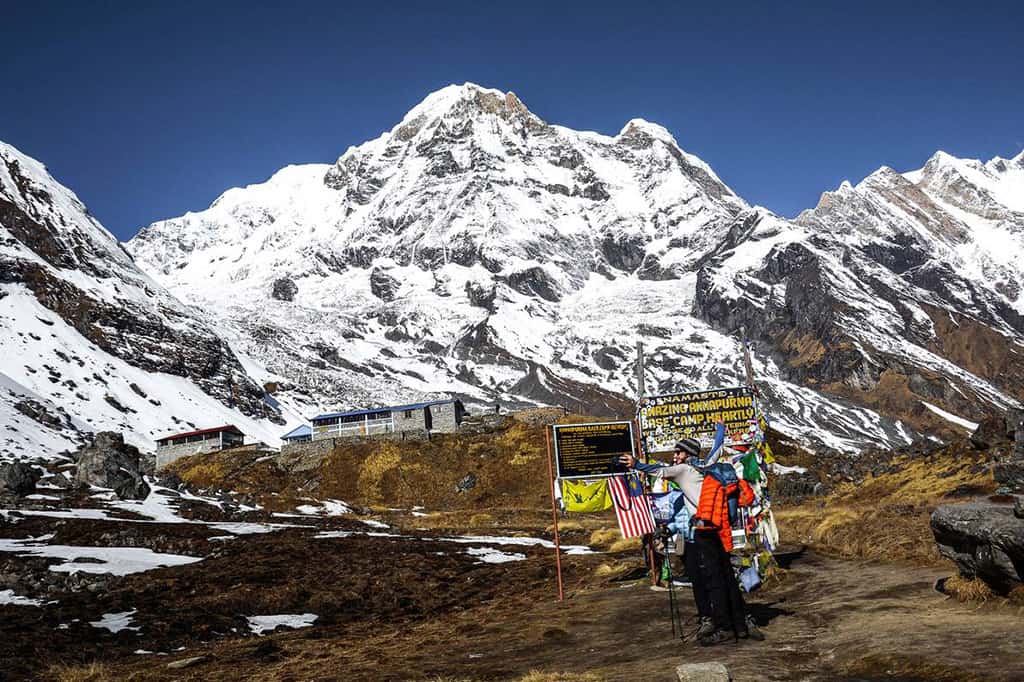
For most trekkers, yes. For roughly half the cost of a typical Everest Base Camp trek (see our EBC cost breakdown), you walk through Gurung villages, rhododendron and bamboo forest and into a high glacial amphitheatre ringed by Annapurna I, Hiunchuli and Machhapuchhre. It fits into a two-week holiday, and the road access means fewer weather-related flight delays than Lukla. If you have more time, it combines well with other treks from Pokhara or a stay in the Annapurna villages such as Ghandruk.
Plan your Annapurna Base Camp trek
A realistic budget for most trekkers is £450–800 on the ground from Pokhara, or £850–1,500 door to door from Kathmandu excluding international flights. If you want permits, guide, porter, transport and accommodation arranged for you with a licensed local partner, see our Annapurna Base Camp trek or get in touch to plan your trip.
Frequently asked questions
How much does the Annapurna Base Camp trek cost per person?
Most trekkers spend about US$400–1,200 (£300–900) per person on the ground from Pokhara for a 7–10 day guided trek, or US$1,100–2,000 (£825–1,500) door to door from Kathmandu, excluding international flights. Solo trekkers pay more because they cannot share the guide and porter.
What is the ABC trek cost for Indian trekkers?
Indian nationals need no visa and pay the SAARC ACAP rate of NPR 1,000 instead of NPR 3,000. A budget 7-day guided trek from Pokhara typically costs around ₹35,000–55,000 per person, depending on group size and how many days you walk.
How much is the ACAP permit for Annapurna Base Camp?
The ACAP entry permit costs NPR 3,000 (about £15) for foreign nationals and NPR 1,000 (about £5) for SAARC nationals; children under 10 are free. Buy it in Kathmandu or Pokhara, or online, because buying at a trail checkpoint is reported to cost double.
Is a TIMS card required for Annapurna Base Camp in 2026?
Sources disagree. Some say TIMS has not been needed in the Annapurna region since April 2023; others say it is still listed but rarely checked. Agencies arrange it if required. If you are organising the trek yourself, budget NPR 2,000 and confirm at the Nepal Tourism Board office.
How much should I pay a guide and porter for ABC?
A licensed guide typically costs US$25–40 per day and a porter US$15–30 per day in 2026. Through an agency, this should include their food, accommodation and insurance. Add a tip of roughly 10–15% of their wages at the end of the trek.
Is it cheaper to book an ABC package or go independently?
Arranging the trek yourself with a hired guide is usually 15–30% cheaper than a local package, but you handle permits, transport and lodges yourself. Packages save time, include transport and permits, and are better value for solo trekkers who would otherwise pay a guide alone.
How much cash should I carry on the ABC trek?
There are no ATMs on the trail, so withdraw in Pokhara. For a self-arranged trek, carry roughly US$35–60 (NPR 5,000–9,000) per day for rooms, food and extras, plus your tips and an emergency reserve of US$100–150. On a package with meals included, US$15–25 per day plus tips is usually enough.
Is Annapurna Base Camp cheaper than Everest Base Camp?
Yes, usually by around 30–50%. ABC is shorter, has no Lukla flight, and needs only one main permit. A typical ABC package costs US$500–1,100, against roughly US$1,400–2,000 for an EBC package from a Nepali agency.