
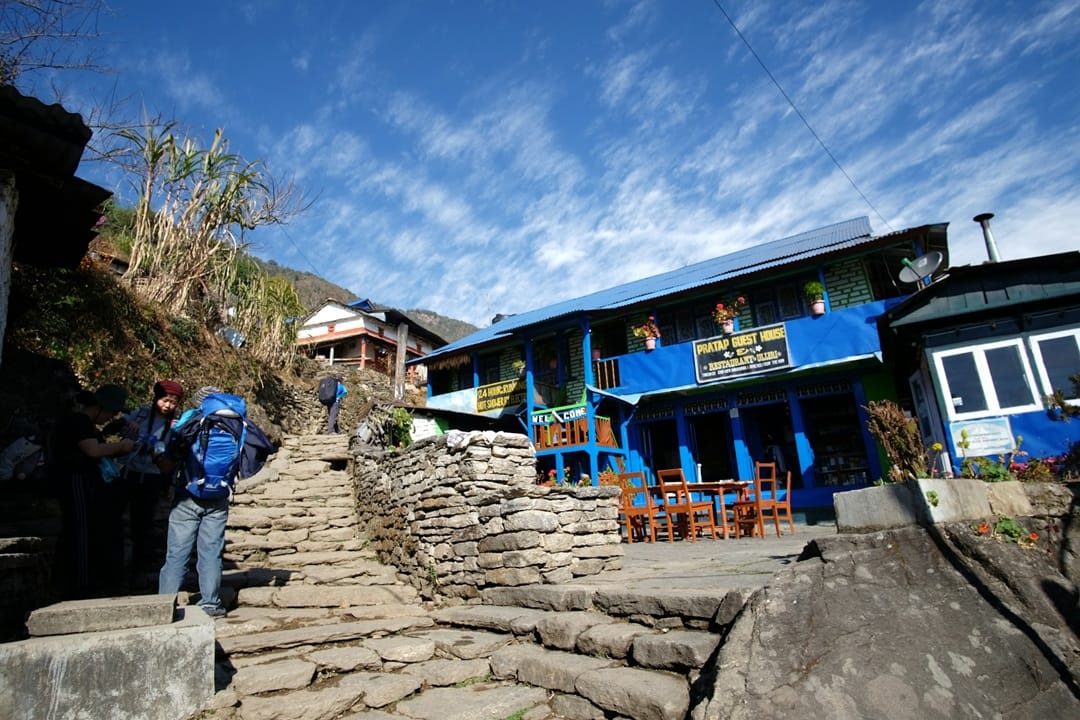
Everest Base Camp teahouses are mountain lodges where trekkers sleep, eat and spend the evening between walking days. Standard accommodation commonly means a simple twin bedroom, a communal dining room and shared bathroom facilities. Some properties offer more comfort, but a private bathroom, hot shower, heated bedroom or reliable Wi-Fi should never be assumed.
The important distinction is between what a lodge offers, what your room includes and what is working when you arrive. An attached toilet does not necessarily mean an attached shower, and a shower does not necessarily mean hot water is included.
This guide explains accommodation and food on the Nepal side of the EBC trek, with practical questions to ask before booking.
What is a teahouse on the Everest Base Camp trek?
A teahouse provides overnight accommodation and meals along the trekking route. You will also see the spelling “tea house”. Despite the name, it is more than somewhere to stop for tea. Buildings range from small guesthouses to larger lodges with different room categories.
“Tea house”, “lodge” and “hotel” are not dependable quality grades. Look at the actual room, bathroom, heating and meal arrangements rather than relying on the name.
The Nepal Tourism Board’s EBC guide describes teahouses along the route, including at Gorak Shep, the final settlement before Base Camp.
Do you sleep at Everest Base Camp itself?
On the usual teahouse itinerary, trekkers stay at Gorak Shep, visit Base Camp and return to their lodge. Expedition camping and specially arranged overnight experiences are different products with their own logistics. Do not assume an ordinary EBC trek includes sleeping among expedition tents.
What is an evening in a tea house like?
The communal dining room is usually the main place to eat and spend time before bed. You may share it with other trekking groups, independent travellers, guides and porters. A quieter bedroom does not necessarily mean a quiet dining room.
Ask about meal-ordering times, where to leave wet boots and whether there are restrictions around the stove. Be considerate about drying clothing, occupying charging points and photographing staff or other guests. Check out with your extras settled rather than assuming everything has been added to the trek bill.
What are the bedrooms like?
Expect functional accommodation rather than a conventional hotel room. A standard room commonly contains two single beds, mattresses, pillows and some bedding, with limited furniture and storage.
Twin rooms, sharing and single-room requests
Twin-share normally means two people sharing a bedroom. Confirm whether you will share with your travelling companion or another member of the group, and how solo travellers are allocated rooms.
A single supplement is a pricing arrangement, not proof that a single room is available at every stop. Ask which nights are confirmed and what happens if your preferred occupancy cannot be provided.
Bedding, sleeping bags and heating
Plan for unheated bedrooms in standard teahouses unless the particular property and room category are confirmed otherwise. A stove in the dining room does not establish that heat reaches the bedrooms or runs throughout the night.
Blankets may supplement your sleeping system, but should not be the basis of your warmth planning. Choose an appropriate sleeping bag for your dates and expected conditions; see the Everest Base Camp packing list for equipment guidance.
Privacy, noise and comfort
Separate bedrooms can still have thin partitions and audible corridor noise. Earplugs, a head torch and clothes reserved for sleeping are useful practical additions. Keep noise down when others are resting, particularly around early starts.
Do not assume daily linen changes, room cleaning or hotel-style laundry services. If these matter to you, ask about the specific accommodation.
Toilets, bathrooms and hot showers
Bathroom arrangements vary between properties and sometimes between rooms in the same building. Ask separately about privacy, toilet type, washing facilities and hot water.
| Description | What it tells you | What still needs checking |
|---|---|---|
| Private room | The bedroom is reserved for your booking. | Whether the bathroom is shared and whether you have booked single or twin occupancy. |
| Attached bathroom | A bathroom or toilet is accessed from the room. | Whether it includes a basin, shower, hot water and functioning plumbing. |
| Hot shower available | The property offers a hot-water washing service. | Location, operating hours, charge and availability during your stay. |
| Heated accommodation | Some form of heating is advertised. | Whether it heats the bedroom, bed or only the dining room, and when it operates. |
| Wi-Fi available | An internet service is offered. | Price, data allowance, device limits and whether the connection currently works. |
Shared toilets and water availability
You may encounter seated or squat toilets, including toilets flushed manually with water from a container. Cold conditions and water-supply problems can affect plumbing, so an advertised fixture does not guarantee normal operation throughout the year.
Carry toilet paper and basic handwashing supplies. Follow the property’s disposal instructions; do not assume paper or sanitary products can go into the toilet. Keep a head torch accessible for nighttime bathroom visits.
Showering and basic washing
Hot showers may be shared, charged separately or unavailable when water or heating systems are not operating. Ask the price and arrangement before using the service.
Be prepared for basic washing between showers. A small quick-drying towel and modest quantities of toiletries are more practical than a large wash bag. Follow local waste arrangements and carry out used wipes where suitable disposal is unavailable.
How accommodation varies along the EBC route
Tea house accommodation changes along the trek. The broad pattern is greater choice in larger settlements and more constrained facilities towards the upper end of the trek. It is not a rule that every higher lodge is worse than every lower one.
The table uses settlements on GLF’s published route, including Phortse on the ascent and Tengboche on the return. It describes planning expectations, not confirmed lodge allocations.
| Route area | What to plan around | What to confirm |
|---|---|---|
| Lukla, Phakding and Namche Bazaar | A choice of basic accommodation and upgraded properties. | Your actual room category; advertised amenities may belong to a different category. |
| Phortse, Tengboche and nearby villages | Different settlements and properties offer different facilities. | The exact overnight location, bathroom arrangement and shower access. |
| Dingboche and Pheriche | Some properties offer upgrades, alongside simpler rooms. | Facilities for each night, particularly during a two-night acclimatisation stop. |
| Lobuche and Gorak Shep | Prepare for simpler accommodation and less flexibility if your preferred room is unavailable. | Sharing arrangements, sleeping equipment and the fallback if facilities change. |
Our Namche Bazaar guide covers the main settlement in more detail. Do not change your acclimatisation schedule simply to reach a more comfortable lodge.
What food is available in EBC teahouses?
Menus commonly combine Nepali dishes with familiar trekking meals. The exact choice depends on the kitchen, supplies and time of year; a printed menu is not a promise that every item is available.
Typical breakfasts and main meals
Breakfast choices can include porridge, bread, pancakes and eggs. Main meals commonly include dal bhat, rice dishes, potatoes, noodles, soups, pasta and momo dumplings.
Dal bhat combines rice and lentil soup, often with vegetable accompaniments. Recipes and portions vary. Ask what comes with the meal rather than assuming unlimited refills or a particular nutritional content.
Breakfast and dinner are often eaten at the overnight lodge, while lunch is taken along the trail. Confirm any expectation to eat where you sleep and how this affects the room price.
Vegetarian and vegan meals
Vegetarian choices are commonly available, but check ingredients rather than relying only on a dish’s name. Noodles, soup stock, sauces and accompaniments may contain ingredients you avoid.
Vegan travellers should ask about milk, butter, cheese, eggs and honey as relevant. Explain your requirements before booking and repeat them when ordering. Expect less variety if several ingredients need excluding.
Allergies, coeliac disease and shared kitchens
A menu containing a suitable ingredient does not establish that the finished meal is safe for a serious allergy or coeliac disease. Shared utensils, surfaces, cooking oil and storage can create cross-contact risks.
Discuss medically necessary restrictions before committing to the trek. Ask what can realistically be checked at each stop and seek individual travel-health advice where needed. Do not rely on a general assurance that “all diets can be accommodated”.
What does an included meal cover?
Meal plans differ. “Meals included” might mean a set menu, one dish per meal or an allowance, with drinks and additional orders charged separately.
Clarify breakfast, lunch, dinner, hot drinks, drinking water, snacks and extra portions individually. Also ask how meals are handled during delays or itinerary changes.
Drinking water and everyday hygiene
Use water that has been adequately treated, or suitable unopened factory-sealed bottled water. Clear-looking tap or stream water should not be assumed safe.
Teahouses may sell boiled drinking water. Ask how it is prepared and stored, and use clean bottles. If you carry a filter, disinfectant or UV device, understand its limitations and follow its instructions; different methods do not remove the same hazards.
The CDC’s food and water guidance recommends careful food selection and safe water for drinking and brushing teeth. Thoroughly cooked food served hot is generally a safer choice than raw or undercooked food. Vegetarian food still requires safe preparation.
Wash your hands with soap and safe water before eating and after using the toilet. Hand sanitiser is a backup when washing is unavailable, rather than an equivalent substitute in every situation.
Charging, Wi-Fi and mobile coverage
Connectivity is available at locations well beyond Namche, but availability does not mean uninterrupted service in every bedroom or lodge.
Everest Link lists Wi-Fi hotspots in settlements including Phortse, Dingboche, Lobuche and Gorak Shep. This is the provider’s advertised network coverage, not a guarantee of speed or uptime during your visit.
Ask whether internet access is included, whether a separate voucher is needed and how any allowance works. Mobile reception and a lodge’s Wi-Fi are separate services; one can work when the other does not.
Charging may be communal and separately priced. Confirm whether the charge is per device, session, hour or full charge, especially for power banks. Carry appropriate cables, an adaptor and backup power, and download important documents before leaving reliable connectivity.
What might cost extra?
Budget for the services excluded from your particular booking, rather than assuming the room rate covers everything.
- Meals outside the stated meal plan
- Hot drinks, snacks and additional portions
- Boiled or bottled drinking water
- Hot showers or washing water
- Wi-Fi and electronic-device charging
- Single occupancy or room upgrades where available
- Extra nights and meals following disruption
Ask for prices in Nepalese rupees (NPR) and check whether a quote is per person, per room or per service. A room-only price cannot be compared directly with a package including meals.
For the wider budget, read our Everest Base Camp trek cost guide. Precise trail prices need checking close to travel; old menus and personal trip reports are not current tariffs.
Standard teahouses or upgraded lodges?
A standard tea house trek suits travellers comfortable with simple rooms, shared facilities and some uncertainty about extras. Upgraded accommodation may suit those who place greater value on privacy, bedding or bathroom access and can accommodate the additional cost.
Compare the actual improvements. Better insulation, a private toilet, a heated bed and a hot shower are different benefits. Ask which are included at each overnight stop.
A “luxury lodge trek” should be assessed night by night. Neither the label nor photographs of one property establish the accommodation standard for the whole journey. Better facilities also do not remove the challenges of altitude, weather and interrupted services.
What to confirm before booking
Request a clear accommodation and meal summary for your proposed itinerary. These questions are more useful than asking only whether the teahouses are “good”.
- Which villages and properties are planned for each night?
- Are the properties confirmed, provisional or subject to substitution?
- Who shares each bedroom, and which single-room requests are confirmed?
- Which nights have shared or attached bathrooms?
- Does an attached bathroom include an operating hot shower?
- What heating is available, and is it included?
- Which meals, drinks and other services are covered?
- How will dietary restrictions be communicated and checked?
- What happens if a lodge or room category becomes unavailable?
- Who pays for extra accommodation after delays or changes?
Availability depends on dates, demand and individual properties. For seasonal context, see our guide to the best time to trek to Everest Base Camp. Do not assume every lodge operates in every season.
Frequently asked questions
Can solo travellers have their own room?
Sometimes, but this needs confirming for each stop. Ask whether a supplement applies, whether it covers every night and what arrangement replaces the single room if it becomes unavailable.
Does an attached bathroom include a hot shower?
Not necessarily. It may contain only a toilet or a toilet and basin. Confirm the shower’s location, hot-water supply and any additional charge separately.
Should teahouses be booked ahead?
Arrange accommodation ahead when you need particular properties, room categories or sharing arrangements, especially during busy periods. Establish who makes and reconfirms reservations. Do not treat an online listing as proof that your preferred room is secured.
What happens if the planned lodge changes?
Ask about the substitution process before booking, including changes to bathroom facilities, room sharing, meal arrangements and price. Discuss alternatives with the person managing your trek; do not independently alter the route or ascent schedule to chase a preferred room.
Discuss your accommodation preferences
Comfort expectations are easier to address before travel. Identify which features you need, which you prefer and where you can be flexible.
Explore GLF’s Everest Base Camp guide and published 16-day itinerary via Phortse, then enquire about your proposed dates, room preferences and dietary requirements. Ask what can be confirmed for the itinerary under discussion.