

To choose a sleeping pad, decide first how cold you will be sleeping and pick an R-value to match, then choose a type (air, self-inflating or closed-cell foam) that balances weight, packed size, comfort and durability for your trip. Size, shape, noise and valve design come next.
This guide explains every one of those choices, how the ASTM F3340 R-value standard works, how to look after a pad so it lasts, and whether you actually need one on a trek in Nepal (on teahouse routes you usually do not).
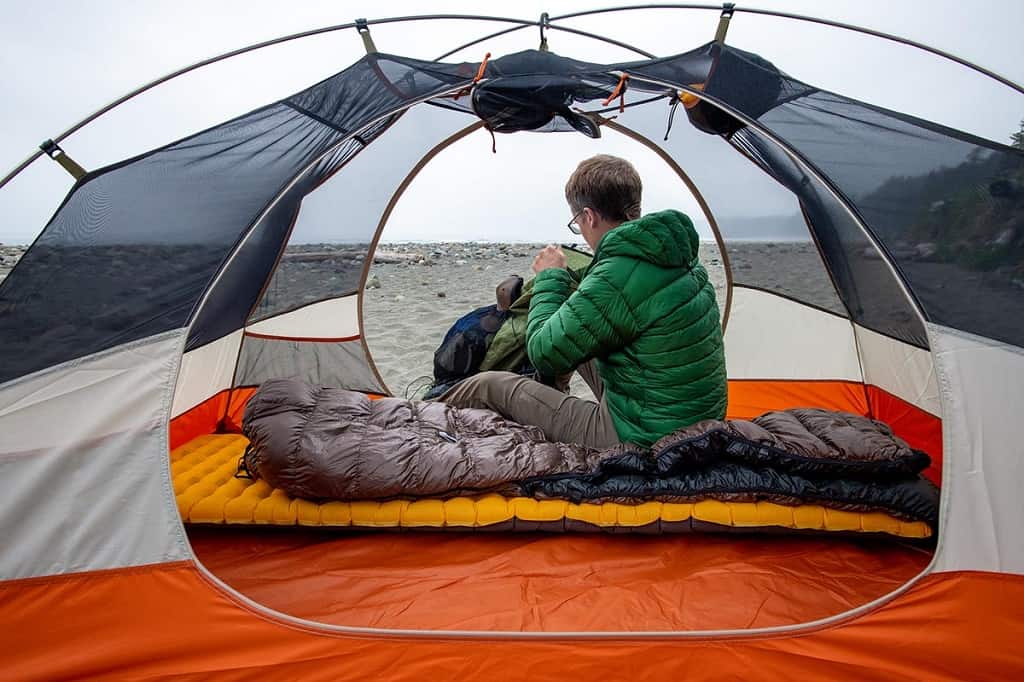
Quick answer: which sleeping pad do you need?
| Trip type | Suggested R-value | Good pad types |
|---|---|---|
| Summer camping, warm nights | Under 2 | Closed-cell foam, uninsulated air pad |
| Three-season backpacking | About 2–4 | Insulated air pad, self-inflating pad |
| Cold nights, shoulder seasons, mountains | About 4–5.5 | Insulated air pad, thick self-inflating pad |
| Winter, snow, high-altitude camps | 5.5 and above | Warm air pad plus foam pad underneath |
| Nepal teahouse trek (EBC, ABC) | Not usually needed | Lodges provide mattresses; a foam sit mat is optional |
| Nepal camping trek | 4–6 and above, depending on altitude | Often supplied by the operator; check before you pack |
These ranges follow the widely used guidance published by major outdoor retailers. Treat them as a starting point: if you sleep cold, go higher.
Why a sleeping pad matters
A sleeping bag keeps you warm by trapping air in its fill. When you lie on it, your body weight crushes the fill underneath you, so the bag does very little to stop heat draining into the ground. That job falls to the pad.
Cold ground draws heat away by conduction, which is why a cheap pad can leave you shivering in an expensive bag. A good pad also gives comfort and protects your bag from damp and sharp ground. Sleeping bag temperature ratings are generally tested on the assumption that you are using a reasonably insulated pad, so an inadequate pad means your bag will not perform as advertised.
Types of sleeping pad
There are three main types. Each has clear strengths, and plenty of experienced campers own more than one.
| Feature | Air pad | Self-inflating pad | Closed-cell foam |
|---|---|---|---|
| Comfort | High; thick and adjustable | Good; firm and stable | Basic; thin and firm |
| Typical weight | Very light to moderate | Moderate to heavy | Light |
| Packed size | Smallest | Medium to bulky | Bulky; usually strapped outside the pack |
| Warmth | From minimal to very high, depending on insulation | Moderate to high | Usually around R2 |
| Durability | Can puncture; seams and valves are weak points | More robust; can still puncture | Virtually indestructible |
| Set-up | Inflate by mouth, pump sack or built-in pump | Open valve, let it expand, top up | Unroll or unfold |
| Price | Mid to high | Mid | Low |
| Best for | Backpacking, trekking, cold-weather camping | Car camping, comfort-focused trips | Budget, rough ground, backup or stacking |
Air pads
Air pads are inflatable mattresses made from coated nylon or polyester. Most backpacking models use internal baffles or chambers to keep them flat, and warmer versions add insulation inside, such as reflective films or synthetic fill, to stop heat escaping by convection and radiation.
They pack down to the size of a water bottle and can be several centimetres thick, which makes them the most comfortable option for side sleepers. The trade-offs are cost, the risk of punctures, and the need to inflate them every night. A field repair kit is essential.
Self-inflating pads
Self-inflating pads combine open-cell foam with an airtight outer shell. When you open the valve, the foam expands and draws air in; you then top up with a few breaths. The foam gives insulation and stability, and if the pad does get punctured, you still have some foam between you and the ground.
They are heavier and bulkier than air pads for the same warmth, which is why they suit car camping, base camps and trips where weight matters less.
Closed-cell foam pads
Closed-cell foam pads are made of dense foam full of tiny closed air pockets, either as a roll-up mat or a folding “egg-box” design. They are cheap, light, cannot puncture and work as a sit mat at rest stops.
On their own they are thin and firm, and most sit around R2. Their real strength in cold conditions is as a base layer under an air pad: R-values add up, so stacking a foam pad under an inflatable both boosts warmth and protects the air pad from sharp ground.
R-value and the ASTM F3340 standard
R-value measures a pad’s resistance to heat flow. The higher the number, the better it insulates you from the ground.
For years, every brand tested R-value in its own way, so numbers could not be compared fairly. That changed with ASTM F3340, the “Standard Test Method for Thermal Resistance of Camping Mattresses Using a Guarded Hot Plate Apparatus”. It was developed with input from pad manufacturers and retailers, published in 2018, and the industry broadly moved to it from around 2019–2020. The current version is ASTM F3340-22, which replaced the 2018 edition.
How the test works
In a laboratory, the pad is held under a set pressure between a heated upper plate, which stands in for your body, and a cold lower plate, which stands in for the ground. Testers measure how much energy it takes to keep the upper plate at a steady temperature, and calculate the R-value from that.
What R-value does and does not tell you
- It does let you compare the insulation of different pads fairly, as long as both are rated to the ASTM standard. Look for “ASTM F3340” on the product listing.
- It does not measure comfort, durability, noise or how easy the pad is to inflate.
- It assumes a new pad, correctly inflated, with you lying in an ideal position. A pad that is too narrow, under-inflated or old may feel colder.
- Older ratings from before the standard were calculated differently and may not match. Be wary of comparing an old listing with a new one.
Stacking R-values
R-values are additive. An air pad rated R4 on top of a foam pad rated R2 gives you roughly R6. This is the standard approach for winter camping and high-altitude camps, and it gives you a backup if the air pad fails.
How to choose a sleeping pad: what to consider
1. Temperature and conditions
Start with the coldest night you are likely to face. The ground temperature matters as much as the air: snow, frozen ground, rock and damp soil all pull heat away fast. If you tend to sleep cold, or are camping at altitude, choose a higher R-value than the minimum.
2. Weight
For backpacking, weight matters. As a rough guide, lightweight air pads typically weigh around 300–600 g, closed-cell foam mats around 250–450 g, and self-inflating pads from around 600 g to well over 1 kg. Lighter pads generally use thinner fabrics, so the very lightest are usually the least durable.
3. Packed size
Air pads pack smallest and fit inside your backpack. Self-inflating pads roll into a longer bundle. Foam pads are the bulkiest and are usually strapped to the outside of a pack, where they can snag on rock and branches. Check your pack’s capacity: our guide on how to choose a backpack for trekking covers sizing.
4. Size and shape
| Option | Typical dimensions | Who it suits |
|---|---|---|
| Regular | About 183 x 51 cm (72 x 20 in) | Most people up to about 6 ft |
| Long / wide | About 196 cm long, 64 cm wide (77 x 25 in) | Tall people, side sleepers, restless sleepers |
| Short / three-quarter | About 120 cm | Ultralight hikers who put their pack under their legs |
| Mummy / tapered | Narrower at head and foot | Saving weight and packed size |
| Rectangular | Full width throughout | Comfort and room to move |
Exact sizes vary between brands, so always check the listing, and check that a wide pad fits your tent.
5. Thickness and comfort
Back sleepers can be comfortable on thinner pads. Side sleepers usually need more thickness, often 6 cm or more, so their hips and shoulders do not bottom out on the ground. Baffle design also matters: some people find vertical channels feel like lying on a lilo, while horizontal or offset baffles feel more stable.
6. Noise
Some insulated air pads, particularly those with reflective film inside, crinkle when you move. Newer designs are generally quieter than early models, but if you share a tent or sleep lightly, read reviews or try one in a shop before you buy.
7. Durability
Fabric thickness is described in denier (D): higher denier generally means tougher fabric, though fibre type matters too. For air and self-inflating pads, valves and seams are often the weak points. Fabric punctures can usually be patched; a split seam often cannot. If you camp on rough ground, a mid-weight pad with a thicker base fabric is a sensible compromise.
8. Valves and inflation
Modern flat valves with a one-way flap make inflating and deflating much quicker. Pump sacks, which double as stuff sacks, keep moisture from your breath out of the pad, which helps it last and stops it losing warmth from damp insulation inside, especially in freezing conditions.
9. Price
Foam pads are the cheapest. Insulated, lightweight air pads cost the most. If budget is tight, a closed-cell foam mat plus a basic air pad can cover a surprising range of conditions.
How to look after your sleeping pad
- Clear your pitch. Remove stones, thorns and twigs before laying out your pad, and use a groundsheet or foam mat underneath on rough ground.
- Use a pump sack. Breath moisture can build up inside air pads and lead to mould or reduced insulation over time.
- Check firmness at bedtime. Air cools and contracts as temperatures drop, so a pad inflated in the afternoon may feel soft later.
- Keep it away from heat. Do not leave pads in hot cars, in direct sun for long periods or near stoves and fires.
- Clean it gently. Wipe with warm water and a mild, non-detergent soap, then let it dry fully. Follow the manufacturer’s care instructions.
- Store it unrolled with the valve open. Air and self-inflating pads last longer stored flat or loosely rolled, for example under a bed, rather than compressed in their stuff sack.
- Carry a repair kit. Find leaks by inflating the pad and listening, or by brushing soapy water over it and looking for bubbles. Patch on a clean, dry surface.
Getting the most warmth from your sleep system
- Match your pad and bag: a warm bag on a thin pad still means a cold night.
- Eat a warm meal and have a hot drink before bed.
- Warm up before getting into your bag with a short walk or a few minutes of gentle exercise.
- Wear a dry base layer, warm hat and dry socks to sleep. Clothing is part of your sleep system: see our guide to trekking trousers for layering advice.
- Fill a hard water bottle with hot water and put it in your bag.
- In very cold conditions, stack a foam pad under your air pad.
Do you need a sleeping pad for trekking in Nepal?
It depends on the style of trek. Our guide to trekking in Nepal explains the main routes and how they differ.
Teahouse treks: usually not
On the popular teahouse routes, including Everest Base Camp and Annapurna Base Camp, you sleep in lodges with simple rooms, beds and foam mattresses. Blankets are often available, but most trekkers bring their own warm sleeping bag. A full sleeping pad is not usually needed and only adds weight. Our guide to Everest Base Camp teahouses describes the rooms in detail.
Two exceptions are worth knowing. A light closed-cell foam sit mat is handy for rest stops on cold ground. And in the busiest weeks of peak season, lodges in some high villages can fill up, so a few trekkers may end up sleeping in a dining room on benches; your guide will usually book ahead to avoid this, but a light foam mat is a cheap insurance policy if you want one.
Camping treks: yes
Remote routes without lodges, such as parts of Dolpo, and trekking peak climbs are run as camping treks. Nights at high camps can drop well below freezing, so you need a warm pad, typically R5 or more, often with a foam pad underneath. Many operators supply mattresses on camping trips, so check what is included before you buy. For other routes, tell us your plans and we will advise on kit.
Sleeping pad checklist
- R-value suited to the coldest expected night (ASTM F3340 rated)
- Weight and packed size that fit your pack
- Length and width that fit you and your tent
- Enough thickness for your sleeping position
- Pump sack and repair kit
- Optional foam pad for stacking or as a sit mat
For the rest of your kit, see our trek packing checklist and our list of essential items for trekking.
Next steps
Choose your R-value first, then the type that suits how you travel. If your next adventure is a teahouse trek in Nepal, you can probably leave the pad at home and put that weight into a warmer sleeping bag instead. Explore our Everest Base Camp Trek or Annapurna Base Camp Trek to see what is included.
Frequently asked questions
What R-value sleeping pad do I need?
As a rough guide, under R2 suits warm summer nights, R2–4 suits three-season use, R4–5.5 suits cold nights, and R5.5 or more suits winter and snow. If you sleep cold, choose a higher rating.
What is the ASTM F3340 standard?
ASTM F3340 is the industry test method for measuring sleeping pad R-values using a heated plate and a cold plate. Published in 2018 and updated in 2022, it means R-values from different brands can be compared fairly.
Can you stack two sleeping pads for more warmth?
Yes. R-values are additive, so a foam pad rated R2 under an air pad rated R4 gives roughly R6. Stacking also protects the air pad from punctures and gives you a backup if it fails.
Is an air pad or a self-inflating pad better?
Air pads are lighter, pack smaller and are usually more comfortable, so they suit backpacking. Self-inflating pads are more stable and durable but heavier and bulkier, so they suit car camping and comfort-focused trips.
Do I need a sleeping pad for the Everest Base Camp trek?
Usually not. On teahouse treks such as Everest Base Camp and Annapurna Base Camp you sleep in lodges with beds and mattresses. A warm sleeping bag matters more. A light foam sit mat is optional.
How do I stop my sleeping pad from going flat overnight?
Check for punctures with soapy water and patch any leaks. If there is no leak, the air has probably cooled and contracted, so top it up just before you go to sleep.
How should I store a sleeping pad?
Store air and self-inflating pads unrolled or loosely rolled with the valve open, somewhere cool and dry. Long-term storage compressed in a stuff sack can trap moisture and, in self-inflating pads, stop the foam expanding properly.
Are sleeping pads noisy?
Some insulated air pads with reflective film inside crinkle when you move. Newer designs are generally quieter. If noise matters to you, read reviews or try a pad in a shop first.