
Choose Annapurna Base Camp if you want a shorter, lower and cheaper trek with varied scenery and no mountain flights. Choose Everest Base Camp if standing beneath the world’s highest mountain matters to you and you have two weeks or more, a bigger budget and the appetite for higher altitude.
Both are among the best treks in Nepal, and both need no climbing skills. This guide compares ABC vs EBC side by side: altitude, days, distance, difficulty, cost, permits, flights, views, culture, crowds, seasons and risks. For full route details, see our Annapurna Base Camp trek guide and our Everest Base Camp guide.
Annapurna Base Camp vs Everest Base Camp: side by side
| Factor | Annapurna Base Camp (ABC) | Everest Base Camp (EBC) |
|---|---|---|
| Maximum altitude | 4,130 m (13,550 ft) | 5,364 m (17,598 ft) at base camp; Kala Patthar viewpoint higher |
| Highest sleeping altitude | 4,130 m | About 5,160 m (Gorak Shep) |
| Trekking days | 6–11, depending on route | 12–14 including acclimatisation days |
| Total trip from arrival in Nepal | About 10–15 days | About 14–16 days |
| Walking distance | About 55–70 km with jeeps; 100–115 km full route | About 130 km round trip from Lukla |
| Difficulty | Moderate: steep steps, many ups and downs | Moderate to challenging: altitude, cold and length |
| Access | Road: Kathmandu to Pokhara by bus or 25-minute flight, then jeep to the trailhead | Mountain flight to Lukla (2,860 m), often from Manthali (Ramechhap) in peak seasons |
| National park / conservation fees | ACAP permit NPR 3,000 (about £15) | Sagarmatha National Park NPR 3,000 plus Khumbu Pasang Lhamu municipality fee NPR 3,000 (about £30 total) |
| Guide rules | Licensed guide required for foreign trekkers | Independent trekking still permitted by local rules in the Khumbu |
| Our trip price | From £795, 15 days | From £1,295, 16 days |
| Views | 360-degree amphitheatre of peaks close up, including Annapurna I and Machhapuchhre | Everest, Lhotse, Nuptse, Ama Dablam; Everest summit seen best from Kala Patthar |
| Landscapes | Terraced farmland, bamboo and rhododendron forest, glacial sanctuary | High alpine valleys, glaciers, moraine and the Khumbu Icefall |
| Culture | Gurung and Magar villages, Hindu and Buddhist traditions | Sherpa Buddhist culture, monasteries, mani walls and prayer flags |
| Crowds | Busy in October and April; quieter otherwise | Busy in October, November, April and May; expedition season in spring |
| Best seasons | October to mid-November; March to April | October to November; March to May |
| Main risks | Avalanches between Deurali and MBC in winter and spring; monsoon landslides | Altitude illness; Lukla flight delays; severe cold |
Altitude and acclimatisation
Altitude is the biggest difference between the two treks. Everest Base Camp is more than 1,200 m higher than Annapurna Base Camp, and most EBC itineraries sleep at Gorak Shep, at about 5,160 m, and climb to the Kala Patthar viewpoint for the classic view of Everest’s summit. At those heights, each breath carries roughly half the oxygen it would at sea level.
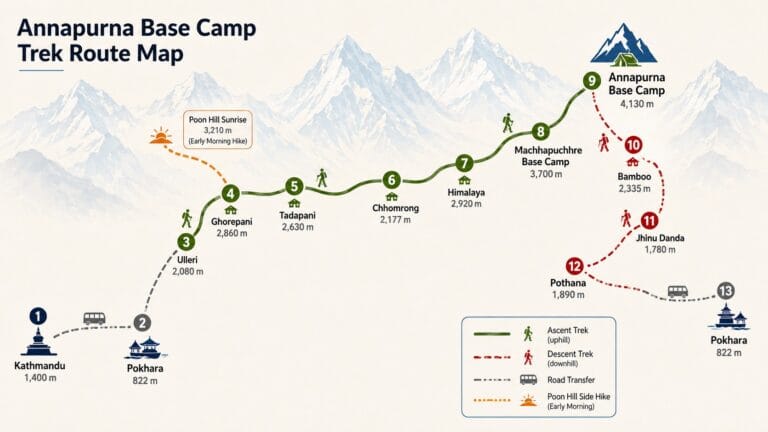
That is why EBC itineraries build in acclimatisation days, typically at Namche Bazaar (3,440 m) and Dingboche (4,410 m). ABC rarely needs a dedicated rest day because it tops out at 4,130 m, but it often climbs quickly: from Chhomrong at 2,170 m to the base camp in about three days. Mild altitude symptoms are common on both treks. The risk of serious altitude illness is higher on EBC, simply because you spend several nights above 4,000 m. Our altitude sickness guide explains symptoms and prevention for both.
Difficulty: which trek is harder?
Everest Base Camp is the harder trek overall. It is longer, higher and colder, and the effort above 4,500 m is relentless even though gradients are often gentle. Annapurna Base Camp is shorter, but it is not easy: it has more steep stone steps and more repeated climbs and descents, especially around Ulleri, Chhomrong and Sinuwa. Some trekkers find individual ABC days just as tiring as EBC days, but they recover better at lower altitude.
| Type of effort | ABC | EBC |
|---|---|---|
| Steps and steep ground | Higher: thousands of stone steps | Moderate: steep sections such as the Namche hill |
| Altitude | Moderate | High |
| Endurance (number of days) | Moderate | High |
| Cold at night | Cold at ABC and MBC | Very cold above Dingboche |
| Recovery between days | Easier | Harder |
See our detailed guide to Annapurna Base Camp trek difficulty for the hardest days, distances and training advice.
Cost: ABC vs EBC
Annapurna Base Camp is significantly cheaper, mainly because there are no Lukla flights and the trip is shorter. Teahouse prices also rise with altitude and remoteness, and lodges above Namche are generally more expensive than those in the Annapurna Sanctuary.
| Cost item | ABC | EBC |
|---|---|---|
| Conservation or park fees | ACAP NPR 3,000 (about £15) | SNP NPR 3,000 + municipality NPR 3,000 (about £30) |
| TIMS card | NPR 2,000 (about £10), arranged through your agency | Not used in the Khumbu; the municipality card replaces it |
| Transport to the trailhead | Bus or flight to Pokhara, then jeep | Return Lukla flights, roughly US$200–250 (about £150–190) each way |
| Guide | Required | Optional by local rules, but strongly recommended |
| GLF package (land only) | From £795 per person, 15 days | From £1,295 per person, 16 days |
For full breakdowns, see our Annapurna Base Camp trek cost and Everest Base Camp trek cost guides. Both treks also need international flights, a Nepal visa and travel insurance that covers trekking altitude and helicopter rescue.
Permits and guide rules
For ABC, you need an Annapurna Conservation Area Project (ACAP) permit (NPR 3,000 for most foreign nationals) and a TIMS card. Since 1 April 2023, Nepal’s rules require foreign trekkers in most trekking areas, including the Annapurna region, to hire a licensed guide through a registered agency.
For EBC, you need a Sagarmatha National Park entry permit (NPR 3,000) and the Khumbu Pasang Lhamu Rural Municipality fee (currently about NPR 3,000 for most foreign visitors). The Khumbu’s local government did not adopt the national guide requirement, so independent trekking is still permitted there. Fees and rules change, so check them close to departure; a good agency will arrange all permits for you.
Getting there: flights vs roads
Getting to ABC is simpler. From Kathmandu, you reach Pokhara by tourist bus (around 6–8 hours) or a short flight, then take a jeep to the trailhead at Nayapul, Ghandruk, Siwai or Jhinu Danda. Road access means weather rarely stops you starting.
EBC starts with a flight to Lukla, one of the world’s most famous mountain airstrips. In spring and autumn many flights leave from Manthali Airport in Ramechhap, about four hours or more by road from Kathmandu. Cloud and wind regularly delay Lukla flights, sometimes for days, so EBC itineraries need buffer days at the end.
Views and scenery
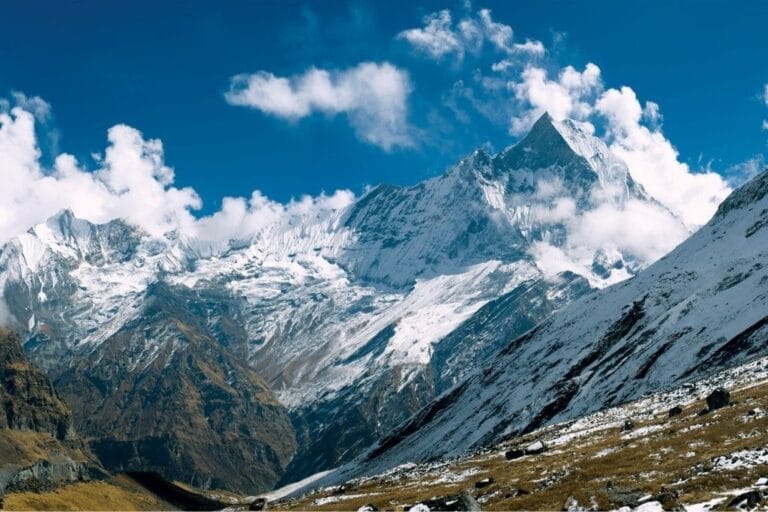
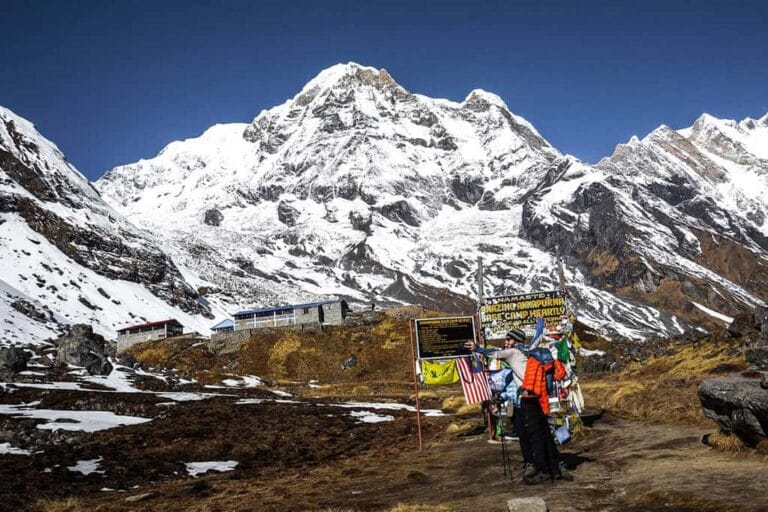
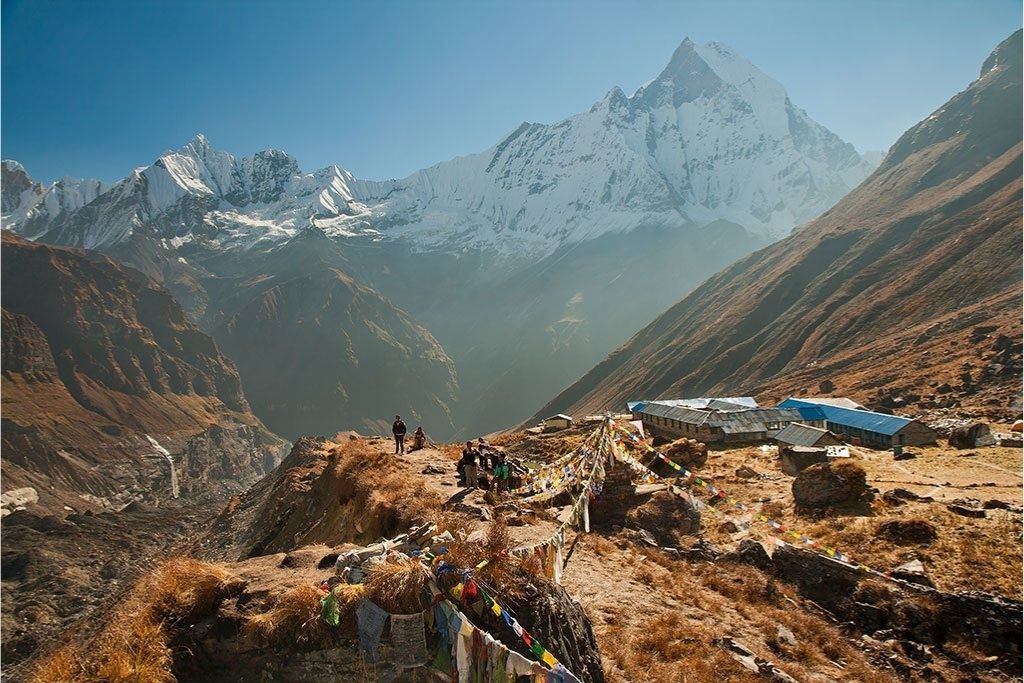
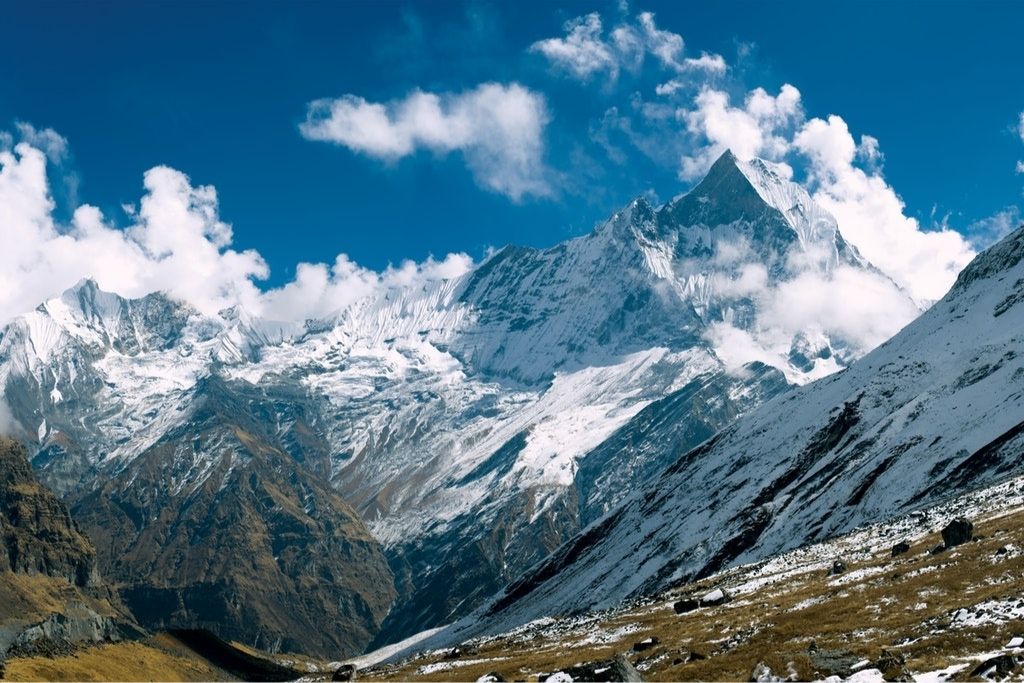
ABC’s great strength is variety and intimacy. The trail climbs from rice terraces and Gurung villages through bamboo and rhododendron forest into the Modi Khola gorge, then opens into the Annapurna Sanctuary: a basin ringed by Annapurna I (8,091 m), Annapurna South, Hiunchuli, Gangapurna and the fishtail summit of Machhapuchhre (6,993 m). At the base camp, you are surrounded by mountains on almost every side.
EBC is grander and starker. Above Namche, the scenery turns high alpine, with Ama Dablam, Lhotse, Nuptse and Pumori dominating the views. Everest Base Camp itself does not give a clear view of Everest’s summit; for that, most trekkers climb Kala Patthar at dawn. The Khumbu Glacier and Icefall are memorable in a way the Annapurna Sanctuary is not.
Culture along the trail
The ABC route passes through Gurung and Magar villages such as Ghandruk and Chhomrong, with slate-roofed houses, farmland and a strong tradition of service in the Gurkha regiments. Machhapuchhre is considered sacred, and it has been closed to climbing for decades.
EBC is the heartland of Sherpa culture. You pass monasteries, chortens and mani walls, and can visit Tengboche Monastery, the largest in the Khumbu. Namche Bazaar is a lively trading hub. Read more about culture in Nepal.
Best time for each trek
Both treks are best in autumn (October to mid-November) and spring (March to May). The main differences:
- ABC is lower and easier to reach, so it works better in December and early February if you can handle the cold, though snow can close the avalanche-prone Deurali–MBC section.
- EBC in April and May coincides with the Everest climbing season, when expedition tents fill the base camp.
- Monsoon (June to September) is poor for both: ABC sits in one of the wettest parts of Nepal, while EBC suffers from cloud and frequent Lukla flight cancellations.
See our month-by-month guides to the best time to trek Annapurna Base Camp and the best time to trek Everest Base Camp.
Risks to consider
On ABC, the main hazards are avalanches between Himalaya, Deurali and Machhapuchhre Base Camp in winter and spring (an avalanche near Deurali in January 2020 killed several trekkers and guides), and landslides and slippery trails in the monsoon. On EBC, the main hazards are altitude illness, extreme cold above 4,500 m and the knock-on effects of flight delays. Rescue on both routes usually means helicopter evacuation, which is why specialist insurance matters.
Which trek suits you?
Choose Annapurna Base Camp if:
- You have 10–15 days in Nepal or want to combine trekking with Pokhara, Chitwan or rafting.
- This is your first trek at altitude.
- You want varied scenery: villages, forest and high mountains.
- You prefer to avoid small-plane flights.
- Budget matters.
Choose Everest Base Camp if:
- Seeing Everest and standing at its base is the goal.
- You have at least 14–16 days.
- You are fit, have some trekking experience and are willing to manage higher altitude.
- You are interested in Sherpa culture and mountaineering history.
- You want a longer, more remote high-mountain journey.
Can you do both ABC and EBC in one trip?
Yes, if you have time. There is no trail linking the two regions, so you must return to Kathmandu between treks. A combined trip usually needs three and a half to four weeks: roughly 10–12 days for ABC including travel to and from Pokhara, a rest day in Kathmandu, then 14–16 days for EBC.
The practical order is ABC first. It is lower and shorter, so it works as a warm-up for EBC and lets you test your fitness and kit. Some of the benefit of acclimatisation fades after a few days at low altitude, so do not shorten the EBC acclimatisation schedule because you have just done ABC. If you are short on time, the Poon Hill trek is a shorter add-on in the Annapurna region.
Our Annapurna Base Camp trek and Everest Base Camp trek can be booked back to back. Start with our trip planner, or see our sample Annapurna Base Camp itinerary for how the ABC section fits.
Frequently asked questions
Is Annapurna Base Camp easier than Everest Base Camp?
Yes, overall. ABC is about 1,200 m lower, shorter and less cold, so altitude is less of a challenge. It has more steep steps and up-and-down sections, though, so it still needs good fitness.
Which is more beautiful, ABC or EBC?
It depends on what you enjoy. ABC offers more variety, from villages and forests to a close amphitheatre of peaks. EBC is higher and more dramatic, with Everest, Lhotse and Ama Dablam and a stark glacial landscape. Many trekkers who do both find ABC more intimate and EBC more awe-inspiring.
Which is cheaper, Annapurna Base Camp or Everest Base Camp?
Annapurna Base Camp is cheaper. There are no Lukla flights, the trip is shorter and lodge prices are generally lower. Our ABC trek starts from £795 for 15 days, compared with £1,295 for our 16-day EBC trek.
Can you see Everest from Annapurna Base Camp?
No. Everest is about 300 km east of the Annapurna Sanctuary and is not visible from the ABC trek. From ABC you see Annapurna I, Annapurna South, Hiunchuli, Gangapurna and Machhapuchhre.
How many days do ABC and EBC take?
ABC usually takes 6–11 trekking days, or about 10–15 days in Nepal. EBC usually takes 12–14 trekking days, or about 14–16 days in Nepal, including acclimatisation and buffer days for Lukla flights.
Should I do Annapurna Base Camp before Everest Base Camp?
If you plan to do both, ABC first is a sensible order: it is lower and shorter, and a good test of your fitness and kit. On separate trips, many people do ABC as their first Himalayan trek and return for EBC later.
Do I need a guide for ABC and EBC?
For ABC, foreign trekkers are required to trek with a licensed guide arranged through a registered agency. In the Everest region, local rules still allow independent trekking, but a guide is strongly recommended for safety and logistics.
Which trek has a higher altitude sickness risk?
Everest Base Camp. You sleep several nights above 4,000 m, including at about 5,160 m at Gorak Shep. ABC tops out at 4,130 m, although fast ABC itineraries can still cause altitude symptoms.