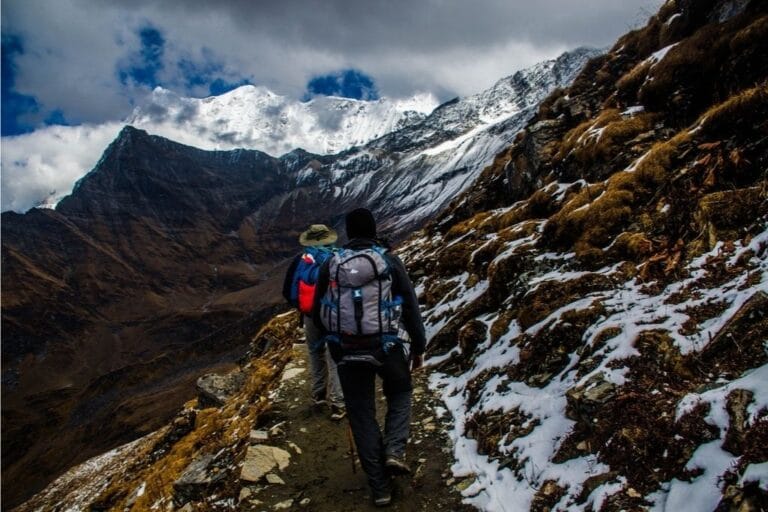

You can absolutely trek on your period. The keys are choosing a product you have already tested at home, carrying more supplies than you think you need, keeping your hands and kit clean with limited water, and packing every used item out rather than burning or burying it. This guide covers all of that for multi-day treks, including teahouse treks in Nepal.
Trekking on your period: the quick answer
| Question | Short answer |
|---|---|
| Is it safe to trek on your period? | Yes. The UIAA Medical Commission states there is no medical risk inherent in normal periods at high altitude. The challenges are practical: long days, cold, and few washing facilities. |
| Best product? | The one you already use confidently. Cups and period pants cut waste; tampons and pads are simpler to keep clean. Many trekkers combine two. |
| What do I do with used products? | Seal them in an opaque, odour-proof bag and carry them out to a town with proper waste management. Do not burn, bury or flush them. |
| Will altitude change my cycle? | It might. Travel, stress, exercise and cold can shift timing and flow, but research on short trips to altitude is limited. |
| Can I delay my period? | Often, yes, using the combined pill or other methods. Talk to a doctor or pharmacist at least a couple of months before you go. |
| Pain relief? | Pack the painkillers that normally work for you, plus a way to apply heat. Check with your doctor if your periods are very painful or heavy. |
Choosing a period product for a multi-day trek
There is no single best option. What matters on the trail is how much waste you create, how easily you can keep things clean, how often you need to change, and whether you trust the product. Never try a new method for the first time on a trek. Use it for at least one full cycle at home first.
| Product | Pros on a trek | Cons on a trek | Best for |
|---|---|---|---|
| Menstrual cup or disc | Tiny to pack; can be worn for longer than a tampon (follow the maker’s limit); almost no waste to carry; one cup lasts years | Needs clean hands and clean water to empty and rinse; learning curve; emptying in a cold squat toilet takes practice | Experienced cup users and longer treks |
| Period pants | No insertion; no waste; comfortable; good as backup with a cup or tampon | Need washing and drying, which is slow in cold, humid weather; bulkier wet pair to carry | Light days, nights and backup |
| Tampons | Familiar; hygienic; easy to change with clean hands; stay comfortable when walking all day | Must be changed roughly every 4 to 8 hours; used tampons and wrappers must be packed out | Most trekkers, especially first-timers |
| Pads | Easiest to use; no insertion; good for people who cannot or prefer not to use internal products | Bulky; can chafe on long walking days; the most waste to pack out | Those who prefer external products |
| Reusable cloth pads | No waste; soft | Need washing and drying; storing used ones hygienically is hard on the move | Short trips with good washing access |
Menstrual cups and discs
Cups are popular with trekkers because they weigh almost nothing and remove most of the waste problem. The trade-off is hygiene. Leave No Trace notes that hand cleanliness is harder outdoors, which raises the risk of contamination when inserting or removing a cup.
Empty the cup in a toilet where possible. On a teahouse trek you will almost always have a toilet, often a squat toilet, so you rarely need to dig a hole. Rinse with treated or boiled water, never untreated stream water. Teahouses sell boiled water, and many trekkers carry a small bottle just for this. Between periods, boil the cup to sterilise it, following the manufacturer’s instructions.
Period pants
Period pants hold roughly one to two tampons’ worth of flow per pair, and the Cleveland Clinic advises not wearing the same pair for more than 12 hours. On a trek they work best as backup or for lighter days and nights. Drying is the weak point: in cold or monsoon conditions they may not dry overnight, so carry enough pairs to rotate, rinse with treated water, and pack wet pairs in a separate waterproof bag.
Tampons
The US Food and Drug Administration advises changing tampons every 4 to 8 hours, never leaving one in for more than 8 hours, and using the lowest absorbency that works for you. Plan your changes around rest stops and lunch. Applicator-free tampons create less waste to carry.
Pads
Pads are a perfectly good choice, especially if internal products are not right for you. Choose a slim, well-fitting pad and wear snug underwear so it stays put on long climbs. A little anti-chafe balm where your hip belt and thigh seams rub helps on long days.
Combining products
Many experienced trekkers use two methods together, for example a cup or tampon by day with period pants as a backup, or period pants at night. This gives you a fallback if a product leaks, gets lost, or your water supply runs low.
How much to pack
Work out what you would use during a normal period, then add a margin. Leave No Trace advises bringing products even if your period is not due, because exertion and new surroundings can bring it on early. Supplies on remote trails can be limited and expensive, and your preferred brand may not be available, so do not rely on buying along the way.
- Disposables: your normal number for a full period, plus around 50 percent extra.
- Cup users: the cup, a storage pouch, and a few tampons or pads as backup.
- Period pants: at least three pairs so one can dry while you wear another.
- Hygiene kit: hand sanitiser, unscented wipes (packed out after use), toilet paper, a small bottle for clean rinse water.
- Waste kit: a few small zip-lock bags plus one opaque, odour-proof outer bag.
- Comfort: your usual painkillers, a hard-sided water bottle you can fill with hot water, and snacks you enjoy.
Add these to your main kit list. Our trek packing checklist covers the rest, and route-specific lists are in our Everest Base Camp packing list and Annapurna Base Camp packing list.
Hygiene when water is limited
Most of the hygiene challenge is about hands. On a teahouse trek you will usually have running water at lodges, but it is cold and not always safe to drink, and higher up it can freeze overnight.
- Clean your hands before and after every change. Use sanitiser, or soap and treated water if available. Do this every time, even when you are cold and tired.
- Use only clean water on anything that touches your body. Leave No Trace advises filtering or boiling water from any questionable source before using it on period products.
- Do a daily wash. If showers are not available or too cold, wipe down with a damp cloth or unscented wipe. Warm afternoons are easier than freezing early mornings.
- Change underwear regularly. Merino or quick-drying synthetic underwear stays fresher and dries faster than cotton.
- Keep clean and used items apart. A dedicated small bag for clean supplies and another for used ones prevents mix-ups in the dark.
Some people find they are more prone to urinary tract infections or thrush in remote conditions. Discuss this with your doctor before travelling, especially if you have had them before, and ask whether to carry treatment. Learn the warning signs of toxic shock syndrome too: sudden fever, vomiting or diarrhoea, dizziness or fainting, and a sunburn-like rash. If they appear, remove the tampon or cup and get medical help straight away.
Packing out used products: Leave No Trace in the Himalaya
This is the part people most often get wrong. Leave No Trace guidance is clear: pack out all tampons, applicators, pads, wrappers, wipes and used toilet paper. Do not bury them, because animals dig them up and they take a long time to break down. Do not try to burn them, as they rarely burn completely in a small fire and fires are often inappropriate in mountain areas. Do not flush them or drop them into squat toilets, which often drain into pit systems or local water.
In remote Himalayan villages there is limited waste infrastructure. Even when a teahouse has a bin, rubbish in high villages is often burned in the open or dumped, and fuel and porters are needed to carry it down. The responsible approach is to carry your used products to a larger town with proper waste collection, or home.
A simple waste system
- Wrap each used item in toilet paper.
- Place it in a small zip-lock bag.
- Store the small bags inside one opaque, odour-proof outer bag. Some people wrap the outside in duct tape so it looks like any other stuff sack.
- Keep the outer bag in your daypack so you are never caught without it.
- Dispose of it in a proper bin at the end of the trek.
A small pinch of baking soda or a used tea bag in the outer bag helps control odour. If you are using a cup and there is no toilet, Leave No Trace suggests going at least 70 steps (about 60 metres) from trails, camps and water, and emptying it into a hole 15 to 20 centimetres deep.
Managing period pain on the trail
Period pain can feel worse when you are cold, tired and carrying a pack. Many people find that steady walking actually helps cramps, which matches NHS advice that gentle exercise can ease period pain.
- Painkillers: carry what normally works for you, such as ibuprofen or paracetamol, and take it as directed. Take ibuprofen with food and plenty of water. If you have asthma, stomach or kidney problems, or take other medicines, check with a pharmacist first.
- Heat: fill a hard-sided bottle with hot water at the teahouse and hold it against your abdomen or lower back at night. Disposable heat pads are light, but pack them out afterwards.
- Warmth and rest: keep your core warm, eat regularly, and allow a slower pace on hard days.
- Hydration: drink regularly. Dehydration makes fatigue and headaches worse at altitude. Our guide to staying hydrated when hiking has more detail.
If your periods are very heavy or very painful, see your doctor well before the trip. Conditions such as endometriosis or fibroids can be managed, and heavy bleeding can lead to iron deficiency. The UIAA recommends checking iron levels about three months before going to altitude, because iron deficiency reduces the blood’s oxygen-carrying capacity and makes climbing harder.
Do altitude and exertion affect your period?
Possibly, but the honest answer is that the evidence is limited. The UIAA notes that travel and stress can change the timing and amount of bleeding, and that science has not yet established whether short-term altitude travel changes cycle patterns. Most high-altitude research has historically focused on men.
What we do know:
- Timing may shift. Jet lag, disrupted sleep, cold, stress and hard exercise are all recognised influences on the cycle. A period arriving early, late or lighter on a trek is common and usually not a cause for concern.
- Cycle phase does not seem to affect altitude sickness. A 2024 study of more than 1,100 female trekkers at Lobuche and Manang in Nepal found no link between menstrual cycle phase or hormonal contraception and acute mountain sickness.
- Low energy intake matters. Burning far more energy than you eat over weeks can disrupt periods. On a two-week trek this is less likely, but eat properly even when altitude reduces your appetite.
If there is any chance you could be pregnant, take a test. If your periods stay irregular or stop for more than a couple of months after you get home, see your doctor. For more on altitude itself, read our guide to altitude sickness on the Everest trek.
Delaying or skipping your period with contraception
Many people choose to delay a period for a trek. This is a personal choice and needs medical advice, because not every method suits everyone. Speak to your doctor, a sexual health clinic or a pharmacist ideally two to three months before you travel, so you have time to settle into a method.
| Option | How it works | Points to discuss with your doctor |
|---|---|---|
| Combined pill taken back to back | Skipping the pill-free or placebo week to avoid a withdrawal bleed | Breakthrough bleeding is common at first; contains oestrogen, which carries a small clot risk; missed pills or vomiting reduce reliability |
| Norethisterone tablets | Started a few days before your period is due and taken through the trip; the period usually follows a few days after stopping | Not a contraceptive; three tablets a day; not suitable for everyone, including some people with a history of clots |
| Hormonal coil, implant or injection | Often reduces or stops bleeding over time | Must be started months in advance; bleeding can be unpredictable at first |
| Ring or patch used continuously | Similar to taking the combined pill back to back | Contains oestrogen; patches can lose adhesion with sweat |
The progestogen-only (mini) pill is not reliable for delaying periods. The UIAA’s general advice is that the safest contraception at altitude is usually the one you already use and tolerate, and that you should avoid switching shortly before departure. For long stays at very high altitude, ask your doctor whether a non-oestrogen method is more suitable. If you take the pill, carry a full spare supply and keep it in your daypack.
Cultural notes: periods and Nepal
You may have read about chhaupadi, the practice of isolating menstruating women and girls in huts or animal sheds. It is a real and serious issue, but it is largely confined to remote rural communities in far-western and mid-western Nepal, in districts such as Achham, Bajura and Bajhang. Nepal’s Supreme Court banned it in 2005, and a 2017 law made forcing someone into the practice a crime, punishable by up to three months in prison, a fine of NPR 3,000 (about £15), or both. Campaigners say enforcement remains a challenge.
Trekkers are not affected by chhaupadi. The main trekking regions, including Everest and Annapurna, are home largely to Sherpa, Gurung, Magar and other communities where the practice is not part of local life, and nobody will ask about your cycle. Teahouse owners are used to trekkers of every background.
Some traditional Hindu households and temples do still expect menstruating women to avoid entering kitchens or shrines. If you visit temples in Kathmandu or elsewhere, follow posted guidance and local cues, and ask a guide if unsure. Being respectful without being judgemental goes a long way. Our guide to culture in Nepal explains more about local customs.
Practical tips for teahouse treks in Nepal
- Toilets: lodge toilets are often squat toilets with a bucket of water rather than a flush, and the higher you go the colder they get. A headtorch makes night-time changes much easier. Our guide to Everest Base Camp teahouses explains what facilities to expect.
- Hot water: most teahouses sell boiled water by the litre or bottle. It is useful for cups, washing and filling a bottle for warmth.
- Showers: hot showers are available at many lower lodges for a fee, but become rare and cold higher up.
- Your guide: if you need a longer stop or a slower day, say so. Guides deal with this routinely. You do not need to explain why.
- Clothing: dark-coloured trekking trousers make any leak less stressful.
For wider advice for women on the trail, including gear fit, safety and finding female guides, read our hiking guide for women, and for general precautions see our safety tips for trekking in Nepal.
Plan your trek with confidence
A period is just one more thing to plan for, like layering or water treatment. Test your products, pack extra, set up a simple waste system and talk to your doctor about pain relief or delaying your period if you want to.
If you are planning Nepal, our Everest Base Camp trek (16 days) and Annapurna Base Camp trek (15 days) both stay in teahouses, so you will have a toilet and boiled water every night. For other routes, tell us what you have in mind.
Frequently asked questions
Is it safe to trek at high altitude on your period?
Yes. The UIAA Medical Commission states that there is no medical risk inherent with normal periods at high altitude. The challenges are practical, such as cold, long walking days and limited washing facilities. If your periods are heavy, ask your doctor about checking your iron levels a few months before you go.
What is the best period product for trekking?
The best product is the one you already know and trust. Menstrual cups and period pants create the least waste, while tampons and pads are simpler to keep clean with limited water. Many trekkers combine a cup or tampons with period pants as backup.
How do I dispose of tampons and pads on a trek?
Wrap them in toilet paper, seal them in a small zip-lock bag, and keep them in an opaque, odour-proof outer bag. Carry them out to a town with proper waste collection. Do not bury, burn or flush them.
Can altitude make my period late or early?
It can. Travel, stress, cold, poor sleep and hard exercise can all change the timing and flow of a period. Research on short trips to altitude is limited, so if your cycle stays irregular for more than a couple of months after you return, see your doctor.
Does your period make altitude sickness more likely?
The evidence suggests not. A 2024 study of more than 1,100 female trekkers in Nepal found no link between menstrual cycle phase or hormonal contraception and acute mountain sickness. Acclimatise sensibly whatever your cycle.
How can I delay my period for a trek?
Common options include taking the combined pill back to back or using norethisterone tablets, which are not contraceptive. Not every method suits everyone, so speak to your doctor, sexual health clinic or pharmacist two to three months before you travel.
Can I use a menstrual cup on a teahouse trek in Nepal?
Yes. Teahouses have toilets and sell boiled water, which makes emptying and rinsing a cup manageable. Clean your hands thoroughly before and after, use only treated water, and carry tampons or pads as a backup.
Will menstruation affect me culturally while trekking in Nepal?
No. Chhaupadi is a practice in some remote far-western and mid-western communities and is illegal. It does not affect trekkers. Some traditional temples may ask menstruating women not to enter, so follow local guidance respectfully.